Parent guide · Grade 2 French · Unit 1
Lesson 1.1 De A à Z
Written for the parent. The Read aloud parts are written to your child; read them as they are. Do this parts are for you. Answers for you are marked Listen for.
At a glance
- Time
- 3 sessions of 15–20 minutes
- Goal
- Sing the French alphabet. Hear which letters sound very different in French (E, G, H, I, J, R, U, W, Y). Spell your own name aloud in French.
- You need
- Paper
- Crayons or markers, especially blue and yellow (for gold)
- A sketchbook or plain paper, and crayons
- A King James Bible
- Worksheet A · the lesson page (it also has a short video (2:10))
Steps
Do this together: Sing the ABC song in English. French uses the very same letters, but it says many of them differently. Listen and find out which ones!
Read aloud: The story. Six hundred years ago there were no printing machines in France. Every book was written by hand, one letter at a time, with a feather pen. A rich duke named Jean de Berry asked three brothers, the Limbourg brothers, to paint him a prayer book. They painted a picture for every month of the year, and they made the first letters of the prayers big and bright with gold and blue. Each letter was a little work of art, because the words were words of prayer to God. The same 26 letters are still in French books today.
Read aloud: How French sounds. Some French letters sound almost like English: B (bay), D (day), F (ef). But listen for the tricky ones: E says uh, I says ee, G says zhay, J says zhee, R comes from the back of the throat, U is the round ü, W is double-vay and Y is ee-GREK, the Greek i!
Read aloud: Say it and move. Sing the alphabet and do a little squat on every vowel: A, E, I, O, U, Y! Then trace each letter in the air with your finger as you sing.
Do this: Say each word clearly; your child says it back twice. Point to a picture or the real thing when you can.
- l’alphabet [lahl-fah-BAY]: alphabet
- la lettre [lah LETR]: letter
- épeler [ay-puh-LAY]: to spell
- le livre [luh LEEVR]: book
- le nom [luh NOHN]: name
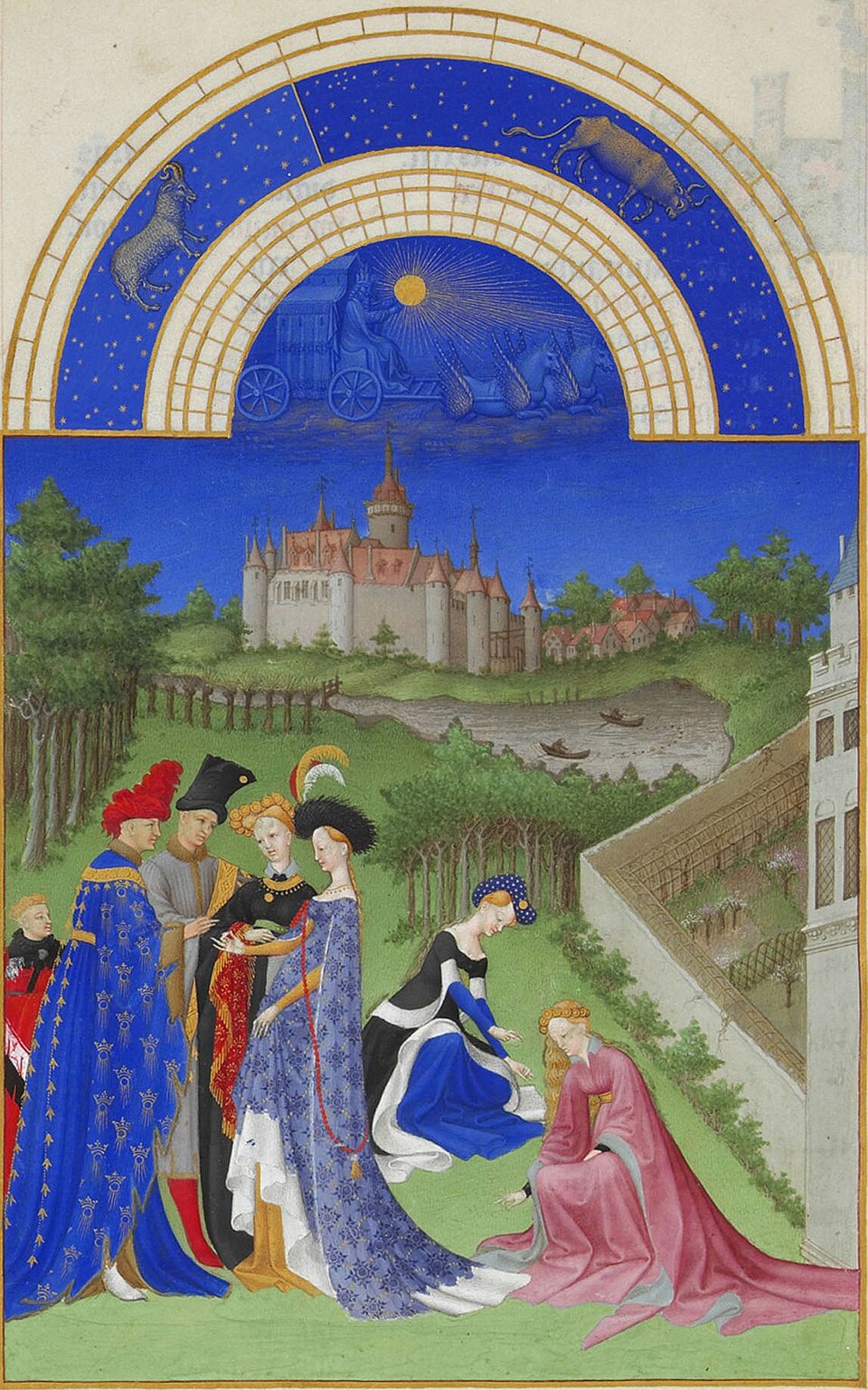
April, from the Très Riches Heures du duc de Berry, The Limbourg brothers, about 1412–1416. Image: Wikimedia Commons, public domain Do this: Look at the picture together for a quiet minute before anyone talks.
Read aloud: This is one page from a prayer book painted by hand for the Duke of Berry. Each month has its own picture. In April, the grass is new and green, the ladies pick spring flowers, and a young man and woman promise to marry. The blue paint was made from a precious stone called lapis lazuli, ground into powder, and the stars are real gold.
Point and find:
- Find the two people exchanging a ring.
- Find the two ladies picking flowers.
- Look at the half-circle at the top. What animals do you see?
- Find the castle. How many towers can you count?
Ask:
- “Why would someone spend years painting a prayer book?”
- “What is your favorite letter? How would you decorate it?”
Show: Spell the name Léa in French.
Say this: “L says el.”
Say this: “É says ay.”
Say this: “A says ah.”
Answer: El, ay, ah.
Show: How does French say the letter J?
Say this: “J sounds like zhee.”
Answer: Zhee.
Do this: Ask out loud. Let your child try first; help only after a real try.
Ask: How does French say the letter A?
Listen for: Ah.
Ask: How does French say the letter I?
Listen for: Ee.
Ask: How does French say the letter E?
Listen for: Uh.
3 more on the lesson page.
Read aloud: Decorate the first letter of your name like a page from the Très Riches Heures.
Steps:
- A parent draws the first letter of your name very big, in outline.
- Fill it with blue and gold, and draw flowers or stars around it.
- Write the rest of your name after it.
- Hold it up and spell your whole name in French.
Tips for you:
- Use glitter glue for real sparkle.
- Make one for each person in your family.
Done when your child can say:
- My letter is big and bright.
- I can spell my name in French.
Do this: Your child picks one or more; you write the date.
- Write the alphabet in your French notebook. Circle the letters that sound very different in French: E, G, H, I, J, R, U, W, Y.
Read aloud: In the Middle Ages, monks and scribes copied books by hand in quiet rooms called scriptoria. Copying one Bible could take years.
- Mixing up G and J. In French, G is zhay and J is zhee: the opposite of what English ears expect.
- Saying I as eye. In French, I says ee.
A parent calls out a letter the French way: zhee! Find it on an alphabet chart, a cereal box or a book, and point to it. Then you call a letter for the parent.
Say this: “Tell me what you learned today.”
Listen for: Sing the French alphabet.; Hear which letters sound very different in French (E, G, H, I, J, R, U, W, Y).; Spell your own name aloud in French.
In the beginning was the Word, and the Word was with God, and the Word was God.
In the French Bible of Louis Segond (1910), this verse reads: <i lang="fr">Au commencement était la Parole, et la Parole était avec Dieu, et la Parole était Dieu.</i> John calls Jesus the Word, la Parole. God speaks to us in words, and He gave us letters to write them down.
Spread over the week
3 sessions of 15–20 minutes. Stop while it is still going well.
- Session 1. Warm-up, then read and teach the new idea and the new words. Picture study and show how.
- Session 2. Practice together, then start the project. Finish the project, then the sketchbook.
- Session 3. Narration, the game and the Scripture.