Parent guide · Grade 2 French · Unit 2
Lesson 2.1 Mon Cartable
Written for the parent. The Read aloud parts are written to your child; read them as they are. Do this parts are for you. Answers for you are marked Listen for.
At a glance
- Time
- 3 sessions of 15–20 minutes
- Goal
- Name six school things in French. Say J’ai un… / J’ai une… (I have a…). Hear what the Bible says about listening to a father’s teaching.
- You need
- A paper lunch bag or an envelope
- Paper, crayons, scissors (a parent helps)
- A sketchbook or plain paper, and crayons
- A King James Bible
- Worksheet A · the lesson page (it also has a short video (1:55))
Steps
Do this together: What do you need for school? Gather a pencil, a book, a notebook and an eraser. Today you learn their French names.
Read aloud: The story. Long ago, in a little farming village in Switzerland, all the children went to one schoolroom: big ones and small ones together. The painter Albert Anker grew up in such a village. He studied painting in Paris, where he learned to speak French, then went home and painted the schoolroom he remembered. The old schoolmaster walks between the benches with a stick for pointing. Some children read, some write, and some whisper to their neighbors when they should be listening! Their parents sent them to school to learn to read, to count and to know the Bible.
Read aloud: How French sounds. In cahier, the h is silent and ier says yay: kah-YAY. In crayon, ay says eh and on is hummed: kreh-YOHN. French has two words for a: un for le words (un crayon) and une for la words (une gomme).
Read aloud: Say it and move. Swing a bag onto your back: le cartable! Write in the air: le crayon! Open a notebook: le cahier! Rub out a mistake: la gomme! Hold up your pencil: J’ai un crayon!
Do this: Say each word clearly; your child says it back twice. Point to a picture or the real thing when you can.
- le cartable [luh kar-TAHBL]: school bag
- le crayon [luh kreh-YOHN]: pencil
- le cahier [luh kah-YAY]: notebook
- la gomme [lah GUM]: eraser
- la règle [lah REHGL]: ruler
- le livre [luh LEEVR]: book
- j’ai [ZHAY]: I have
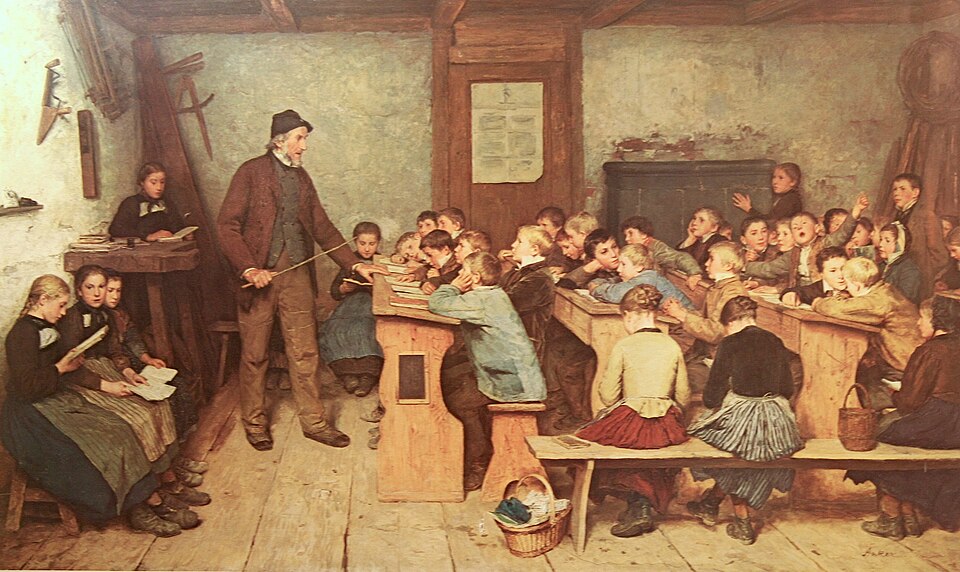
The Village School of 1848, Albert Anker, 1896. Image: Wikimedia Commons, public domain Do this: Look at the picture together for a quiet minute before anyone talks.
Read aloud: Albert Anker was a Swiss painter who lived for many years in Paris and spoke French. He loved to paint the children of his village. This big painting shows a country school as it was when Anker himself was a boy. Look closely and every child is doing something different: reading, writing, listening or talking.
Point and find:
- Find the schoolmaster. What is he holding?
- Find a child reading a book.
- Can you find a child who is not paying attention?
- Count the children on one bench.
Ask:
- “How is this school like your school? How is it different?”
- “Why did parents want their children to learn to read?”
Show: Say I have a notebook.
Say this: “Notebook is le cahier, so it takes un.”
Say this: “I have is J’ai.”
Answer: J’ai un cahier.
Show: Say I have an eraser.
Say this: “Eraser is la gomme, so it takes une.”
Answer: J’ai une gomme.
Do this: Ask out loud. Let your child try first; help only after a real try.
Ask: Say pencil in French.
Listen for: Le crayon.
Ask: Say book in French.
Listen for: Le livre.
Ask: Say school bag in French.
Listen for: Le cartable.
3 more on the lesson page.
Read aloud: Make a paper school bag and fill it with paper school things labeled in French.
Steps:
- Decorate the bag and label it le cartable.
- Draw and cut out a pencil, a notebook, an eraser, a ruler and a book.
- A parent writes the French name on each one, with un or une.
- Pack the bag, saying J’ai un crayon! for each thing.
Tips for you:
- Use real school things instead of paper ones.
- Unpack it again tomorrow and see what you remember.
Done when your child can say:
- My cartable has five things.
- I can say J’ai un… for each one.
Do this: Your child picks one or more; you write the date.
- Draw your school things in your French notebook and label them with un or une: un crayon, un cahier, une gomme, une règle, un livre.
Read aloud: Long ago, French schoolchildren wrote with a dip pen and a little pot of ink set into a hole in the desk. A drop of ink in the wrong place meant a blot on the page!
- Saying the h in cahier. French h is silent.
- Using un with la words. La words take une: une gomme, une règle.
Lay out five school things and name them in French. Close your eyes while a parent hides one. Open them and say what is missing: le crayon!
Say this: “Tell me what you learned today.”
Listen for: Name six school things in French.; Say J’ai un… / J’ai une… (I have a…).; Hear what the Bible says about listening to a father’s teaching.
My son, hear the instruction of thy father, and forsake not the law of thy mother:
In the French Bible of Louis Segond (1910), this verse reads: <i lang="fr">Écoute, mon fils, l’instruction de ton père, Et ne rejette pas l’enseignement de ta mère;</i> The Bible tells children to hear the teaching of father and mother. Learning is a way of honoring them.
Spread over the week
3 sessions of 15–20 minutes. Stop while it is still going well.
- Session 1. Warm-up, then read and teach the new idea and the new words. Picture study and show how.
- Session 2. Practice together, then start the project. Finish the project, then the sketchbook.
- Session 3. Narration, the game and the Scripture.