Parent guide · Grade 2 French · Unit 4
Lesson 4.1 Les Animaux de la Ferme
Written for the parent. The Read aloud parts are written to your child; read them as they are. Do this parts are for you. Answers for you are marked Listen for.
At a glance
- Time
- 3 sessions of 15–20 minutes
- Goal
- Name five farm animals in French. Make the French animal sounds. Say La vache fait meuh (The cow says moo).
- You need
- Three sheets of paper folded and stapled into a book
- Crayons
- A sketchbook or plain paper, and crayons
- A King James Bible
- Worksheet A · the lesson page (it also has a short video (3:23))
Steps
Do this together: What does a rooster say? Cock-a-doodle-doo! In France, a rooster says something different. Let’s find out what!
Read aloud: The story. Long before tractors, French farmers ploughed their fields with oxen. Very early in the morning, while mist still lay on the ground, the farmer led his oxen out of the barn. The big animals walked slowly but never gave up, pulling the plough all day so that wheat could grow for bread. The painter Constant Troyon loved animals and painted them again and again. God gave us these strong, patient animals, and the Bible says that the cattle upon a thousand hills all belong to Him.
Read aloud: How French sounds. French animals say things differently! La vache fait meuh (MUH). Le coq fait cocorico (koh-koh-ree-KOH). Le chien fait ouaf ouaf (WAF WAF). Le cochon fait groin groin (GRWAN). Le chat fait miaou (mee-YAH-oo).
Read aloud: Say it and move. Walk on all fours and say meuh! Flap your wings and crow cocorico! Wag a tail and bark ouaf ouaf! Snort like a pig: groin groin!
Do this: Say each word clearly; your child says it back twice. Point to a picture or the real thing when you can.
- la vache [lah VAHSH]: cow
- le cochon [luh koh-SHOHN]: pig
- le coq [luh KOK]: rooster
- le bœuf [luh BUF]: ox
- le chien [luh SHYAN]: dog
- le chat [luh SHAH]: cat
- fait [FEH]: says; makes
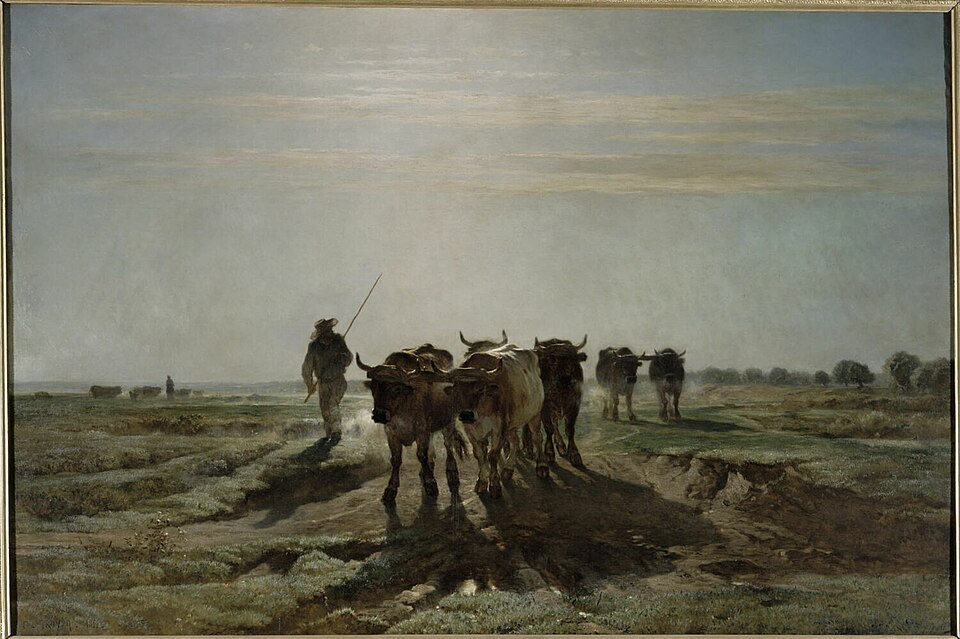
Oxen Going to Work: Morning, Constant Troyon, 1855. Image: Wikimedia Commons, public domain Do this: Look at the picture together for a quiet minute before anyone talks.
Read aloud: Constant Troyon began as a painter of porcelain and became one of the most famous animal painters in France. He painted the oxen walking toward us with the morning sun behind them, so that their backs shine and their shadows reach across the field. The farmer is small; the animals are the heroes of the picture.
Point and find:
- Count the oxen.
- Find the farmer. What is he holding?
- Where is the sun? How can you tell?
- Is it morning or evening?
Ask:
- “Why were oxen so important to farmers long ago?”
- “Which farm animal would you most like to take care of?”
Show: Say The rooster says cocorico.
Say this: “Rooster is le coq.”
Say this: “Says is fait.”
Answer: Le coq fait cocorico.
Show: What does le chien say in French?
Say this: “A French dog barks ouaf.”
Answer: Ouaf ouaf!
Do this: Ask out loud. Let your child try first; help only after a real try.
Ask: Say cow in French.
Listen for: La vache.
Ask: Say pig in French.
Listen for: Le cochon.
Ask: What does a French cow say?
Listen for: Meuh!
3 more on the lesson page.
Read aloud: Make a little book of farm animals and their French sounds.
Steps:
- On each page, draw one farm animal.
- A parent writes the animal’s French name and its French sound in a speech bubble: La vache fait meuh!
- Trace the words.
- Read your book aloud, making every sound.
Tips for you:
- Add a horse: le cheval fait hiii!
- Read it to a younger child.
Done when your child can say:
- My book has at least five animals.
- I can read each sound in French.
Do this: Your child picks one or more; you write the date.
- Draw a farm in your French notebook with a cow, a pig, a rooster, a dog and a cat. Write each French sound in a speech bubble.
Read aloud: The rooster, le coq, is a symbol of France. You can see a golden rooster on top of many French church steeples, reminding people to wake up and pray, as the rooster reminded Peter.
- Saying the q in coq softly. It is a clear k: KOK.
- Using English animal sounds. French animals say meuh, cocorico and ouaf!
One person makes a French animal sound. Everyone else shouts the animal’s French name. Whoever is first makes the next sound.
Say this: “Tell me what you learned today.”
Listen for: Name five farm animals in French.; Make the French animal sounds.; Say La vache fait meuh (The cow says moo).
For every beast of the forest is mine, and the cattle upon a thousand hills.
In the French Bible of Louis Segond (1910), this verse reads: <i lang="fr">Car tous les animaux des forêts sont à moi, Toutes les bêtes des montagnes par milliers;</i> Every beast of the forest and the cattle on a thousand hills belong to God. We take care of His animals.
Spread over the week
3 sessions of 15–20 minutes. Stop while it is still going well.
- Session 1. Warm-up, then read and teach the new idea and the new words. Picture study and show how.
- Session 2. Practice together, then start the project. Finish the project, then the sketchbook.
- Session 3. Narration, the game and the Scripture.