Parent guide · Grade 3 French · Unit 1
Lesson 1.1 Bonjour et Au Revoir
Written for the parent. The Read aloud parts are written to your child; read them as they are. Do this parts are for you. Answers for you are marked Listen for.
At a glance
- Time
- 3 sessions of 20–30 minutes
- Goal
- Greet people in French at different times of day.; Ask and answer Comment ça va?; Tell who Samuel de Champlain was and why French is spoken in Québec.
- You need
- A paper plate
- A paper arrow and a brass fastener
- Markers
- A sketchbook or plain paper, and crayons
- A King James Bible
- Worksheet A · the lesson page (it also has a short video (2:09))
Steps
Do this together: How many ways can you say hello and goodbye in English? Hi, hello, good morning, bye, see you later… French has many too. Let’s learn them.
Read aloud: The story. In 1608, a French explorer named Samuel de Champlain sailed across the Atlantic Ocean and up the great Saint Lawrence River in Canada. Where the river narrows beneath a high cliff, he built a wooden fort and called the place Québec. French farmers, priests, nuns and families followed. Today, more than four hundred years later, millions of people in Québec still speak French. A child in Québec says bonjour in the morning just like a child in Paris.
Read aloud: How French sounds. French people say bonjour when they walk into a shop, a classroom or a home. It is rude to skip it! Use bonjour all day and bonsoir in the evening. Salut is only for friends and family. In bonjour, on is hummed and the j sounds like the s in treasure: bohn-ZHOOR. The r comes from the back of the throat.
Read aloud: Answering Comment ça va? You can answer: Ça va bien, merci! (Fine, thanks!) Très bien! (Very well!) Comme ci, comme ça. (So-so.) Pas mal. (Not bad.) Then ask back: Et toi? (And you?) or, to a grown-up, Et vous?
Do this: Say each word clearly; your child says it back twice. Point to a picture or the real thing when you can.
- bonjour [bohn-ZHOOR]: hello; good day
- bonsoir [bohn-SWAHR]: good evening
- bonne nuit [bun NWEE]: good night
- salut [sah-LÜ]: hi; bye (friends)
- au revoir [oh ruh-VWAHR]: goodbye
- à bientôt [ah byan-TOH]: see you soon
- Comment ça va? [koh-MAHN sah VAH]: How are you?
- ça va bien [sah vah BYAN]: I’m fine
- très bien [treh BYAN]: very well
- comme ci, comme ça [kum see kum SAH]: so-so
- et toi? [ay TWAH]: and you?
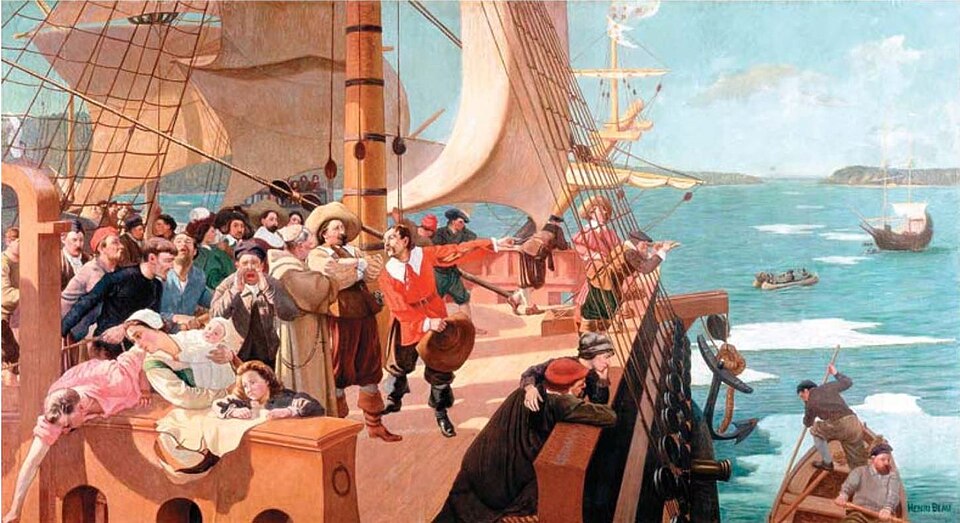
The Arrival of Champlain at Québec, Henri Beau, 1903. Image: Wikimedia Commons, public domain Do this: Look at the picture together for a quiet minute before anyone talks.
Read aloud: Henri Beau was a painter from Montréal who studied in Paris. Almost three hundred years after Champlain, he imagined the moment when the French ship came up the river to the place that would become Québec. Everyone on deck crowds to the rail to see the new land.
Point and find:
- Find the man in the red coat.
- Count the sails you can see.
- Find the little boats on the water.
- What are the people looking at?
Ask:
- “How do you think the travelers felt after weeks at sea?”
- “What would be the first word you would say to the people you met?”
Show: You meet your teacher at 9 in the morning. What do you say?
Say this: “It is daytime.”
Say this: “A teacher is a grown-up, so not salut.”
Answer: Bonjour, Madame (or Monsieur)!
Show: A friend asks Comment ça va? You feel great. Answer and ask back.
Say this: “Very well is très bien.”
Say this: “And you, to a friend, is et toi?”
Answer: Très bien, merci! Et toi?
Do this: Ask out loud. Let your child try first; help only after a real try.
Ask: How do you say good evening?
Listen for: Bonsoir.
Ask: How do you say goodbye?
Listen for: Au revoir.
Ask: What does salut mean?
Listen for: Hi or bye, to friends.
3 more on the lesson page.
Read aloud: Make a paper clock that shows which greeting to use at each time of day.
Steps:
- Divide the plate into morning, afternoon, evening and night.
- Write bonjour in the morning and afternoon parts, bonsoir in the evening part and bonne nuit in the night part.
- Draw a sun, a sunset and a moon.
- Attach the arrow. Turn it and greet your family with the right word.
Tips for you:
- Add salut on the back for friends.
- Use the clock every day this week.
Done when your child can say:
- My clock shows bonjour, bonsoir and bonne nuit.
- I can use the right greeting for the time.
Do this: Your child picks one or more; you write the date.
- In your French notebook, draw a speech bubble for each greeting: bonjour, bonsoir, salut, au revoir, à bientôt. Write Comment ça va? and three answers.
Read aloud: The motto of Québec, on every license plate, is Je me souviens: I remember.
- Saying salut to grown-ups. Use bonjour, Madame / Monsieur.
- Saying the t in salut. It is silent: sah-LÜ.
A parent holds up a card: a sun, a moon, a friend’s face or a grown-up’s face. You give the right French greeting as fast as you can. Then switch roles.
Say this: “Tell me what you learned today.”
Listen for: Greet people in French at different times of day.; Ask and answer Comment ça va?; Tell who Samuel de Champlain was and why French is spoken in Québec.
And, behold, Boaz came from Bethlehem, and said unto the reapers, The LORD be with you. And they answered him, The LORD bless thee.
In the Louis Segond Bible (1910): <i lang="fr">Que l’Éternel soit avec vous! Ils lui répondirent: Que l’Éternel te bénisse!</i> Boaz greeted his reapers with a blessing, and they blessed him back. A greeting can be a little prayer for someone.
Spread over the week
3 sessions of 20–30 minutes. Stop while it is still going well.
- Session 1. Warm-up, then read and teach the new idea and the new words. Picture study and show how.
- Session 2. Practice together, then start the project. Finish the project, then the sketchbook.
- Session 3. Narration, the game and the Scripture.