Parent guide · Grade 3 French · Unit 2
Lesson 2.1 De Zéro à Dix
Written for the parent. The Read aloud parts are written to your child; read them as they are. Do this parts are for you. Answers for you are marked Listen for.
At a glance
- Time
- 3 sessions of 20–30 minutes
- Goal
- Count from 0 to 10 in French and spell the number words.; Ask Combien? and answer Il y a…; Count things in a painting in French.
- You need
- Paper
- Cotton swabs and two or three colors of paint, or markers
- A sketchbook or plain paper, and crayons
- A King James Bible
- Worksheet A · the lesson page (it also has a short video (3:22))
Steps
Do this together: Count to ten in English as fast as you can. Now let’s learn to do it in French, and to say how many of something there are.
Read aloud: The story. Georges Seurat was a young painter in Paris who had a new idea. Instead of mixing paint on his palette, he put tiny dots of pure color side by side on the canvas, and let our eyes mix them. It took him about two years to finish his giant painting of people enjoying a Sunday afternoon on an island in the River Seine, called La Grande Jatte. Up close you see only dots; step back, and you see ladies with parasols, a man in a top hat, a little girl in white, a dog and boats on the water. There are so many people in it that it makes a perfect counting game.
Read aloud: Counting. zéro, un, deux, trois, quatre, cinq, six, sept, huit, neuf, dix. Watch out: in six and dix, the x says s when the number stands alone (SEES, DEES). In sept, the p is silent: SET. In huit, say WEET.
Read aloud: How many? Ask Combien de chiens? (How many dogs?) and answer Il y a deux chiens. (There are two dogs.) Il y a means both there is and there are: Il y a un bateau. Il y a trois bateaux.
Do this: Say each word clearly; your child says it back twice. Point to a picture or the real thing when you can.
- zéro [zay-ROH]: zero
- un [UN]: one
- deux [DUH]: two
- trois [TRWAH]: three
- quatre [KAHTR]: four
- cinq [SANK]: five
- six [SEES]: six
- sept [SET]: seven
- huit [WEET]: eight
- dix [DEES]: ten
- combien? [kohm-BYAN]: how many?
- il y a [eel-ee-YAH]: there is; there are
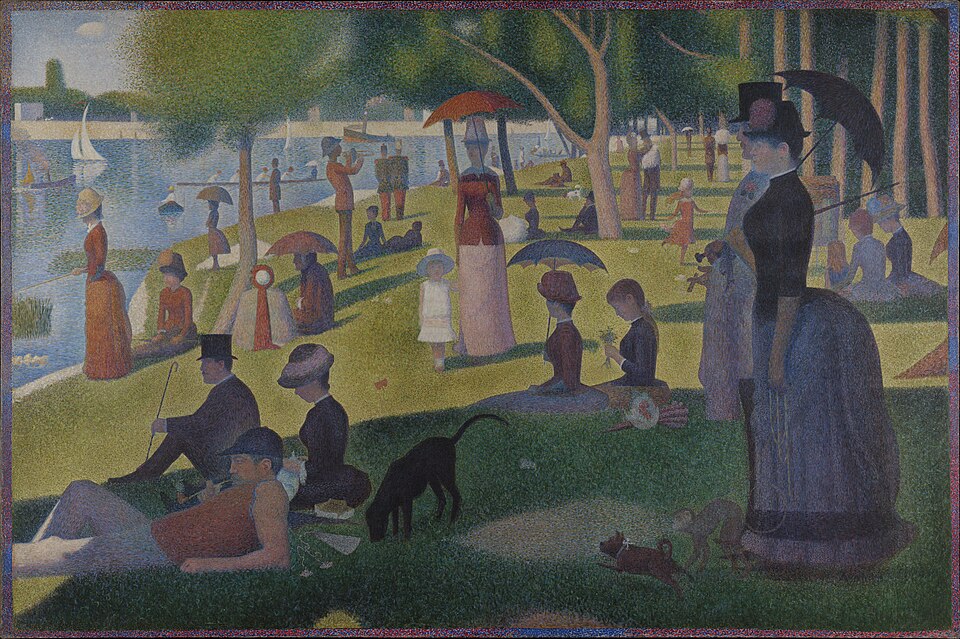
A Sunday on La Grande Jatte, Georges Seurat, 1884–1886. Image: Wikimedia Commons, public domain Do this: Look at the picture together for a quiet minute before anyone talks.
Read aloud: Seurat called his method pointillism, from the French word point, a dot. He studied how colors work and placed his dots very carefully. The people are still, like statues, as if time has stopped on a quiet Sunday afternoon. The painting is about ten feet wide, as big as a wall.
Point and find:
- Combien de parapluies? Count the umbrellas and parasols in French.
- Combien de chiens? How many dogs can you find?
- Find the monkey!
- Count the boats on the river in French.
Ask:
- “Why do you think Seurat used dots instead of brushstrokes?”
- “What do people do on a quiet Sunday afternoon?”
Show: How many boats? (There are 3.)
Say this: “Combien de bateaux?”
Say this: “Il y a + number + thing.”
Answer: Il y a trois bateaux.
Show: Spell 8 in French.
Say this: “h-u-i-t.”
Say this: “The h is silent: WEET.”
Answer: Huit.
Do this: Ask out loud. Let your child try first; help only after a real try.
Ask: Say 5 in French.
Listen for: Cinq.
Ask: Say 9 in French.
Listen for: Neuf.
Ask: What does Il y a mean?
Listen for: There is / there are.
3 more on the lesson page.
Read aloud: Make a small pointillist picture and count in French as you dot.
Steps:
- Lightly sketch something simple: a sun, a tree, a boat.
- Fill it in with dots only, counting them in French as you go: un, deux, trois…
- Put dots of two colors side by side and step back to see them mix.
- Show your picture and ask: Combien de couleurs? Il y a… couleurs.
Tips for you:
- Try yellow and blue dots side by side: from far away they look green.
- Count to dix again and again as you work.
Done when your child can say:
- My picture is made only of dots.
- I counted aloud in French while I worked.
Do this: Your child picks one or more; you write the date.
- Write the numbers 0 to 10 as words in your French notebook. Then write three sentences about the Seurat painting with Il y a…: Il y a un chien.
Read aloud: Seurat’s painting was so carefully planned that he made dozens of sketches and smaller studies of the park before he started the big canvas.
- Pronouncing the p in sept. It is silent: SET.
- Saying il y a as three separate words. Run them together: eel-ee-YAH.
A parent hides a handful of buttons or beans under a cup. Lift the cup for two seconds. Say how many in French: Il y a sept boutons! Count together to check.
Say this: “Tell me what you learned today.”
Listen for: Count from 0 to 10 in French and spell the number words.; Ask Combien? and answer Il y a…; Count things in a painting in French.
And he wrote on the tables, according to the first writing, the ten commandments, which the LORD spake unto you in the mount out of the midst of the fire in the day of the assembly: and the LORD gave them unto me.
In the Louis Segond Bible (1910): <i lang="fr">les dix paroles qu’il vous avait dites sur la montagne</i> Moses tells how God wrote the ten commandments, the ten words, on tables of stone. Ten is the first big number every child learns, and these ten words are the most important to know by heart.
Spread over the week
3 sessions of 20–30 minutes. Stop while it is still going well.
- Session 1. Warm-up, then read and teach the new idea and the new words. Picture study and show how.
- Session 2. Practice together, then start the project. Finish the project, then the sketchbook.
- Session 3. Narration, the game and the Scripture.