Parent guide · Grade 1 German · Unit 1
Lesson 1.1 Mutter, Vater, Kinder
Written for the parent. The Read aloud parts are written to your child; read them as they are. Do this parts are for you. Answers for you are marked Listen for.
At a glance
- Time
- 3 sessions of 15–20 minutes
- Goal
- Name mother, father, brother, sister and baby in German. Count the children in a family painting. Say the commandment about father and mother.
- You need
- A large sheet of paper
- Crayons or markers
- Family photos (optional) and glue
- A sketchbook or plain paper, and crayons
- A King James Bible
- Worksheet A · the lesson page (it also has a short video (2:54))
Steps
Do this together: Who lives in your house? Name everyone in your family in English: Mom, Dad, brothers, sisters, babies. Today you learn to name them in German.
Read aloud: The story. About two hundred years ago in Vienna, the capital of Austria, there lived a painter named Ferdinand Georg Waldmüller. One summer a man named Dr. Eltz asked him to paint his whole family on holiday in the mountain town of Ischl. What a big family! There is the father in his black coat, holding one of his little boys in his arms. There is the mother in a beautiful red dress, with the baby on her lap. And all around them are their children: big brothers in hats ready for a hike, sisters in white dresses, a boy kneeling in the grass and a little girl in pink. Behind them rise green hills and snowy mountains. Can you count all the children?
Read aloud: How German sounds. In Vater, the v sounds like f: FAH-ter. Schwester starts with schw, said shv: SHVES-ter. The u in Mutter and Bruder sounds like the oo in book or boot. Remember the little word in front: die Mutter, der Vater, der Bruder, die Schwester, das Baby.
Read aloud: Say it and move. Rock a pretend baby: das Baby! Stand tall like Dad: der Vater! Give a big hug: die Mutter! Flex your muscles: der Bruder! Twirl: die Schwester!
Do this: Say each word clearly; your child says it back twice. Point to a picture or the real thing when you can.
- die Mutter [dee MUT-ter]: mother
- der Vater [dehr FAH-ter]: father
- der Bruder [dehr BROO-der]: brother
- die Schwester [dee SHVES-ter]: sister
- das Baby [dahs BAY-bee]: baby
- die Familie [dee fah-MEE-lee-uh]: family
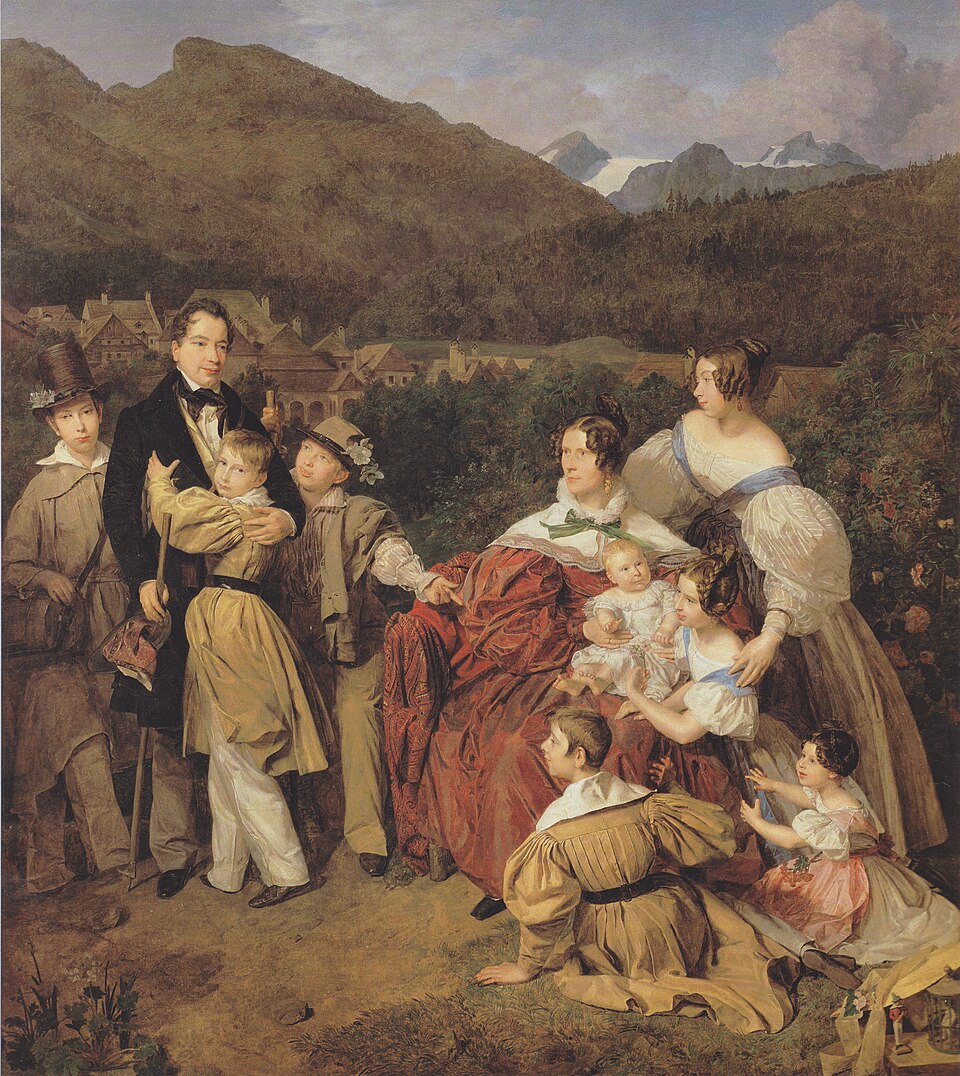
The Notary Dr. Josef August Eltz with His Wife and Eight Children in Ischl, Ferdinand Georg Waldmüller, 1835. Image: Wikimedia Commons, public domain Do this: Look at the picture together for a quiet minute before anyone talks.
Read aloud: Waldmüller loved bright daylight and clear colors. He painted every face so carefully that we can see each child’s own look. The family seems to have stopped for a moment on a summer walk. Look how the children turn toward the mother and the baby: the baby is at the very center of the picture.
Point and find:
- Count the children in German.
- Find the father. Who is he holding?
- Find the mother. What color is her dress?
- Find the baby. Where is the baby sitting?
Ask:
- “What do you think the family will do next on their holiday?”
- “If someone painted your family, where would you like to be?”
Show: The parent points to Dad. Who is that in German?
Say this: “Dad is the father.”
Say this: “Father is der Vater.”
Answer: Der Vater! (dehr FAH-ter)
Show: Count the children in the painting in German.
Say this: “Point to each child.”
Say this: “Count: eins, zwei, drei…”
Answer: Acht! (eight)
Do this: Ask out loud. Let your child try first; help only after a real try.
Ask: Say mother in German.
Listen for: Die Mutter.
Ask: Say father in German.
Listen for: Der Vater.
Ask: Say baby in German.
Listen for: Das Baby.
3 more on the lesson page.
Read aloud: Draw a family tree with your family on it and label it in German.
Steps:
- Draw a big tree with a strong trunk and branches.
- Draw (or glue a photo of) each person in your family on the branches.
- A parent writes die Mutter, der Vater, der Bruder, die Schwester or das Baby under each one.
- Point to each person and say who it is in German.
Tips for you:
- Add your grandparents at the roots of the tree.
- Count how many people are in your family in German.
Done when your child can say:
- My tree shows everyone in my family.
- I can name each person in German.
Do this: Your child picks one or more; you write the date.
- Draw your family in your picture dictionary. A parent writes die Mutter, der Vater, der Bruder, die Schwester and das Baby under the right people.
Read aloud: Bad Ischl, the town in the painting, is in the Austrian Alps. It was a favorite summer town for families from Vienna. Austria is one of the countries where people speak German every day.
- Saying Vater with a v sound. German v sounds like f: FAH-ter.
- Saying Schwester with sw. Say shv: SHVES-ter.
A parent describes a family member without saying the name: She is tall and she reads to you. Answer in German: die Mutter! Then you describe someone and the parent guesses.
Say this: “Tell me what you learned today.”
Listen for: Name mother, father, brother, sister and baby in German.; Count the children in a family painting.; Say the commandment about father and mother.
Honour thy father and thy mother: that thy days may be long upon the land which the LORD thy God giveth thee.
In the German Bible of Martin Luther (1912 revision), this verse reads: <i lang="de">Du sollst deinen Vater und deine Mutter ehren</i> This is the fifth of the Ten Commandments. God tells children to honor their father and mother: to love them, listen to them and obey them.
Spread over the week
3 sessions of 15–20 minutes. Stop while it is still going well.
- Session 1. Warm-up, then read and teach the new idea and the new words. Picture study and show how.
- Session 2. Practice together, then start the project. Finish the project, then the sketchbook.
- Session 3. Narration, the game and the Scripture.