Parent guide · Grade 1 German · Unit 2
Lesson 2.1 Das Haus
Written for the parent. The Read aloud parts are written to your child; read them as they are. Do this parts are for you. Answers for you are marked Listen for.
At a glance
- Time
- 3 sessions of 15–20 minutes
- Goal
- Name four rooms of the house in German. Say Das ist die Küche (This is the kitchen). Look closely at a painting of a room.
- You need
- A large sheet of paper
- Crayons or markers
- A ruler (optional)
- A sketchbook or plain paper, and crayons
- A King James Bible
- Worksheet A · the lesson page (it also has a short video (5:31))
Steps
Do this together: Walk around your house with your parent. What rooms do you have? Where do you cook? Where do you sleep? Where do you take a bath? Today you learn the rooms in German.
Read aloud: The story. About a hundred and eighty years ago in Berlin, the capital of Germany, there lived a painter named Adolph Menzel. He was a very small man, but he had sharp eyes and drew all the time, everywhere he went. One summer day he looked into a room in his apartment and saw something lovely: the balcony door was open, the wind was blowing the white curtain, and sunlight was pouring across the floor. Nobody was in the room, only two chairs, a mirror and a rug. Menzel painted it just for himself. Today it is one of the most loved paintings in Berlin.
Read aloud: How German sounds. Many German room words end in Zimmer, which means room. Wohnzimmer is the living room (wohnen means to live) and Schlafzimmer is the sleeping room (schlafen means to sleep). The z in Zimmer says ts: TSIM-mer. In Küche, the ü is round again and the ch is soft: KÜ-khuh. Haus sounds like the English word house: HOWS.
Read aloud: Say it and move. Stir a pretend pot: die Küche! Sit on the sofa: das Wohnzimmer! Lay your head on your hands: das Schlafzimmer! Scrub your arms: das Bad! Draw a house shape in the air: das Haus!
Do this: Say each word clearly; your child says it back twice. Point to a picture or the real thing when you can.
- das Haus [dahs HOWS]: house
- die Küche [dee KÜ-khuh]: kitchen
- das Wohnzimmer [dahs VOHN-tsim-mer]: living room
- das Schlafzimmer [dahs SHLAHF-tsim-mer]: bedroom
- das Bad [dahs BAHT]: bathroom
- das Zimmer [dahs TSIM-mer]: room
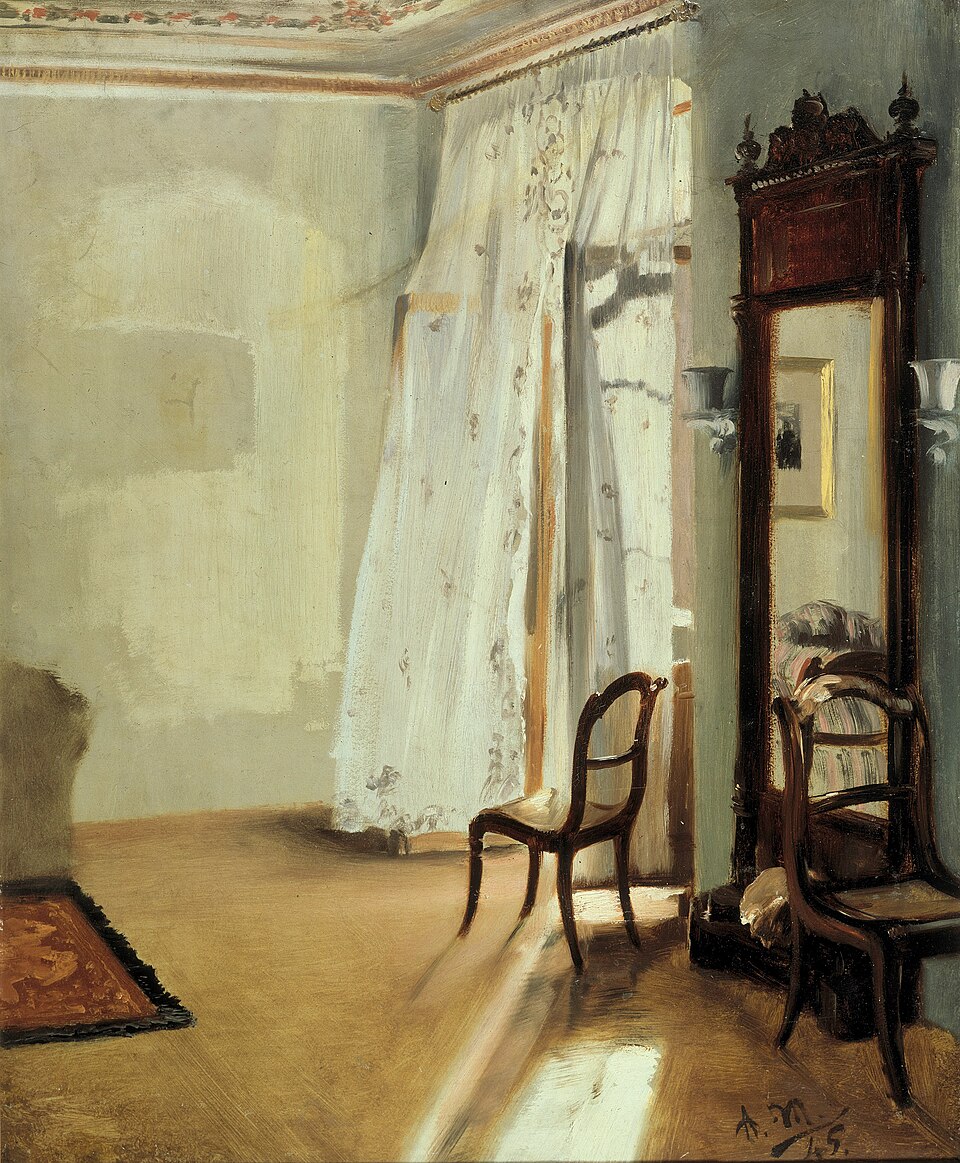
The Balcony Room, Adolph Menzel, 1845. Image: Wikimedia Commons, public domain Do this: Look at the picture together for a quiet minute before anyone talks.
Read aloud: Menzel did not paint people or a story here. He painted air and light: the breeze moving the curtain, the sunshine on the floor, the reflection in the mirror. The walls are painted loosely, as if Menzel was in a hurry to catch the light before it moved.
Point and find:
- Find the curtain. What is making it move?
- Find the sunlight on the floor.
- Count the chairs.
- Look in the mirror. What can you see there?
Ask:
- “Which room in your house is the sunniest?”
- “What do you think is outside the balcony door?”
Show: You are cooking with Mom. Which room are you in?
Say this: “We cook in the kitchen.”
Say this: “Kitchen is die Küche.”
Answer: Die Küche! (dee KÜ-khuh)
Show: Stand in your bedroom. Say This is the bedroom.
Say this: “Bedroom is das Schlafzimmer.”
Say this: “Das ist, then the room.”
Answer: Das ist das Schlafzimmer.
Do this: Ask out loud. Let your child try first; help only after a real try.
Ask: Say house in German.
Listen for: Das Haus.
Ask: Say kitchen in German.
Listen for: Die Küche.
Ask: Say bathroom in German.
Listen for: Das Bad.
3 more on the lesson page.
Read aloud: Draw a house cut open like a dollhouse, with each room labeled in German.
Steps:
- Draw a big house shape with a roof.
- Divide it into four rooms with lines.
- Draw a stove in one room, a sofa in one, a bed in one and a bathtub in one.
- A parent writes die Küche, das Wohnzimmer, das Schlafzimmer and das Bad. Trace them.
- Tell someone about your house: Das ist die Küche…
Tips for you:
- Draw your family in the rooms.
- Add a door and windows.
Done when your child can say:
- My house has four labeled rooms.
- I can name each room in German.
Do this: Your child picks one or more; you write the date.
- Draw a house in your picture dictionary. A parent writes das Haus. Draw a stove for die Küche and a bed for das Schlafzimmer.
Read aloud: Many German families live in apartments, called Wohnungen, in tall buildings in the city. Many have a balcony with flower boxes, and in summer the balconies are full of red geraniums.
- Saying Zimmer with a z sound. German z says ts: TSIM-mer.
- Saying Küche like cook. Round your lips for ü: KÜ-khuh.
A parent acts out something: brushing teeth, cooking, sleeping, watching the fire. Name the room in German: das Bad! die Küche! Then switch.
Say this: “Tell me what you learned today.”
Listen for: Name four rooms of the house in German.; Say Das ist die Küche (This is the kitchen).; Look closely at a painting of a room.
And if it seem evil unto you to serve the LORD, choose you this day whom ye will serve; whether the gods which your fathers served that were on the other side of the flood, or the gods of the Amorites, in whose land ye dwell: but as for me and my house, we will serve the LORD.
In the German Bible of Martin Luther (1912 revision), this verse reads: <i lang="de">Ich aber und mein Haus wollen dem HERRN dienen.</i> Joshua told all the people that his whole family would follow God. A Christian home is a house that serves the Lord together.
Spread over the week
3 sessions of 15–20 minutes. Stop while it is still going well.
- Session 1. Warm-up, then read and teach the new idea and the new words. Picture study and show how.
- Session 2. Practice together, then start the project. Finish the project, then the sketchbook.
- Session 3. Narration, the game and the Scripture.