Parent guide · Grade 1 German · Unit 3
Lesson 3.1 Montag bis Sonntag
Written for the parent. The Read aloud parts are written to your child; read them as they are. Do this parts are for you. Answers for you are marked Listen for.
At a glance
- Time
- 3 sessions of 15–20 minutes
- Goal
- Say the seven days of the week in German. Say Heute ist… (Today is…). Tell why Sunday is special.
- You need
- Two paper plates
- A paper fastener (brad)
- Crayons and scissors (a parent helps)
- A sketchbook or plain paper, and crayons
- A King James Bible
- Worksheet A · the lesson page (it also has a short video (6:41))
Steps
Do this together: Say the days of the week in English. Which day is today? Which day do you go to church? Today you learn all seven days in German.
Read aloud: The story. More than a hundred and forty years ago, a painter named Wilhelm Leibl lived in a village in the mountains of Bavaria, in the south of Germany. Every Sunday, the village people put on their best clothes and went to church. Leibl wanted to paint them just as they were. He set up his easel in the cold village church and painted three women sitting in a carved wooden pew. It took him about four years! An old woman folds her hands in prayer, another reads her prayer book, and a young woman in a flowered shawl and a black hat reads her book too. It is Sonntag, the Lord’s day.
Read aloud: How German sounds. The German days are Montag, Dienstag, Mittwoch, Donnerstag, Freitag, Samstag and Sonntag. Most end in tag (day), said tahk. Mittwoch means mid-week. Sonntag starts with a z sound: ZON-tahk. Heute has the eu sound, like oy in boy: HOY-tuh.
Read aloud: Say it and move. Say a day for each finger: Montag, Dienstag, Mittwoch, Donnerstag, Freitag, Samstag, and for Sonntag fold your hands as in church. Stamp your foot for heute!
Do this: Say each word clearly; your child says it back twice. Point to a picture or the real thing when you can.
- der Montag [dehr MOHN-tahk]: Monday
- der Mittwoch [dehr MIT-vokh]: Wednesday
- der Freitag [dehr FRY-tahk]: Friday
- der Sonntag [dehr ZON-tahk]: Sunday
- heute [HOY-tuh]: today
- die Woche [dee VOKH-uh]: week
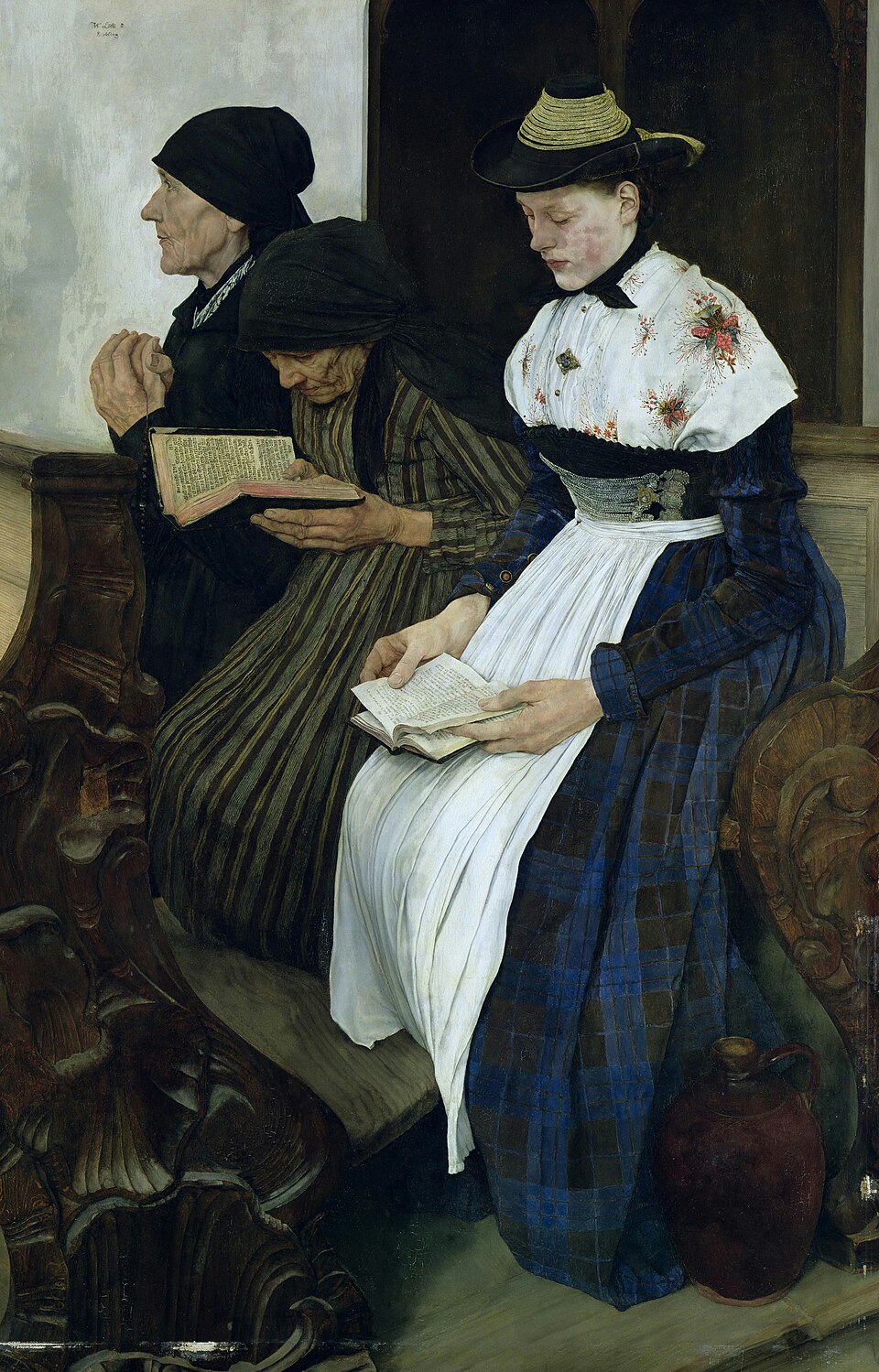
Three Women in Church, Wilhelm Leibl, 1878–1882. Image: Wikimedia Commons, public domain Do this: Look at the picture together for a quiet minute before anyone talks.
Read aloud: Leibl painted every thread and wrinkle as carefully as the old German painters, like Dürer and Holbein. The young woman wears the festive Sunday clothes of the Bavarian countryside. The three women may be a grandmother, a mother and a daughter, all worshiping God together. Look at their quiet, serious faces: nobody is looking at the painter.
Point and find:
- Find the woman who is praying with folded hands.
- How many women are reading a book?
- Find the flowers on the young woman’s shawl. What color are they?
- Find the jug on the floor.
Ask:
- “Why do you think the women wore their best clothes to church?”
- “What do you do on Sunday?”
Show: Today is Monday. Say it in German.
Say this: “Today is heute ist.”
Say this: “Monday is Montag.”
Answer: Heute ist Montag.
Show: What day comes after Samstag?
Say this: “Samstag is Saturday.”
Say this: “After Saturday comes Sunday.”
Answer: Sonntag.
Do this: Ask out loud. Let your child try first; help only after a real try.
Ask: Say Monday in German.
Listen for: Montag.
Ask: Say Sunday in German.
Listen for: Sonntag.
Ask: What does heute mean?
Listen for: Today.
3 more on the lesson page.
Read aloud: Make a wheel that shows the day of the week.
Steps:
- Divide one plate into seven slices like a pie.
- A parent writes one German day in each slice; draw a little picture for each (a church for Sonntag).
- Cut a window in the second plate the size of one slice.
- Fasten the two plates together in the middle with the brad.
- Every morning, turn the wheel and say: Heute ist…
Tips for you:
- Color Sonntag gold.
- Say the day before (gestern) and the day after (morgen) too.
Done when your child can say:
- My wheel shows all seven days.
- I can say Heute ist… every morning.
Do this: Your child picks one or more; you write the date.
- Write the seven days in your picture dictionary, one per line, with a parent’s help. Draw a church next to Sonntag, a sun beside it (Sonntag means sun day) and a moon next to Montag (moon day).
Read aloud: In Germany most shops are closed on Sunday by law, so Sonntag is a quiet day for church, family walks and visiting. The church bells ring all over town on Sunday morning.
- Saying Sonntag with an s. German s before a vowel sounds like z: ZON-tahk.
- Saying heute like hute. The eu says oy: HOY-tuh.
Lay seven papers on the floor with the days written on them. Hop from one to the next, saying each day. Then a parent calls a day and you jump onto it!
Say this: “Tell me what you learned today.”
Listen for: Say the seven days of the week in German.; Say Heute ist… (Today is…).; Tell why Sunday is special.
Remember the sabbath day, to keep it holy.
In the German Bible of Martin Luther (1912 revision), this verse reads: <i lang="de">Gedenke des Sabbattags, daß du ihn heiligest.</i> This is the fourth commandment. God made six days for work and gave one day to rest and worship Him. For Christians, Sunday is the Lord’s day, the day Jesus rose from the dead.
Spread over the week
3 sessions of 15–20 minutes. Stop while it is still going well.
- Session 1. Warm-up, then read and teach the new idea and the new words. Picture study and show how.
- Session 2. Practice together, then start the project. Finish the project, then the sketchbook.
- Session 3. Narration, the game and the Scripture.