Parent guide · Grade 1 German · Unit 4
Lesson 4.1 Komm, Herr Jesu
Written for the parent. The Read aloud parts are written to your child; read them as they are. Do this parts are for you. Answers for you are marked Listen for.
At a glance
- Time
- 3 sessions of 15–20 minutes
- Goal
- Name bread, milk, water, butter and cake in German. Say the German table prayer. Look closely at a painting of a family at prayer.
- You need
- A sheet of construction paper
- Crayons or markers
- Clear contact paper (optional)
- A sketchbook or plain paper, and crayons
- A King James Bible
- Worksheet A · the lesson page (it also has a short video (1:41))
Steps
Do this together: What do you eat for breakfast? For supper? Name your favorite foods in English. Before you eat, what does your family do? Today you learn food words and a table prayer in German.
Read aloud: The story. Long ago in Germany, many families said this prayer before every meal: Komm, Herr Jesu, sei unser Gast, und segne, was du uns bescheret hast. It means: Come, Lord Jesus, be our guest, and bless what You have given us. Fritz von Uhde, the painter of Jesus and the children, painted this prayer. A poor family stands around their table in a plain room. The mother puts out the soup, the grandfather folds his hands, the children stand by their chairs. And who is coming in? Jesus Himself, in a blue robe, with His hand raised to bless them! The father bows to welcome Him. Jesus really is with us when we pray.
Read aloud: How German sounds. Brot sounds like brought with a t: BROHT. In Milch, the ch is the soft one, at the front of the mouth: MILKH. Wasser starts with a v sound: VAHS-ser. In Kuchen, the ch is the throaty one: KOO-khun. Herr is said with a little rolled r: HEHR.
Read aloud: Say it and move. Break a pretend loaf: das Brot! Drink a pretend glass: die Milch! Pour water: das Wasser! Spread butter: die Butter! Blow out candles: der Kuchen! Fold your hands: Komm, Herr Jesu, sei unser Gast.
Do this: Say each word clearly; your child says it back twice. Point to a picture or the real thing when you can.
- das Brot [dahs BROHT]: bread
- die Milch [dee MILKH]: milk
- das Wasser [dahs VAHS-ser]: water
- die Butter [dee BUT-ter]: butter
- der Kuchen [dehr KOO-khun]: cake
- der Käse [dehr KAY-zuh]: cheese
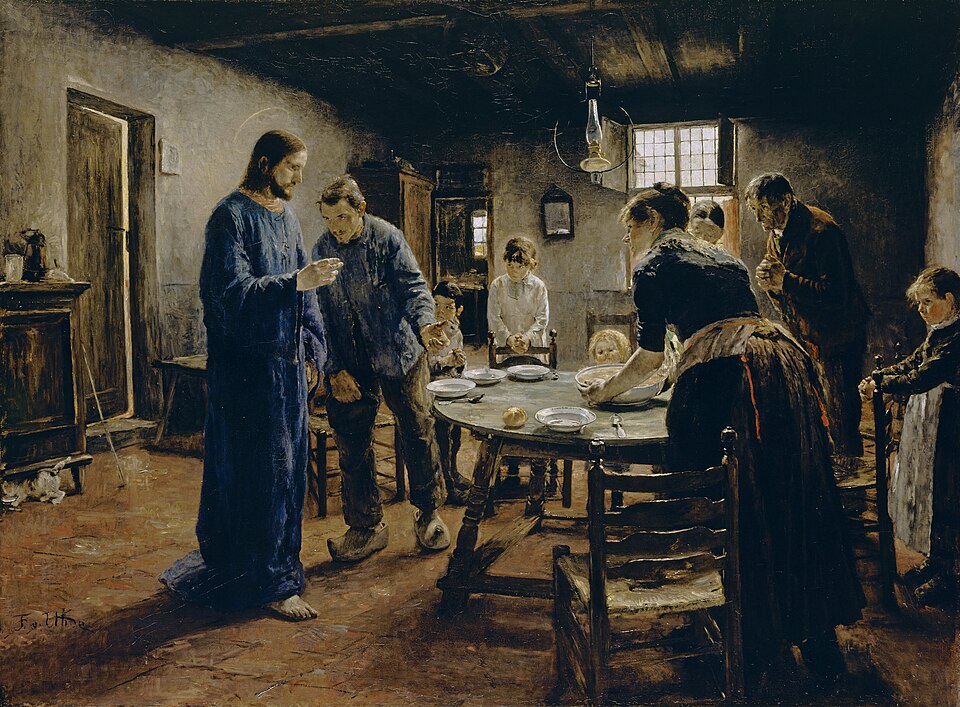
The Mealtime Prayer (Come, Lord Jesus, Be Our Guest), Fritz von Uhde, 1885. Image: Wikimedia Commons, public domain Do this: Look at the picture together for a quiet minute before anyone talks.
Read aloud: Uhde painted the table prayer as if it came true: the family asked Jesus to be their guest, and He came. Nobody in the room looks surprised or frightened. The father welcomes Jesus with open hands, like a host greeting a friend. The light from the window falls on the family and the soup bowls, and Jesus stands in the soft light near the door.
Point and find:
- Find Jesus. What is He doing with His hand?
- Find the father. What is he wearing on his feet?
- Count the bowls on the table.
- Find the cat.
Ask:
- “How do you think the family felt when Jesus came in?”
- “Who would you invite to your table?”
Show: You want a drink of water. What is water in German?
Say this: “Water is das Wasser.”
Say this: “The w sounds like v.”
Answer: Das Wasser! (dahs VAHS-ser)
Show: What do German families say before eating?
Say this: “They ask Jesus to come.”
Say this: “Komm, Herr Jesu, sei unser Gast.”
Answer: Komm, Herr Jesu, sei unser Gast, und segne, was du uns bescheret hast.
Do this: Ask out loud. Let your child try first; help only after a real try.
Ask: Say bread in German.
Listen for: Das Brot.
Ask: Say milk in German.
Listen for: Die Milch.
Ask: Say cake in German.
Listen for: Der Kuchen.
3 more on the lesson page.
Read aloud: Make a place mat with the German table prayer on it.
Steps:
- A parent writes Komm, Herr Jesu, sei unser Gast, und segne, was du uns bescheret hast across the top.
- Draw a plate, a cup, a loaf of bread and a glass of milk around it.
- Label each one in German: das Brot, die Milch.
- Cover it with contact paper if you like, and use it at every meal this week.
Tips for you:
- Make one for each person in the family.
- Lead the family in the prayer before supper.
Done when your child can say:
- My place mat has the prayer and four labeled foods.
- I can say the table prayer in German.
Do this: Your child picks one or more; you write the date.
- Draw a breakfast table in your picture dictionary: bread, milk, butter and water. A parent writes das Brot, die Milch, die Butter and das Wasser.
Read aloud: Germany is famous for bread: there are more than three thousand kinds! German children often eat a slice of dark bread with butter and cheese for breakfast, and a Brezel (pretzel) as a snack.
- Saying Wasser with a w. German w says v: VAHS-ser.
- Saying Milch with a k. The ch is a soft hiss: MILKH.
Set up a pretend bakery with toy or paper foods. The customer comes in and says Guten Tag! Ein Brot, bitte! The baker hands it over and says Bitte schön! The customer says Danke! Tschüss! Take turns.
Say this: “Tell me what you learned today.”
Listen for: Name bread, milk, water, butter and cake in German.; Say the German table prayer.; Look closely at a painting of a family at prayer.
Give us this day our daily bread.
In the German Bible of Martin Luther (1912 revision), this verse reads: <i lang="de">Unser täglich Brot gib uns heute.</i> Jesus taught us to ask God for our daily bread. Every meal is a gift from Him, so we thank Him before we eat.
Spread over the week
3 sessions of 15–20 minutes. Stop while it is still going well.
- Session 1. Warm-up, then read and teach the new idea and the new words. Picture study and show how.
- Session 2. Practice together, then start the project. Finish the project, then the sketchbook.
- Session 3. Narration, the game and the Scripture.