Parent guide · Grade 1 German · Unit 5
Lesson 5.1 Hut, Jacke, Schuhe
Written for the parent. The Read aloud parts are written to your child; read them as they are. Do this parts are for you. Answers for you are marked Listen for.
At a glance
- Time
- 3 sessions of 15–20 minutes
- Goal
- Name five pieces of clothing in German. Say Ich trage… (I am wearing…). Look closely at a painting of a family on a walk.
- You need
- Stiff paper or a cereal box
- Paper, crayons and scissors (a parent helps)
- Tape
- A sketchbook or plain paper, and crayons
- A King James Bible
- Worksheet A · the lesson page (it also has a short video (2:10))
Steps
Do this together: What are you wearing today? Name each thing in English: shirt, pants, shoes, socks. Today you learn clothes in German, and you get to play dress-up.
Read aloud: The story. Do you remember Carl Spitzweg, who painted the old bookworm on the ladder? He also painted a family going for a walk on a Sunday afternoon. They are dressed in their very best clothes, but they have wandered right into a field of tall golden wheat! The plump father walks in front, so hot that he carries his tall black hat on the end of his walking stick. The mother follows with a white parasol and a big bonnet. Behind them come the girls with little green sunshades and a basket, and at the very back a boy runs with a butterfly net. On the hill stands the village church. Spitzweg is gently laughing at them, but he loves them too.
Read aloud: How German sounds. Hut sounds like hoot: HOOT. In Jacke, the j sounds like y: YAHK-kuh. Kleid has ei, said eye: KLITE. In Schuhe the h is silent: SHOO-uh. To say what you are wearing: Ich trage eine Jacke. Ich trage einen Hut.
Read aloud: Say it and move. Put on a pretend hat and tip it: der Hut! Zip up a jacket: die Jacke! Twirl in a dress: das Kleid! Pull up your pants: die Hose! Tie your shoes: die Schuhe!
Do this: Say each word clearly; your child says it back twice. Point to a picture or the real thing when you can.
- der Hut [dehr HOOT]: hat
- die Jacke [dee YAHK-kuh]: jacket
- das Kleid [dahs KLITE]: dress
- die Hose [dee HOH-zuh]: pants
- die Schuhe [dee SHOO-uh]: shoes
- das Hemd [dahs HEMT]: shirt
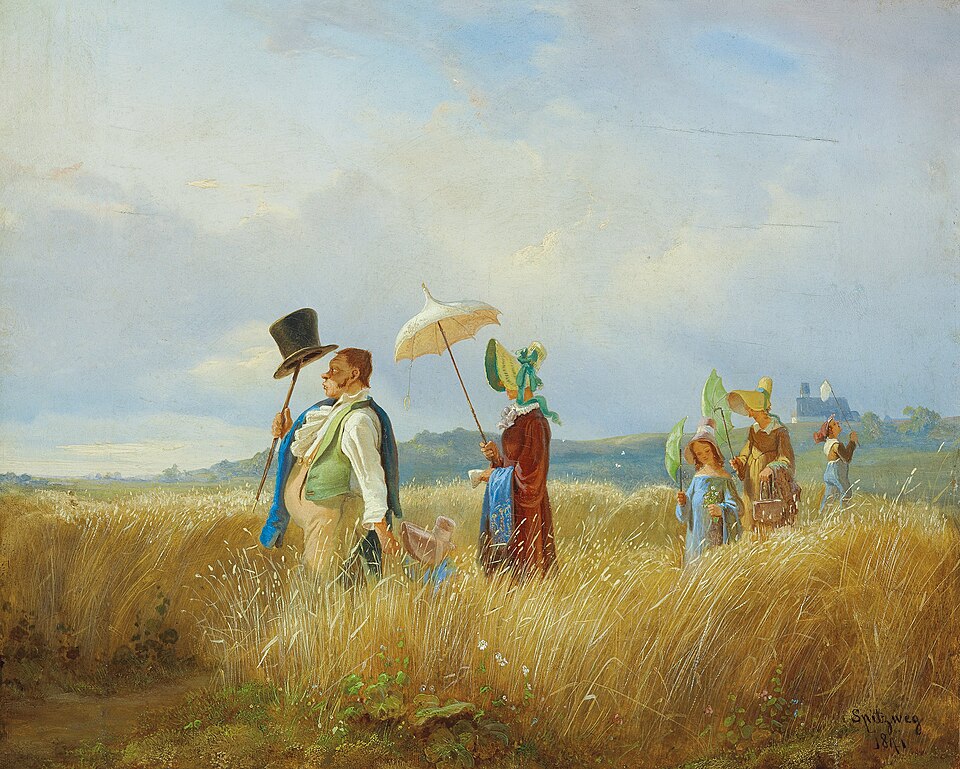
The Sunday Walk, Carl Spitzweg, 1841. Image: Wikimedia Commons, public domain Do this: Look at the picture together for a quiet minute before anyone talks.
Read aloud: Spitzweg liked to paint ordinary townspeople with a gentle smile. The family has dressed up very properly for their Sunday walk, but now they are wading through the wheat in the heat. The father is so warm that he carries his hat on his stick. The wide sky, the golden field and the breeze in the wheat make it feel like a perfect summer day.
Point and find:
- Find the father’s hat. Where is it?
- Find the white parasol. Who is holding it?
- Count the people in the family.
- Find the church on the hill.
Ask:
- “Is it hot or cold in this picture? How can you tell?”
- “What would you wear on a walk through a wheat field?”
Show: It is cold outside. What do you put on? Say it in German.
Say this: “When it is cold we wear a jacket.”
Say this: “Jacket is die Jacke.”
Answer: Die Jacke! (dee YAHK-kuh)
Show: What is the father in the painting carrying on his stick?
Say this: “Look at the top of his cane.”
Say this: “It is his hat.”
Answer: Der Hut! (his hat)
Do this: Ask out loud. Let your child try first; help only after a real try.
Ask: Say hat in German.
Listen for: Der Hut.
Ask: Say shoes in German.
Listen for: Die Schuhe.
Ask: Say dress in German.
Listen for: Das Kleid.
3 more on the lesson page.
Read aloud: Make a paper doll with clothes to put on and take off, and name each piece in German.
Steps:
- Draw and cut out a person about as tall as your hand.
- Draw and cut out a hat, a jacket, a dress or pants, and shoes to fit.
- Color them, and leave little tabs to fold over the doll.
- Dress the doll and say each piece in German: der Hut, die Jacke, die Schuhe.
Tips for you:
- Make clothes for sunny days and for rainy days.
- Say Sie trägt ein Kleid (She is wearing a dress).
Done when your child can say:
- My doll has at least four pieces of clothing.
- I can name each piece in German.
Do this: Your child picks one or more; you write the date.
- Draw a hat, a jacket, a dress, pants and shoes in your picture dictionary. A parent writes der Hut, die Jacke, das Kleid, die Hose and die Schuhe.
Read aloud: In the mountains of southern Germany and Austria, people still wear traditional clothes for church, weddings and festivals: Lederhosen (leather shorts) for men and boys, and the Dirndl, a dress with an apron, for women and girls.
- Saying Jacke with a j. German j says y: YAHK-kuh.
- Saying the h in Schuhe. It is silent: SHOO-uh.
Put a pile of grown-up clothes on the floor: a hat, a jacket, big shoes. A parent calls a German word: der Hut! Run, put it on and say Ich trage einen Hut! Keep going until you are wearing everything.
Say this: “Tell me what you learned today.”
Listen for: Name five pieces of clothing in German.; Say Ich trage… (I am wearing…).; Look closely at a painting of a family on a walk.
Wherefore, if God so clothe the grass of the field, which to day is, and to morrow is cast into the oven, shall he not much more clothe you, O ye of little faith?
In the German Bible of Martin Luther (1912 revision), this verse reads: <i lang="de">So denn Gott das Gras auf dem Felde also kleidet</i> Jesus said God dresses the grass of the field in beauty. If God takes such care of the grass, He will surely give His children what they need to wear.
Spread over the week
3 sessions of 15–20 minutes. Stop while it is still going well.
- Session 1. Warm-up, then read and teach the new idea and the new words. Picture study and show how.
- Session 2. Practice together, then start the project. Finish the project, then the sketchbook.
- Session 3. Narration, the game and the Scripture.