Parent guide · Grade 2 German · Unit 1
Lesson 1.1 Das ABC
Written for the parent. The Read aloud parts are written to your child; read them as they are. Do this parts are for you. Answers for you are marked Listen for.
At a glance
- Time
- 3 sessions of 15–20 minutes
- Goal
- Sing the German ABC. Say the German names of the letters. Spell your name in German.
- You need
- A potato cut in half (a parent cuts)
- A knife for a parent to carve, or foam letter stamps
- Paint or an ink pad and paper
- A sketchbook or plain paper, and crayons
- A King James Bible
- Worksheet A · the lesson page (it also has a short video (2:27))
Steps
Do this together: Sing the ABC song in English. Do you know that German uses almost the same letters, but says some of them differently? Today you sing the ABC in German.
Read aloud: The story. More than five hundred and fifty years ago, in the city of Mainz in Germany, there lived a goldsmith named Johannes Gutenberg. In those days every book had to be copied by hand, letter by letter, and it took a scribe many months to copy one Bible. Gutenberg had an idea: he made each letter as a little block of metal. He could put the letters together into words and lines, ink them and press them onto paper, again and again, then take them apart and use them for the next page. The first great book he printed was the Bible! Today one of his Bibles lies under glass in the Library of Congress in Washington, and people come from everywhere to see it.
Read aloud: How German sounds. Some German letter names sound different from English: A is ah, E is ay, I is ee, J is yot, R is air, V is fow, W is vay, Y is ÜP-see-lon and Z is tset. So the ABC is ah, bay, tsay! And many other letters you know already: bay, day, eff, gay, hah.
Read aloud: Say it and move. Make each letter with your body: stand straight for I (ee), arms up in a V for Y, hands on hips for A (ah). Then spell your name and jump for each letter!
Do this: Say each word clearly; your child says it back twice. Point to a picture or the real thing when you can.
- das Alphabet [dahs ahl-fah-BAYT]: alphabet
- der Buchstabe [dehr BOOKH-shtah-buh]: letter
- das Buch [dahs BOOKH]: book
- die Bibel [dee BEE-bul]: Bible
- lesen [LAY-zun]: to read
- schreiben [SHRY-bun]: to write
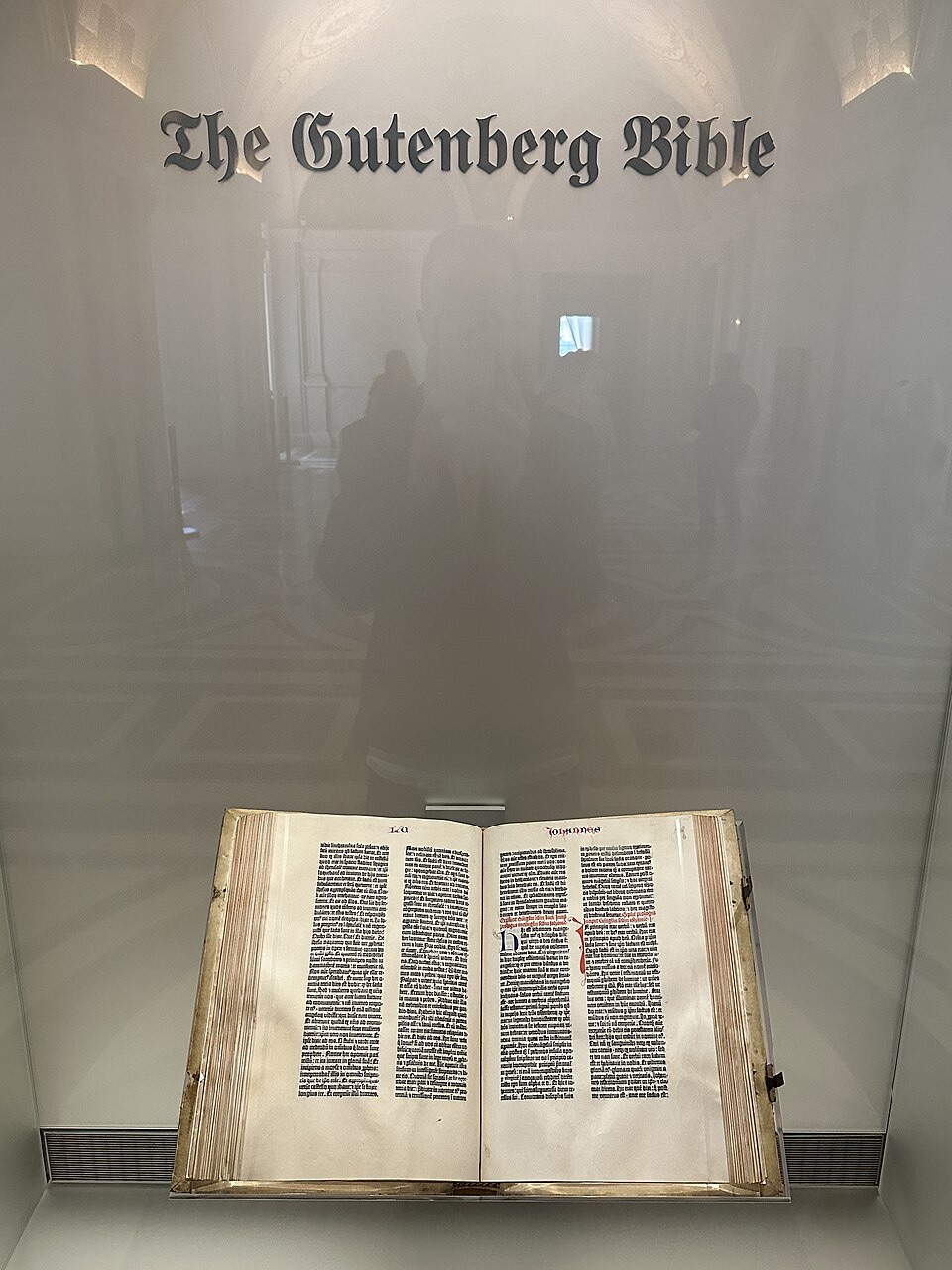
The Gutenberg Bible, Johannes Gutenberg (printer); photograph by APK, printed about 1454–1455; photographed 2026. Image: Wikimedia Commons, photograph by APK, CC BY 4.0 Do this: Look at the picture together for a quiet minute before anyone talks.
Read aloud: Gutenberg wanted his printed Bible to look as beautiful as the best hand-copied books, so he made letters in the old style that scribes used. After the pages were printed, artists added red headings and colored capital letters by hand. Look at how straight and even the columns are: every line ends at the same place.
Point and find:
- How many columns of print are on each page?
- Find the red letters. Were they printed or painted?
- Find the big capital letter.
- Read the sign above the book.
Ask:
- “Why do you think Gutenberg chose the Bible as his first great book?”
- “How long do you think it would take to copy a whole Bible by hand?”
Show: Spell the name Max in German.
Say this: “M is emm.”
Say this: “A is ah.”
Say this: “X is iks.”
Answer: Emm, ah, iks.
Show: What letter is called yot in German?
Say this: “German letter names: J is yot.”
Answer: J.
Do this: Ask out loud. Let your child try first; help only after a real try.
Ask: Say A, B, C in German.
Listen for: Ah, bay, tsay.
Ask: What is the German name of the letter W?
Listen for: Vay.
Ask: What did Gutenberg invent?
Listen for: Printing with movable metal letters.
3 more on the lesson page.
Read aloud: Make letter stamps like Gutenberg’s and print your name.
Steps:
- A parent carves the first letter of your name into a potato half, backwards (a stamp prints the mirror image!).
- Dip it in paint and press it onto the paper.
- Print it several times in a row.
- Say the German name of the letter each time you print it.
- If you have foam letters, print your whole name and spell it in German.
Tips for you:
- Print your initials with a fancy border.
- Notice why the letter must be carved backwards.
Done when your child can say:
- My stamp prints a letter of my name.
- I can spell my name in German.
Do this: Your child picks one or more; you write the date.
- In your German notebook, write the alphabet in a parent’s neat letters. Beside the letters that sound different, write how to say them: E (ay), I (ee), J (yot), V (fow), W (vay), Z (tset).
Read aloud: Gutenberg printed about 180 copies of his Bible. About fifty still exist, and the Library of Congress copy is one of only a few perfect copies printed on vellum, a fine material made from calfskin.
- Saying E as ee. In German, E is ay and I is ee.
- Saying J as jay. In German it is yot.
A parent says a German letter name: tset! Find a Z somewhere on a book, a box or a sign and point to it. Take turns calling letters.
Say this: “Tell me what you learned today.”
Listen for: Sing the German ABC.; Say the German names of the letters.; Spell your name in German.
In the beginning was the Word, and the Word was with God, and the Word was God.
In the German Bible of Martin Luther (1912 revision), this verse reads: <i lang="de">Im Anfang war das Wort</i> John calls Jesus the Word of God. God speaks to us in words, and He gave us the Bible so we can read His words. That is why Gutenberg printed the Bible first.
Spread over the week
3 sessions of 15–20 minutes. Stop while it is still going well.
- Session 1. Warm-up, then read and teach the new idea and the new words. Picture study and show how.
- Session 2. Practice together, then start the project. Finish the project, then the sketchbook.
- Session 3. Narration, the game and the Scripture.