Parent guide · Grade 2 German · Unit 2
Lesson 2.1 Der erste Schultag
Written for the parent. The Read aloud parts are written to your child; read them as they are. Do this parts are for you. Answers for you are marked Listen for.
At a glance
- Time
- 3 sessions of 15–20 minutes
- Goal
- Name school, teacher and student in German. Tell about the first day of school in Germany. Look closely at a painting of a writing lesson.
- You need
- A large sheet of poster board or heavy paper
- Tape or glue, tissue paper
- Crayons, stickers
- Small treats, a pencil, an eraser
- A sketchbook or plain paper, and crayons
- A King James Bible
- Worksheet A · the lesson page (it also has a short video (3:15))
Steps
Do this together: Do you remember starting school or your first lesson at home? What did you bring? What did you learn first? Today you learn German words for school and see how German children start school.
Read aloud: The story. About a hundred and sixty years ago in Switzerland, where many people speak German, there lived a painter named Albert Anker. As a young man he studied to become a pastor, but he loved painting so much that he became a painter instead. He painted the children of his village again and again: children reading, knitting, praying and learning. In this picture a little boy bends over a sheet of paper, writing carefully with a dip pen and an inkwell. His big sister leans her head on her hand and watches him with a kind smile. She may be his first teacher! On the table lies a toy doll, waiting until the lesson is done.
Read aloud: How German sounds. Schule starts with sch, the German sh: SHOO-luh. In Schüler, the ü is round. When a word is about a woman or girl, German often adds -in: der Lehrer, die Lehrerin; der Schüler, die Schülerin. The first day of school is der erste Schultag.
Read aloud: Say it and move. Put on a pretend backpack: die Schule! Stand up straight and point to the board like a teacher: der Lehrer! Raise your hand: der Schüler! Hug a big pretend cone: die Schultüte!
Do this: Say each word clearly; your child says it back twice. Point to a picture or the real thing when you can.
- die Schule [dee SHOO-luh]: school
- der Lehrer [dehr LAY-rer]: teacher (man)
- die Lehrerin [dee LAY-ruh-rin]: teacher (woman)
- der Schüler [dehr SHÜ-ler]: student (boy)
- die Schülerin [dee SHÜ-luh-rin]: student (girl)
- lernen [LEHR-nun]: to learn
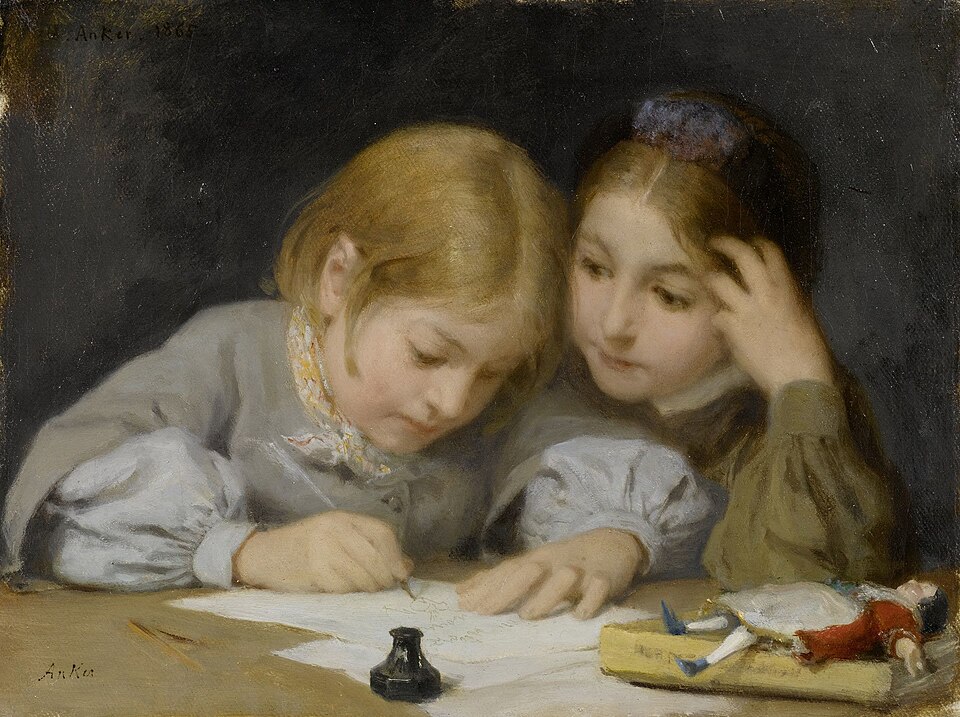
The Writing Lesson, Albert Anker, 1865. Image: Wikimedia Commons, public domain Do this: Look at the picture together for a quiet minute before anyone talks.
Read aloud: Anker painted children with great love and respect. The light falls on the children’s faces, hands and the white paper, and the background is dark, so we look right at the lesson. Notice how hard the little boy is concentrating, and how patient his sister is.
Point and find:
- What is the boy writing with?
- Find the inkwell.
- What is the sister doing with her hand?
- Find the toy on the box. What is it?
Ask:
- “Who taught you to write your first letters?”
- “Why do you think the doll is lying on the box?”
Show: Your teacher is a woman. What do you call her in German?
Say this: “Teacher is Lehrer.”
Say this: “For a woman add -in.”
Answer: Die Lehrerin.
Show: What do German children get on the first day of school?
Say this: “It is a big paper cone.”
Say this: “It is full of treats.”
Answer: A Schultüte.
Do this: Ask out loud. Let your child try first; help only after a real try.
Ask: Say school in German.
Listen for: Die Schule.
Ask: Say teacher (a man) in German.
Listen for: Der Lehrer.
Ask: Say student (a girl) in German.
Listen for: Die Schülerin.
3 more on the lesson page.
Read aloud: Make a German school cone and fill it with small treats and school things.
Steps:
- Roll the poster board into a big cone and tape it closed (a parent helps).
- Decorate the outside with stickers and drawings.
- A parent writes Mein erster Schultag (my first school day) on it.
- Fill it with treats and school things, and stuff tissue paper in the top.
- Open it and name each school thing in German.
Tips for you:
- Make a small one for a younger brother or sister.
- Take a picture with your Schultüte, the way German children do.
Done when your child can say:
- My Schultüte is decorated and filled.
- I can tell what a Schultüte is for.
Do this: Your child picks one or more; you write the date.
- In your German notebook, draw yourself at school. Write die Schule, der Lehrer or die Lehrerin, and der Schüler or die Schülerin.
Read aloud: German children start school at about six. On the first day, called Einschulung, the family comes along, there is often a church service, and every child gets a Schultüte. Many families keep the photo of that day for life.
- Saying Schule with sk. Sch is sh: SHOO-luh.
- Forgetting -in for a woman teacher: die Lehrerin.
Take turns being die Lehrerin or der Lehrer. The teacher gives commands in German: Steht auf! (Stand up!), Setzt euch! (Sit down!), Hände hoch! (Hands up!). The students obey quickly.
Say this: “Tell me what you learned today.”
Listen for: Name school, teacher and student in German.; Tell about the first day of school in Germany.; Look closely at a painting of a writing lesson.
And Jesus increased in wisdom and stature, and in favour with God and man.
In the German Bible of Martin Luther (1912 revision), this verse reads: <i lang="de">Und Jesus nahm zu an Weisheit, Alter und Gnade bei Gott und den Menschen.</i> When Jesus was a boy, He grew in wisdom and in body, and God and people loved Him. Learning is part of growing up the way God wants.
Spread over the week
3 sessions of 15–20 minutes. Stop while it is still going well.
- Session 1. Warm-up, then read and teach the new idea and the new words. Picture study and show how.
- Session 2. Practice together, then start the project. Finish the project, then the sketchbook.
- Session 3. Narration, the game and the Scripture.