Parent guide · Grade 2 German · Unit 3
Lesson 3.1 Januar bis Dezember
Written for the parent. The Read aloud parts are written to your child; read them as they are. Do this parts are for you. Answers for you are marked Listen for.
At a glance
- Time
- 3 sessions of 15–20 minutes
- Goal
- Say the twelve months in German.; Say when your birthday is: Mein Geburtstag ist im…; Tell the story of the Silent Night chapel.
- You need
- A large sheet of paper divided into twelve boxes
- Markers or crayons
- A list of family birthdays
- A sketchbook or plain paper, and crayons
- A King James Bible
- Worksheet A · the lesson page (it also has a short video (4:18))
Steps
Do this together: Say the months of the year in English. Which month is your birthday? Which month is Christmas? Today you learn all twelve months in German. Many of them sound almost like English!
Read aloud: The story. In December of the year 1818, in a little village called Oberndorf in Austria, the young assistant pastor, Joseph Mohr, had a Christmas poem he had written two years before. On the day before Christmas he walked to the schoolteacher, Franz Xaver Gruber, and asked him to write a tune for it, a tune for two voices and a guitar. That very night, on Christmas Eve, the two men stood in the church of St. Nicholas and sang the new song for the first time: Stille Nacht, heilige Nacht! Silent night, holy night! The old church is gone now, but in its place stands a small white chapel, the Silent Night Chapel. Every Christmas Eve people gather there in the snow to sing the song that is now sung all over the world.
Read aloud: How German sounds. Many months sound like English: April, August, September, November. Watch these: Januar (YAH-noo-ahr), Juni (YOO-nee) and Juli (YOO-lee), because the j says y; März (MERTS) has an Umlaut; Mai (MY) sounds like the word my; and Dezember starts with day-TSEM. To say in a month, use im: im Mai, im Dezember.
Read aloud: Say it and move. Shiver for Januar and Februar; pick flowers for April and Mai; swim for Juli and August; rake leaves for Oktober; and make a star over your head for Dezember!
Do this: Say each word clearly; your child says it back twice. Point to a picture or the real thing when you can.
- der Monat [dehr MOH-naht]: month
- das Jahr [dahs YAHR]: year
- der Januar [dehr YAH-noo-ahr]: January
- der Mai [dehr MY]: May
- der Dezember [dehr day-TSEM-ber]: December
- der Geburtstag [dehr guh-BOORTS-tahk]: birthday
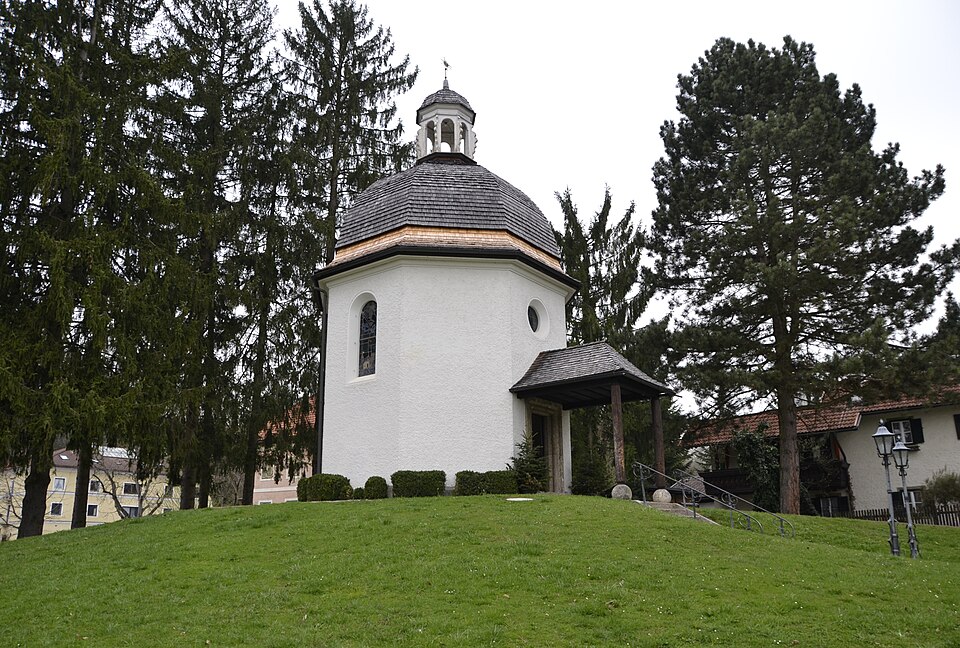
The Silent Night Chapel, Oberndorf, Photograph by High Contrast, chapel built 1924–1937; photographed 2012. Image: Wikimedia Commons, photograph by High Contrast, CC BY 3.0 de Do this: Look at the picture together for a quiet minute before anyone talks.
Read aloud: The chapel is small, only big enough for a few people inside. It was built on the spot where St. Nicholas Church stood, the church where Stille Nacht was first sung. Flooding from the nearby river damaged the old church, so it was torn down, and the town built this memorial chapel in its place.
Point and find:
- What shape is the chapel? Count its sides if you can.
- Find the little bell tower on top.
- What kind of trees grow around it?
- Find the porch at the door.
Ask:
- “Why do you think people built a chapel to remember a song?”
- “What would it be like to sing Stille Nacht here on Christmas Eve?”
Show: Your birthday is in May. Say it in German.
Say this: “Birthday is Geburtstag.”
Say this: “In May is im Mai.”
Answer: Mein Geburtstag ist im Mai.
Show: Which month comes after November?
Say this: “November, then…”
Answer: Dezember.
Do this: Ask out loud. Let your child try first; help only after a real try.
Ask: Say January in German.
Listen for: Januar.
Ask: Say December in German.
Listen for: Dezember.
Ask: What does Monat mean?
Listen for: Month.
3 more on the lesson page.
Read aloud: Make a calendar of birthdays in your family with the German months.
Steps:
- A parent writes one German month in each box: Januar to Dezember.
- Write or draw each family member in the month of his or her birthday.
- Draw a cake for each birthday.
- Mark Christmas in Dezember with a star.
- Tell when each person’s birthday is: Papas Geburtstag ist im Mai.
Tips for you:
- Add your grandparents and cousins.
- Count how many birthdays are in each month.
Done when your child can say:
- My calendar has twelve months in German.
- I can say when my birthday is.
Do this: Your child picks one or more; you write the date.
- In your German notebook, write the twelve months in a column. Circle your birthday month and Dezember.
Read aloud: Germans often sing Zum Geburtstag viel Glück on birthdays, to the same tune as Happy Birthday, and the birthday child may get a cake with candles and a wooden birthday ring.
- Saying Juni and Juli with a j. German j says y.
- Mixing up Juni and Juli. Germans often say Juno and Julei so they don’t get confused!
Write the twelve months on cards and mix them up. Put them in order as fast as you can, saying each month. Then a parent takes one away: which month is missing?
Say this: “Tell me what you learned today.”
Listen for: Say the twelve months in German.; Say when your birthday is: Mein Geburtstag ist im…; Tell the story of the Silent Night chapel.
To every thing there is a season, and a time to every purpose under the heaven:
In the German Bible of Martin Luther (1912 revision), this verse reads: <i lang="de">Ein jegliches hat seine Zeit</i> God made the months and the seasons. Every time of the year has its own work and joy, all under His care.
Spread over the week
3 sessions of 15–20 minutes. Stop while it is still going well.
- Session 1. Warm-up, then read and teach the new idea and the new words. Picture study and show how.
- Session 2. Practice together, then start the project. Finish the project, then the sketchbook.
- Session 3. Narration, the game and the Scripture.