Parent guide · Grade 2 German · Unit 4
Lesson 4.1 Im Wald
Written for the parent. The Read aloud parts are written to your child; read them as they are. Do this parts are for you. Answers for you are marked Listen for.
At a glance
- Time
- 3 sessions of 15–20 minutes
- Goal
- Name forest, tree, deer and stag in German. Look closely at a painting of deer in a forest. Learn the psalm of the deer.
- You need
- Black construction paper with shapes cut out (a parent helps), or clear contact paper
- Colored tissue paper in green, blue, red and yellow
- Glue
- A sketchbook or plain paper, and crayons
- A King James Bible
- Worksheet A · the lesson page (it also has a short video (2:32))
Steps
Do this together: Close your eyes and imagine a deep, green forest. What do you hear? What animals might be hiding there? Today you visit a German forest in words and pictures.
Read aloud: The story. Do you remember Franz Marc, who painted the blue horse? He also loved the deer that lived in the forests near his home in Bavaria. He kept two pet deer in his garden! In this painting, deer rest quietly in the forest. A red-brown deer lies in front with its head turned. A blue deer lies above it, and a little fawn rests in the middle. All around them the forest is broken into shapes of green, blue, red and gold, like pieces of colored glass. Marc wanted to show the forest the way the deer might feel it: peaceful and full of light. A psalm in the Bible says: As the hart panteth after the water brooks, so panteth my soul after thee, O God.
Read aloud: How German sounds. In Wald, the w is v and the d at the end is t: VAHLT. Baum has au, said ow: BOWM. Reh is short and easy: RAY. Hirsch ends with sch: HEERSH. Kuckuck is said just like the bird calls: KOOK-ook.
Read aloud: Say it and move. Stand tall with arms out like branches: der Baum! Spread your arms wide: der Wald! Put fingers on your head like antlers: der Hirsch! Tiptoe quietly: das Reh! Cup your hands: Kuckuck!
Do this: Say each word clearly; your child says it back twice. Point to a picture or the real thing when you can.
- der Wald [dehr VAHLT]: forest
- der Baum [dehr BOWM]: tree
- das Reh [dahs RAY]: deer
- der Hirsch [dehr HEERSH]: stag
- der Kuckuck [dehr KOOK-ook]: cuckoo
- das Blatt [dahs BLAHT]: leaf
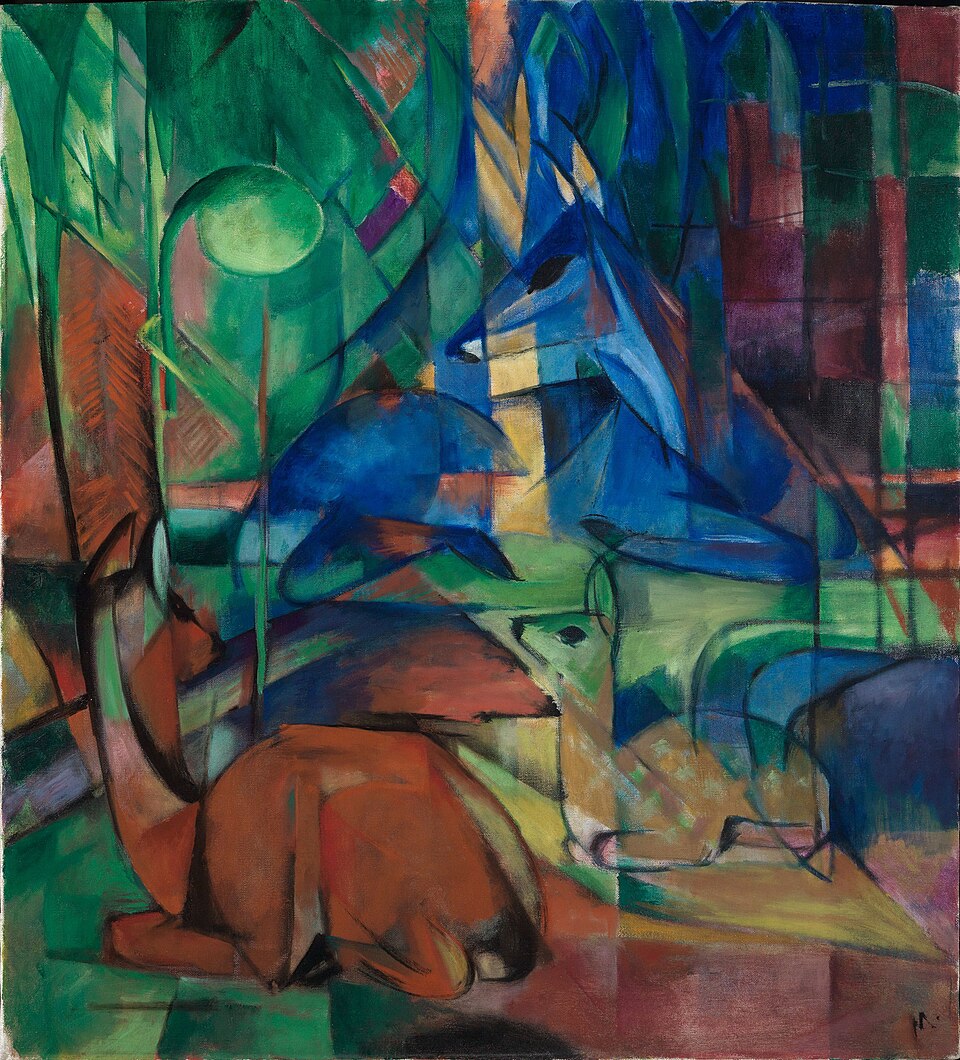
Deer in the Forest II, Franz Marc, 1914. Image: Wikimedia Commons, public domain Do this: Look at the picture together for a quiet minute before anyone talks.
Read aloud: This is one of Franz Marc’s last paintings before he went to war in 1914. Instead of painting each tree and leaf, he broke the forest into sharp shapes and bright colors. The deer are curled up safe and still in the middle of it all. Look for the round green shape at the top left: it might be the top of a small tree, or a patch of sunlight.
Point and find:
- Find the red-brown deer. Is it standing or lying down?
- Find the blue deer.
- Find the little fawn.
- What colors do you see in the forest?
Ask:
- “Does this forest feel noisy or quiet? Why?”
- “Why do you think Marc painted the deer in blue and red?”
Show: What animal has big antlers? Say it in German.
Say this: “The big deer with antlers is the stag.”
Say this: “Stag is der Hirsch.”
Answer: Der Hirsch! (dehr HEERSH)
Show: Many trees together make a… what, in German?
Say this: “Many trees make a forest.”
Say this: “Forest is der Wald.”
Answer: Der Wald! (dehr VAHLT)
Do this: Ask out loud. Let your child try first; help only after a real try.
Ask: Say tree in German.
Listen for: Der Baum.
Ask: Say forest in German.
Listen for: Der Wald.
Ask: Say deer in German.
Listen for: Das Reh.
3 more on the lesson page.
Read aloud: Make a forest window with colored tissue paper, like the shapes in Marc’s painting.
Steps:
- Cut a frame from black paper, or use a sheet of clear contact paper.
- Tear tissue paper into pointed shapes.
- Glue the pieces to fill the frame, overlapping the colors.
- Cut out a deer shape from brown paper and glue it in the middle.
- Hang it in the window and say der Wald, der Baum, das Reh.
Tips for you:
- Add a fox or a bird.
- Label the colors in German.
Done when your child can say:
- My forest window has many colors and a deer.
- I can name the forest and the deer in German.
Do this: Your child picks one or more; you write the date.
- In your German notebook, draw a forest with a deer and a stag. Label der Wald, der Baum, das Reh and der Hirsch.
Read aloud: Germany is about one-third forest. The most famous is the Black Forest, der Schwarzwald, in the southwest, where cuckoo clocks are made. Germans love to go walking in the forest on Sundays.
- Saying Wald with a w. German w says v: VAHLT.
- Saying Baum like bomb. The au says ow: BOWM.
One person hides and calls Kuckuck! every few seconds. The others follow the sound to find the cuckoo. Whoever finds the cuckoo hides next.
Say this: “Tell me what you learned today.”
Listen for: Name forest, tree, deer and stag in German.; Look closely at a painting of deer in a forest.; Learn the psalm of the deer.
To the chief Musician, Maschil, for the sons of Korah. As the hart panteth after the water brooks, so panteth my soul after thee, O God.
In the German Bible of Martin Luther (1912 revision), this verse reads: <i lang="de">Wie der Hirsch schreit nach frischem Wasser, so schreit meine Seele, Gott, zu dir.</i> A thirsty deer longs for fresh water. The psalm writer says his soul longs for God just as much. We need God more than anything.
Spread over the week
3 sessions of 15–20 minutes. Stop while it is still going well.
- Session 1. Warm-up, then read and teach the new idea and the new words. Picture study and show how.
- Session 2. Practice together, then start the project. Finish the project, then the sketchbook.
- Session 3. Narration, the game and the Scripture.