Parent guide · Grade 2 German · Unit 5
Lesson 5.1 Sonne, Mond und Sterne
Written for the parent. The Read aloud parts are written to your child; read them as they are. Do this parts are for you. Answers for you are marked Listen for.
At a glance
- Time
- 3 sessions of 15–20 minutes
- Goal
- Name sky, sun, moon and stars in German. Sing part of Weißt du, wie viel Sternlein stehen. Look closely at a painting of the moon.
- You need
- Dark blue or black paper
- White and yellow paint or crayons, glitter (optional)
- A white crayon or chalk
- A sketchbook or plain paper, and crayons
- A King James Bible
- Worksheet A · the lesson page (it also has a short video (2:51))
Steps
Do this together: Go to the window or outside. What do you see in the sky right now? In the daytime? At night? Today you learn the sky in German.
Read aloud: The story. About two hundred years ago, a painter named Caspar David Friedrich lived in the city of Dresden in Germany. He was a quiet man who loved God and loved to walk alone in the mountains and forests, especially at dawn and at dusk. In this painting, two friends have stopped on a rocky path in the forest at evening. One leans on the other’s shoulder. They stand very still and look at the thin new moon and a bright evening star shining in the golden sky. An old oak tree with twisting roots and branches reaches over them. Friedrich wanted people to feel how great and beautiful God’s creation is, and how small we are. King David felt that too: When I consider thy heavens, the work of thy fingers, the moon and the stars…
Read aloud: How German sounds. Himmel means both sky and heaven: HIM-mel. In Sterne, the st says sht, and the e at the end is soft: SHTEHR-nuh. Wolke starts with a v sound: VOL-kuh. Sternlein means little stars; -lein makes things small, like the -let in booklet.
Read aloud: Say it and move. Sweep your arm across the sky: der Himmel! Make a big circle: die Sonne! Make a C shape with your hand: der Mond! Twinkle your fingers: die Sterne! Puff out your cheeks: die Wolke!
Do this: Say each word clearly; your child says it back twice. Point to a picture or the real thing when you can.
- der Himmel [dehr HIM-mel]: sky; heaven
- die Sonne [dee ZON-nuh]: sun
- der Mond [dehr MOHNT]: moon
- die Sterne [dee SHTEHR-nuh]: stars
- die Wolke [dee VOL-kuh]: cloud
- die Erde [dee EHR-duh]: earth
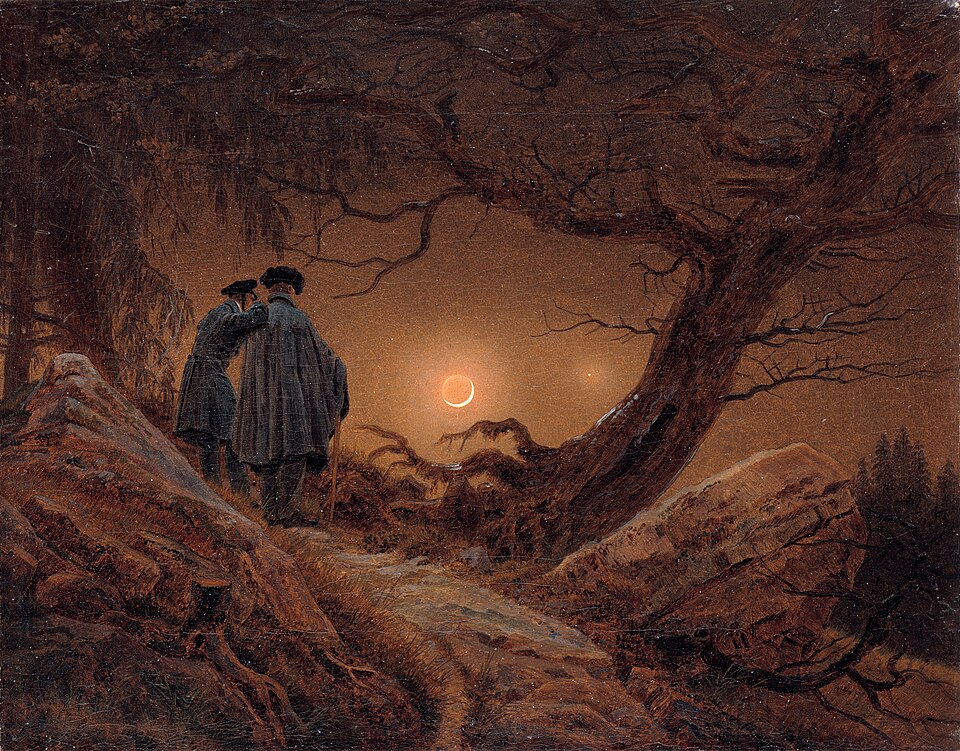
Two Men Contemplating the Moon, Caspar David Friedrich, 1819–1820. Image: Wikimedia Commons, public domain Do this: Look at the picture together for a quiet minute before anyone talks.
Read aloud: Friedrich often painted people from behind, so that we stand with them and look at what they see. The two friends are silent, filled with wonder. The old tree is half uprooted, but still standing. The moon is tiny, but it is the brightest thing in the picture, and everything leads our eyes to it.
Point and find:
- Find the moon. What shape is it?
- Find the bright star near the moon.
- What is one man holding?
- Find the old tree. What do its branches look like?
Ask:
- “What do you think the two friends are thinking about?”
- “Have you ever stopped to look at the moon? How did it make you feel?”
Show: It is night. What do you see in the sky? Say two things in German.
Say this: “At night we see the moon and the stars.”
Answer: Der Mond und die Sterne.
Show: Himmel has two meanings. What are they?
Say this: “It is above us.”
Say this: “It is also where God is.”
Answer: Sky and heaven.
Do this: Ask out loud. Let your child try first; help only after a real try.
Ask: Say sun in German.
Listen for: Die Sonne.
Ask: Say moon in German.
Listen for: Der Mond.
Ask: Say stars in German.
Listen for: Die Sterne.
3 more on the lesson page.
Read aloud: Paint a night sky with a crescent moon and stars, and label it in German.
Steps:
- Paint a thin crescent moon in the sky.
- Add stars with dots of yellow paint or glitter.
- Draw the dark shapes of trees or hills at the bottom.
- With the white crayon, label der Himmel, der Mond and die Sterne.
- Count your stars in German.
Tips for you:
- Add two small people looking up, like Friedrich’s friends.
- Write Weißt du, wie viel Sternlein stehen? across the top.
Done when your child can say:
- My painting has a moon, stars and the night sky.
- I can label them in German.
Do this: Your child picks one or more; you write the date.
- In your German notebook, draw the sky by day and by night. Label die Sonne, die Wolke, der Mond, die Sterne and der Himmel.
Read aloud: Weißt du, wie viel Sternlein stehen was written about two hundred years ago by Wilhelm Hey, a pastor. In the song, God counts the stars, the clouds, the fish and the little birds, and He knows and loves every child too.
- Saying Sterne with st. Say sht: SHTEHR-nuh.
- Saying Wolke with a w. Say v: VOL-kuh.
A parent calls a sky word in German. If it belongs to the day (die Sonne, die Wolke), stand up and stretch. If it belongs to the night (der Mond, die Sterne), crouch and close your eyes. Go faster and faster!
Say this: “Tell me what you learned today.”
Listen for: Name sky, sun, moon and stars in German.; Sing part of Weißt du, wie viel Sternlein stehen.; Look closely at a painting of the moon.
When I consider thy heavens, the work of thy fingers, the moon and the stars, which thou hast ordained;
In the German Bible of Martin Luther (1912 revision), this verse reads: <i lang="de">Wenn ich sehe die Himmel, deiner Finger Werk, den Mond und die Sterne</i> King David looked at the moon and stars and was amazed that the God who made them cares about people. God made the heavens with His fingers, and He cares for you.
Spread over the week
3 sessions of 15–20 minutes. Stop while it is still going well.
- Session 1. Warm-up, then read and teach the new idea and the new words. Picture study and show how.
- Session 2. Practice together, then start the project. Finish the project, then the sketchbook.
- Session 3. Narration, the game and the Scripture.