Parent guide · Grade 3 German · Unit 1
Lesson 1.1 Guten Tag und auf Wiedersehen
Written for the parent. The Read aloud parts are written to your child; read them as they are. Do this parts are for you. Answers for you are marked Listen for.
At a glance
- Time
- 3 sessions of 20–30 minutes
- Goal
- Greet people in German at different times of day.; Say goodbye formally and informally.; Ask and answer Wie geht’s?
- You need
- A paper plate
- A paper arrow and a brass fastener
- Markers
- A sketchbook or plain paper, and crayons
- A King James Bible
- Worksheet A · the lesson page (it also has a short video (3:22))
Steps
Do this together: How many ways can you say hello and goodbye in English? Hi, hello, good morning, bye, see you later… German has many too. Let’s learn them.
Read aloud: The story. About a hundred and fifty years ago, a young painter named Hans Thoma grew up in a small village in the Black Forest, in the southwest of Germany. His family was poor, and as a boy he painted clock faces for the clockmakers of the Black Forest. Later he became one of the most loved painters in Germany. One spring he painted eight village children dancing in a ring on a green meadow full of little yellow flowers. Most of them are barefoot. They hold hands and sing as they go round, with a lake and snowy mountains far behind them. When German children meet to play, they greet each other with Hallo! and when they go home, they call Tschüss!
Read aloud: How German sounds. Germans greet people when they walk into a shop, a waiting room or a home. To grown-ups, say Guten Morgen until about ten o’clock, Guten Tag during the day and Guten Abend in the evening. Hallo and Tschüss are friendly, for family and friends. In southern Germany and Austria, people say Grüß Gott, God greet you. In Auf Wiedersehen, the w says v and ie says ee: owf VEE-der-zayn.
Read aloud: Answering Wie geht’s? You can answer: Gut, danke! (Fine, thanks!) Sehr gut! (Very good!) Es geht. (So-so.) Nicht so gut. (Not so good.) Then ask back: Und dir? (And you?) to a friend, or Und Ihnen? to a grown-up.
Do this: Say each word clearly; your child says it back twice. Point to a picture or the real thing when you can.
- Guten Tag [GOO-tun TAHK]: good day; hello
- Guten Abend [GOO-tun AH-bunt]: good evening
- Grüß Gott [GRÜSS GOT]: hello (God greet you)
- Auf Wiedersehen [owf VEE-der-zayn]: goodbye
- Tschüss [CHÜSS]: bye
- gut [GOOT]: good; well
- Wie geht’s? [vee GAYTS]: How are you?
- danke [DAHN-kuh]: thank you
- sehr gut [zair GOOT]: very good
- Und dir? [oont DEER]: And you? (to a friend)
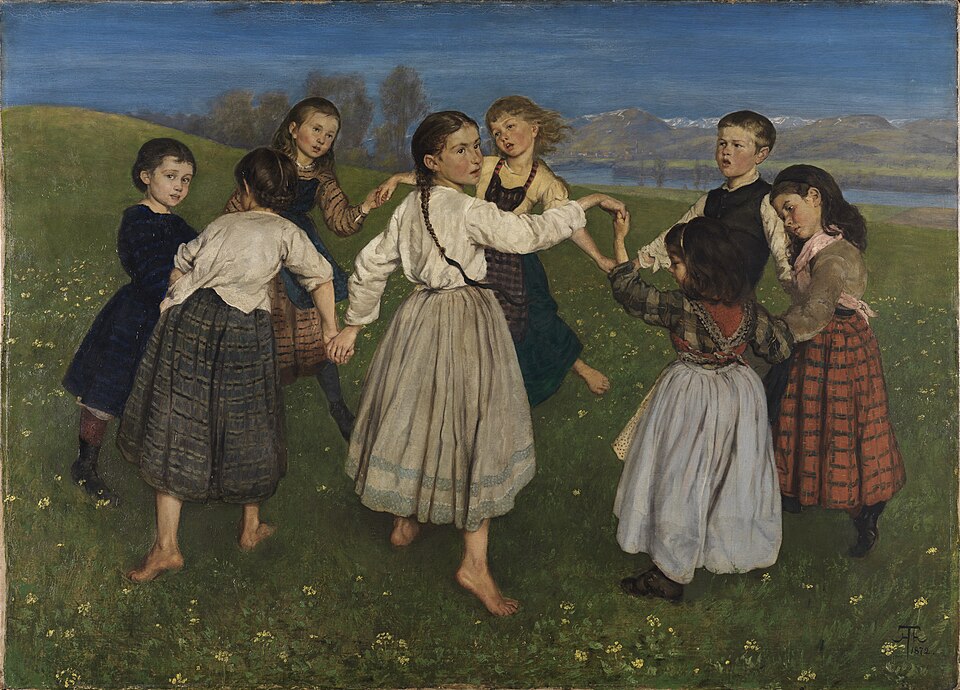
Children Dancing in a Ring, Hans Thoma, 1872. Image: Wikimedia Commons, public domain Do this: Look at the picture together for a quiet minute before anyone talks.
Read aloud: Thoma painted real village children from his home country, not dressed up but in their everyday clothes. The ring of children turns before our eyes: some face us, some have their backs to us, and the blond girl’s hair swings out as she spins. The wide meadow and the far mountains make the children seem small and free.
Point and find:
- Count the children in German.
- Find the girl with the long braid.
- Find the boy. What is he doing with his mouth?
- What do you see far behind the children?
Ask:
- “What song do you think the children are singing?”
- “What games do you play in a circle?”
Show: You meet your piano teacher at 3 in the afternoon. What do you say?
Say this: “It is daytime.”
Say this: “A teacher is a grown-up, so not Hallo.”
Answer: Guten Tag, Frau (or Herr) …!
Show: A friend asks Wie geht’s? You feel great. Answer and ask back.
Say this: “Very good is sehr gut.”
Say this: “And you, to a friend, is und dir?”
Answer: Sehr gut, danke! Und dir?
Do this: Ask out loud. Let your child try first; help only after a real try.
Ask: How do you say good evening?
Listen for: Guten Abend.
Ask: How do you say goodbye politely?
Listen for: Auf Wiedersehen.
Ask: What does Tschüss mean?
Listen for: Bye, to friends and family.
3 more on the lesson page.
Read aloud: Make a paper clock that shows which greeting to use at each time of day.
Steps:
- Divide the plate into morning, day, evening and night.
- Write Guten Morgen, Guten Tag, Guten Abend and Gute Nacht in the four parts.
- Draw a sunrise, a sun, a sunset and a moon.
- Attach the arrow. Turn it and greet your family with the right words.
Tips for you:
- Add Hallo and Tschüss on the back for friends.
- Use the clock every day this week.
Done when your child can say:
- My clock shows four greetings.
- I can use the right greeting for the time.
Do this: Your child picks one or more; you write the date.
- In your German notebook, draw a speech bubble for each greeting: Guten Morgen, Guten Tag, Guten Abend, Hallo, Grüß Gott, Auf Wiedersehen, Tschüss. Write Wie geht’s? and three answers.
Read aloud: Hans Thoma later became director of the art museum in Karlsruhe, the very museum where this painting hangs today.
- Saying Auf Wiedersehen with a w sound. Say owf VEE-der-zayn.
- Saying Guten Morgen in the evening. After about ten in the morning, say Guten Tag.
A parent holds up a card: a sunrise, a sun, a moon, a friend’s face or a grown-up’s face. Give the right German greeting as fast as you can. Then switch roles.
Say this: “Tell me what you learned today.”
Listen for: Greet people in German at different times of day.; Say goodbye formally and informally.; Ask and answer Wie geht’s?
And, behold, Boaz came from Bethlehem, and said unto the reapers, The LORD be with you. And they answered him, The LORD bless thee.
In the Luther Bible (1912): <i lang="de">Der HERR mit euch! Sie antworteten: Der HERR segne dich!</i> Boaz greeted his reapers with a blessing, and they blessed him back. Grüß Gott is like that: a greeting that is also a little prayer.
Spread over the week
3 sessions of 20–30 minutes. Stop while it is still going well.
- Session 1. Warm-up, then read and teach the new idea and the new words. Picture study and show how.
- Session 2. Practice together, then start the project. Finish the project, then the sketchbook.
- Session 3. Narration, the game and the Scripture.