Parent guide · Grade 3 German · Unit 4
Lesson 4.1 Mein Großvater
Written for the parent. The Read aloud parts are written to your child; read them as they are. Do this parts are for you. Answers for you are marked Listen for.
At a glance
- Time
- 3 sessions of 20–30 minutes
- Goal
- Name ten family members in German. Use mein and meine correctly. Study Anker’s Grandfather’s Devotions.
- You need
- A large sheet of paper
- Markers
- Family photos or drawings
- A sketchbook or plain paper, and crayons
- A King James Bible
- Worksheet A · the lesson page (it also has a short video (7:26))
Steps
Do this together: Draw a quick family tree with your grandparents, parents, aunts, uncles and cousins. How many people are on it? Today you learn to name them all in German.
Read aloud: The story. Albert Anker, the Swiss painter who first studied to be a pastor, loved to paint the old and the young together. In this painting an old grandfather sits in an armchair, propped up with pillows. He is too weak to read for himself, so he folds his hands and listens. His grandson sits beside him in a blue shirt and a long work apron and reads aloud from a small book, the daily devotions. A cup sits on the table, and behind them is a big tiled stove to keep the room warm. The boy is honoring his grandfather, just as God commands.
Read aloud: mein and meine. For der words and das words, say mein: mein Vater, mein Onkel, mein Großvater, mein Baby. For die words, say meine: meine Mutter, meine Tante, meine Großmutter. For plurals, also meine: meine Eltern, meine Geschwister. So: Das ist mein Onkel. Das ist meine Tante. Das sind meine Eltern.
Read aloud: How German sounds. Großvater has the long o and the ß: GROHS-fah-ter. Cousin and Cousine are borrowed from French, so they sound French: koo-ZANG, koo-ZEE-nuh. Geschwister is a handy word English lacks: all your brothers and sisters together.
Do this: Say each word clearly; your child says it back twice. Point to a picture or the real thing when you can.
- der Großvater [dehr GROHS-fah-ter]: grandfather
- die Großmutter [dee GROHS-mut-ter]: grandmother
- der Onkel [dehr ONG-kel]: uncle
- die Tante [dee TAHN-tuh]: aunt
- die Eltern [dee EL-tern]: parents
- die Geschwister [dee guh-SHVIS-ter]: brothers and sisters
- der Cousin [dehr koo-ZANG]: cousin (boy)
- die Cousine [dee koo-ZEE-nuh]: cousin (girl)
- mein [MINE]: my (der, das words)
- meine [MY-nuh]: my (die words)
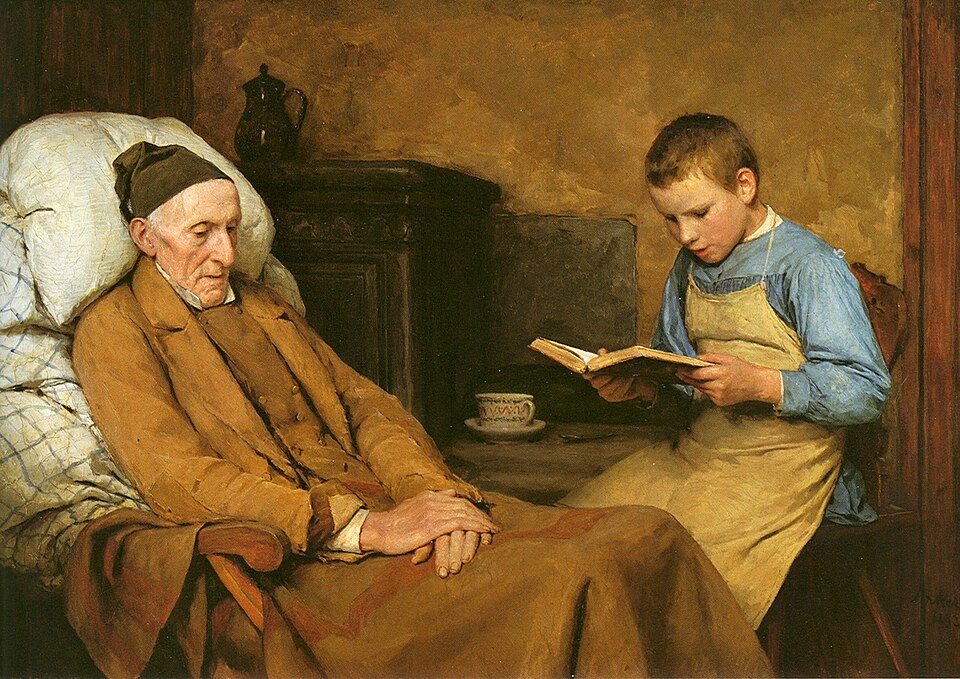
Grandfather’s Devotions, Albert Anker, 1893. Image: Wikimedia Commons, public domain Do this: Look at the picture together for a quiet minute before anyone talks.
Read aloud: Anker painted the old man’s tired face and folded hands with great tenderness. The warm browns and the soft light make the room feel quiet and peaceful. The boy reads carefully, holding the book up to the light. This is how faith was passed down in many Swiss and German homes: the young reading God’s Word to the old.
Point and find:
- What is the boy holding?
- What is the grandfather doing with his hands?
- Find the cup and saucer.
- What colors are the boy’s shirt and apron?
Ask:
- “Why do you think the boy is reading to his grandfather?”
- “How could you help an older person in your family?”
Show: Say This is my grandmother.
Say this: “Grandmother is die Großmutter, a die word.”
Say this: “Die word: meine.”
Answer: Das ist meine Großmutter.
Show: Say These are my parents.
Say this: “Parents is die Eltern, plural.”
Say this: “Plural: meine; and sind for are.”
Answer: Das sind meine Eltern.
Do this: Ask out loud. Let your child try first; help only after a real try.
Ask: Say uncle in German.
Listen for: Der Onkel.
Ask: Say aunt in German.
Listen for: Die Tante.
Ask: What does Geschwister mean?
Listen for: Brothers and sisters.
3 more on the lesson page.
Read aloud: Make a family tree with every person labeled in German.
Steps:
- Draw a tree with roots, a trunk and branches.
- Put your grandparents at the roots, your parents, aunts and uncles on the trunk, and yourself, your brothers, sisters and cousins on the branches.
- Label each person: mein Großvater, meine Tante…
- Present it: Das ist mein Onkel Peter. Das ist meine Cousine Lisa.
Tips for you:
- Add great-grandparents: der Urgroßvater, die Urgroßmutter.
- Write how many people are in each generation in German.
Done when your child can say:
- My tree has at least ten people labeled in German.
- I use mein and meine correctly.
Do this: Your child picks one or more; you write the date.
- In your German notebook, write ten family words with der or die. Write five sentences with Das ist mein… or Das ist meine…
Read aloud: In German-speaking countries many families keep a family Bible with the births, baptisms, weddings and deaths of the family written inside the front cover, sometimes going back two hundred years.
- Saying meine Onkel. Onkel is a der word: mein Onkel.
- Saying the n in Cousin. It is French: koo-ZANG.
A parent asks riddles in German: Wer ist der Bruder von deiner Mutter? (Who is your mother’s brother?) Answer: Mein Onkel! Then you make up riddles for the parent.
Say this: “Tell me what you learned today.”
Listen for: Name ten family members in German.; Use mein and meine correctly.; Study Anker’s Grandfather’s Devotions.
Thy wife shall be as a fruitful vine by the sides of thine house: thy children like olive plants round about thy table.
In the Luther Bible (1912): <i lang="de">deine Kinder wie Ölzweige um deinen Tisch her</i> The psalm pictures a godly home: children gathered round the table like young olive trees. A family that fears the Lord is blessed.
Spread over the week
3 sessions of 20–30 minutes. Stop while it is still going well.
- Session 1. Warm-up, then read and teach the new idea and the new words. Picture study and show how.
- Session 2. Practice together, then start the project. Finish the project, then the sketchbook.
- Session 3. Narration, the game and the Scripture.