Parent guide · Grade 3 German · Unit 5
Lesson 5.1 Die Vögel
Written for the parent. The Read aloud parts are written to your child; read them as they are. Do this parts are for you. Answers for you are marked Listen for.
At a glance
- Time
- 3 sessions of 20–30 minutes
- Goal
- Name birds and bird parts in German. Sing part of Die Vogelhochzeit. Study Dürer’s Wing of a Blue Roller.
- You need
- A real feather (or a picture of a bird’s wing)
- Paper, colored pencils
- A magnifying glass if you have one
- A sketchbook or plain paper, and crayons
- A King James Bible
- Worksheet A · the lesson page (it also has a short video (2:31))
Steps
Do this together: Look out the window or go outside. What birds can you see or hear? What colors are they? Today you learn birds in German.
Read aloud: The story. Albrecht Dürer loved to study God’s creation up close. One day he had the wing of a bird called the blue roller, a bird of the fields and forests with feathers of turquoise, blue and brown. He laid it on a sheet of fine parchment and painted it with watercolors, feather by feather: the soft brown feathers near the body, the shining green and turquoise in the middle, the deep blue and black of the long flight feathers. At the top he wrote 1512, and at the bottom his monogram, A and D. The wing looks so real that you want to stroke it.
Read aloud: Birds in German. German children know the Amsel (blackbird), the Spatz or Sperling (sparrow), die Meise (titmouse), der Storch (stork) and die Eule (owl). A bird has a Schnabel (beak), two Flügel (wings) and many Federn (feathers). Say: Der Vogel hat einen Schnabel und zwei Flügel.
Read aloud: How German sounds. Vogel starts with an f sound: FOH-gel; the plural Vögel adds an Umlaut: FÖ-gel. Flügel has the round ü. Schnabel starts with shn: SHNAH-bel. In the song, fiderallala is just a happy nonsense chorus, like fa-la-la.
Do this: Say each word clearly; your child says it back twice. Point to a picture or the real thing when you can.
- der Vogel [dehr FOH-gel]: bird
- die Feder [dee FAY-der]: feather
- der Flügel [dehr FLÜ-gel]: wing
- der Schnabel [dehr SHNAH-bel]: beak
- die Amsel [dee AHM-zel]: blackbird
- der Storch [dehr SHTORKH]: stork
- die Federn [dee FAY-dern]: feathers
- die Vögel [dee FÖ-gel]: birds
- die Eule [dee OY-luh]: owl
- die Meise [dee MY-zuh]: titmouse
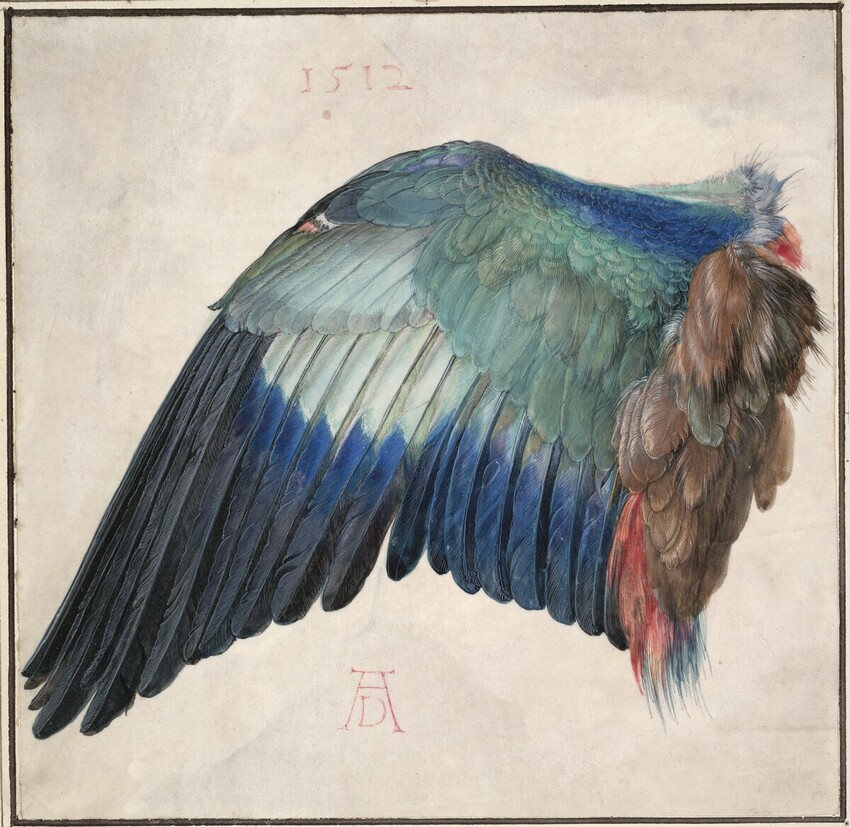
Wing of a Blue Roller, Albrecht Dürer, 1512 (date on the sheet). Image: Wikimedia Commons, public domain Do this: Look at the picture together for a quiet minute before anyone talks.
Read aloud: Dürer painted each feather with tiny brushstrokes, showing how they overlap like roof tiles. The colors change from brown to green to blue as the light catches them. There is no background, nothing but the wing, so we can study it the way a scientist would. Dürer was an artist and a careful observer of God’s world at the same time.
Point and find:
- Find the brown feathers near the body.
- Find the green and turquoise feathers.
- Find the long blue and black feathers.
- Find the date and Dürer’s letters.
Ask:
- “Why do you think Dürer painted only the wing and not the whole bird?”
- “What would you like to paint as carefully as Dürer?”
Show: Say The bird has two wings.
Say this: “Bird is der Vogel; wings are Flügel.”
Say this: “Has is hat.”
Answer: Der Vogel hat zwei Flügel.
Show: What is the plural of der Vogel?
Say this: “Add an Umlaut.”
Answer: Die Vögel.
Do this: Ask out loud. Let your child try first; help only after a real try.
Ask: Say feather in German.
Listen for: Die Feder.
Ask: Say beak in German.
Listen for: Der Schnabel.
Ask: What is eine Amsel?
Listen for: A blackbird.
3 more on the lesson page.
Read aloud: Draw a feather or a wing as carefully as Dürer and label it in German.
Steps:
- Look closely at the feather. Notice the stiff center line and the soft barbs on both sides.
- Draw it large, one line at a time.
- Color it carefully, matching the real colors.
- Label: die Feder. Add a sentence: Die Feder ist braun und weiß.
Tips for you:
- Draw a whole bird and label der Schnabel, der Flügel, der Schwanz (tail).
- Look up which German bird your feather might come from.
Done when your child can say:
- My drawing shows the feather’s details.
- I labeled it in German.
Do this: Your child picks one or more; you write the date.
- In your German notebook, draw a bird and label der Schnabel, der Flügel, die Feder and der Schwanz. Write the names of four German birds.
Read aloud: Storks build huge nests on church towers and chimneys in Germany. Many villages have a stork nest, and people still tell children that the stork brings the babies.
- Saying Vogel with a v sound. Say FOH-gel.
- Forgetting the Umlaut in the plural: die Vögel.
Make bingo cards with pictures of birds and bird parts. A parent calls German words: die Amsel! der Schnabel! Mark the picture. Whoever gets a row first calls Fiderallala!
Say this: “Tell me what you learned today.”
Listen for: Name birds and bird parts in German.; Sing part of Die Vogelhochzeit.; Study Dürer’s Wing of a Blue Roller.
Behold the fowls of the air: for they sow not, neither do they reap, nor gather into barns; yet your heavenly Father feedeth them. Are ye not much better than they?
In the Luther Bible (1912): <i lang="de">Sehet die Vögel unter dem Himmel an</i> Jesus told us to look at the birds. God feeds them every day. If He takes care of them, He will surely take care of you.
Spread over the week
3 sessions of 20–30 minutes. Stop while it is still going well.
- Session 1. Warm-up, then read and teach the new idea and the new words. Picture study and show how.
- Session 2. Practice together, then start the project. Finish the project, then the sketchbook.
- Session 3. Narration, the game and the Scripture.