Parent guide · Grade 1 Biblical Hebrew · Unit 1
Lesson 1.1 Review: Alef to Yod
Written for the parent. The Read aloud parts are written to your child; read them as they are. Do this parts are for you. Answers for you are marked Listen for.
At a glance
- Time
- 3 sessions of 15–20 minutes
- Goal
- Name the ten letters from alef to yod in order. Give a word that begins with at least five of them. Point to the first letter of a Hebrew word (on the right).
- You need
- Ten index cards
- A hole punch and a ring or string
- Crayons
- A sketchbook or plain paper, and crayons
- A King James Bible
- Worksheet A · the lesson page (it also has a short video (2:12))
Steps
Do this together: Lay out ten cards, one for each letter you learned in kindergarten: א ב ג ד ה ו ז ח ט י. Starting at the right, point to each one and say its name. Which ones do you remember? Which ones need a little help?
Read aloud: The ten letters. Alef the ox, bet the house, gimel the camel, dalet the door, he the shout of Behold!, vav the tent peg, zayin the tool, chet the fence, tet the basket, and yod the little hand. Each began as a small picture whose name starts with its sound. In order: א ב ג ד ה ו ז ח ט י.
Read aloud: The story. On the first day, God made light. Then God called the light Day, and the darkness he called Night. In Hebrew, Day is יוֹם, yom, which begins with yod, and Night is לַיְלָה, laylah, which begins with a letter you will meet in Unit 2. And the evening and the morning were the first day.
Read aloud: Say it and move. Do the motion for each letter as you say it: ox horns for alef, a roof for bet, a camel sway for gimel, a door for dalet, arms up for he, a stiff peg for vav, a buzz for zayin, a fence for chet, a thumbs-up for tet (tov!), and a wave for yod.
Do this: Say each word clearly; your child says it back twice. Point to a picture or the real thing when you can.
- יוֹם (yom) [YOHM]: day
- לַיְלָה (laylah) [LAI-lah]: night
- טוֹב (tov) [TOHV]: good
- יָד (yad) [YAHD]: hand
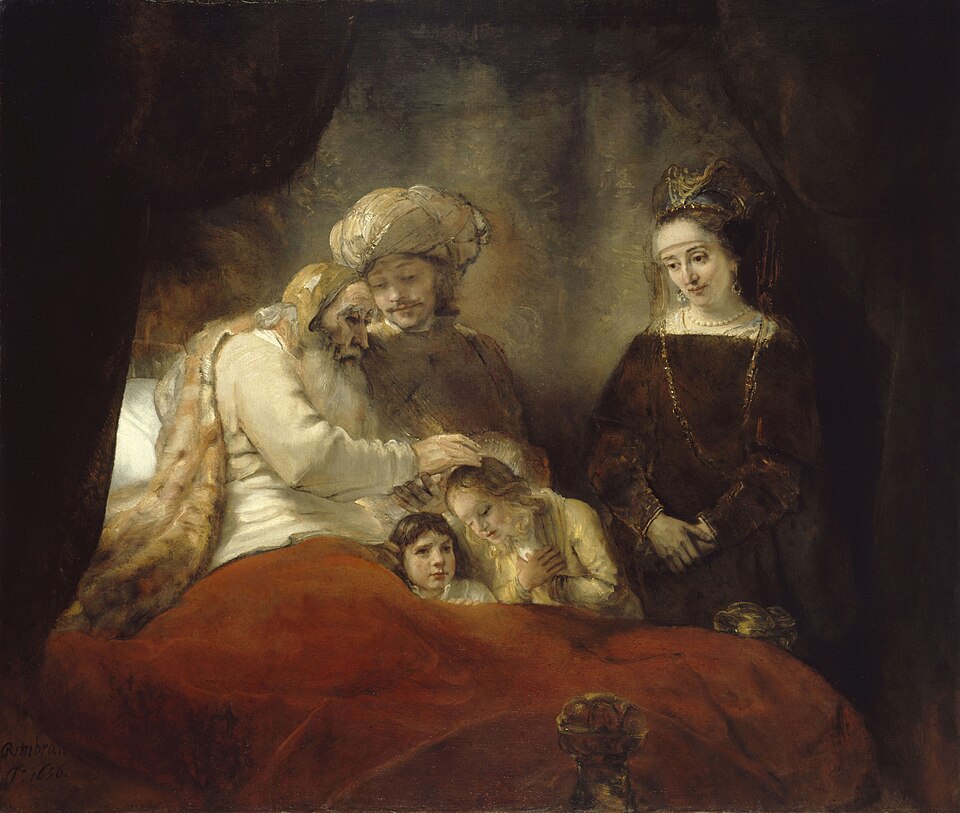
Jacob Blessing the Sons of Joseph, Rembrandt van Rijn, 1656. Image: Wikimedia Commons, public domain Do this: Look at the picture together for a quiet minute before anyone talks.
Read aloud: In Genesis 48, Jacob, very old and nearly blind, blesses Joseph’s two sons, Ephraim and Manasseh. He crosses his hands on purpose to give the younger boy the greater blessing. Rembrandt paints the moment with warm light on the hands and faces.
Point and find:
- Whose head is Jacob’s hand resting on?
- Find Joseph. What is he doing with his hand?
- How is the boy being blessed holding his hands?
- Find the mother. How does she look?
Ask:
- “Why do you think blessings in the Bible were given with the hands?”
- “Who has blessed you?”
Show: Name the letters: ב ד ו
Say this: “Start on the right.”
Say this: “The first is the house, the second the door, the third the peg.”
Answer: Bet, dalet, vav.
Show: Which letter comes between chet and yod?
Say this: “Say them in order: … zayin, chet, ___, yod.”
Answer: Tet.
Show: What is the first letter of יָד?
Say this: “Look at the right end of the word.”
Answer: Yod, י.
Do this: Ask out loud. Let your child try first; help only after a real try.
Ask: Name the first letter on the right: טוֹב
Listen for: Tet.
Ask: Say the letters from alef to he.
Listen for: Alef, bet, gimel, dalet, he.
Ask: What does yom mean?
Listen for: Day.
3 more on the lesson page.
Read aloud: Make a flip book that shows each letter on the front and its picture and word on the back.
Steps:
- On the front of each card, write one letter large (a parent helps): א ב ג ד ה ו ז ח ט י.
- On the back, draw its picture: ox, house, camel, door, a person shouting, peg, tool, fence, basket, hand.
- Write a Hebrew word under the picture if you know one: אָב, בַּיִת, גָּמָל, דֶּלֶת, הַר, זָהָב, חַלּוֹן, טוֹב, יָד.
- Punch a hole in the top right corner and ring the cards together, alef on top.
- Flip through and say each letter, then check the back.
Tips for you:
- Ring the cards on the RIGHT side so the book opens the Hebrew way.
Done when your child can say:
- My flip book has all ten letters in order.
- I can say each letter before I flip.
Do this: Your child picks one or more; you write the date.
- Write the ten letters across a page from right to left.
- Under three of them, draw their pictures.
Read aloud: Hebrew children have learned the alef-bet in order for thousands of years. Several psalms are written in alphabet order so that the letters help the singer remember the words.
- Mixing he ה and chet ח. He has a gap at the top left.
- Mixing vav ו, zayin ז and yod י. Yod is short; vav is tall with a little hook; zayin has a cap.
The parent shows a Hebrew word on a card (טוֹב, יָד, בַּיִת, הַר, דָּוִד). Find the first letter on the right and name it. Score a point for each one, and then make cards for the parent to solve.
Say this: “Tell me what you learned today.”
Listen for: Name the ten letters from alef to yod in order.; Give a word that begins with at least five of them.; Point to the first letter of a Hebrew word (on the right).
And God called the light Day, and the darkness he called Night. And the evening and the morning were the first day.
In Hebrew, from the Leningrad Codex: <span class="heb-block" lang="he" dir="rtl">וַיִּקְרָא אֱלֹהִים לָאוֹר יוֹם</span> This is the end of the first day of creation. Find yom, Day, the fourth word from the right; it begins with yod.
Spread over the week
3 sessions of 15–20 minutes. Stop while it is still going well.
- Session 1. Warm-up, then read and teach the new idea and the new words. Picture study and show how.
- Session 2. Practice together, then start the project. Finish the project, then the sketchbook.
- Session 3. Narration, the game and the Scripture.