Parent guide · Grade 1 Biblical Hebrew · Unit 2
Lesson 2.1 Lamed, the Tall Letter
Written for the parent. The Read aloud parts are written to your child; read them as they are. Do this parts are for you. Answers for you are marked Listen for.
At a glance
- Time
- 3 sessions of 15–20 minutes
- Goal
- Point to lamed and say its name. Say that lamed began as a goad or staff. Say lev (heart), lechem (bread) and laylah (night).
- You need
- Bread dough or pizza dough (homemade or from the store)
- A baking sheet
- An adult for the oven
- A sketchbook or plain paper, and crayons
- A King James Bible
- Worksheet A · the lesson page (it also has a short video (4:52))
Steps
Do this together: Stand up as tall as you can, and then reach one arm even higher. Today’s letter is the tallest of all the Hebrew letters: it reaches up above the top of the line.
Read aloud: The story. In Bible times, farmers ploughed with oxen. To keep them walking straight, the farmer carried a long stick with a point, called a goad, and gave a gentle poke when an ox wandered. The letter lamed may have begun as a picture of that goad or a shepherd’s staff. Bethlehem, the town where David was born and where Jesus was born, is בֵּית לֶחֶם, Beit Lechem: house of bread.
Read aloud: How Hebrew sounds. Lamed says l. It is the only letter that rises above the top of the line, like a staff held high. Say LAH-med, LAYV (heart), LEH-khem (bread), LAI-lah (night).
Read aloud: Say it and move. Hold a pretend goad high above your head: Lamed! Put your hand on your heart: lev! Pretend to eat bread: lechem! Lay your head down: laylah!
Do this: Say each word clearly; your child says it back twice. Point to a picture or the real thing when you can.
- ל (lamed) [LAH-med]: the letter lamed: l
- לֵב (lev) [LAYV]: heart
- לֶחֶם (lechem) [LEH-khem]: bread
- לַיְלָה (laylah) [LAI-lah]: night
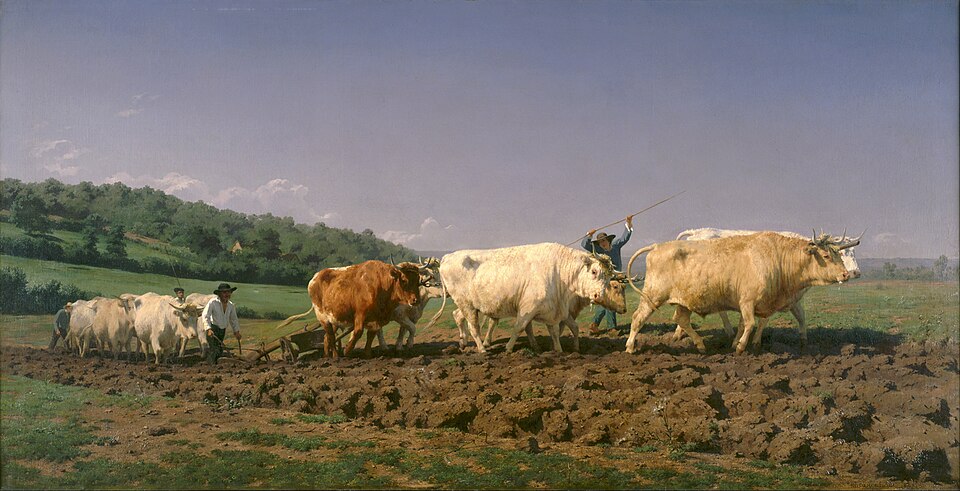
Ploughing in the Nivernais, Rosa Bonheur, 1849. Image: Wikimedia Commons, public domain Do this: Look at the picture together for a quiet minute before anyone talks.
Read aloud: Rosa Bonheur was a French painter who loved animals and studied them closely on farms and in markets. This huge painting shows the autumn ploughing, when the earth is turned over before sowing.
Point and find:
- Find the man holding the long goad. What does it look like?
- How many oxen can you count?
- Look at the earth. Which part has been ploughed?
- Which ox looks the strongest?
Ask:
- “Why would a farmer need a goad?”
- “How is God like a good farmer who guides us?”
Show: Find the tallest letter in בֵּית לֶחֶם.
Say this: “Lamed rises above the line.”
Say this: “It begins the second word.”
Answer: ל, the first letter of the second word (Lechem).
Show: What does lev mean?
Say this: “It begins with lamed.”
Answer: Heart.
Do this: Ask out loud. Let your child try first; help only after a real try.
Ask: Which letter is the tallest?
Listen for: Lamed.
Ask: Say lamed.
Listen for: LAH-med.
Ask: What does lechem mean?
Listen for: Bread.
3 more on the lesson page.
Read aloud: Shape a lamed out of bread dough and bake it.
Steps:
- Roll the dough into a long rope.
- Shape a lamed: a short stroke rising up at the top, then the body, curving down to the left at the bottom.
- Bake it with an adult’s help.
- Before you eat it, say: lamed, lechem!
Tips for you:
- The top stroke of lamed rises above the other letters.
Done when your child can say:
- My lamed reaches up tall.
- I can say lamed and lechem.
Do this: Your child picks one or more; you write the date.
- Write ל tall on a new page, rising above the line. Draw a heart beside לֵב and bread beside לֶחֶם.
Read aloud: Lamed became the Greek lambda and our letter L.
- Writing lamed the same height as the other letters. Its top rises above the line.
- Mixing lechem (bread) and laylah (night). Both begin with lamed; listen to the next sounds.
The parent says a letter name. If it is lamed, stand on tiptoe and stretch up. If it is yod, crouch down small. For any other letter, stand normally. Speed up!
Say this: “Tell me what you learned today.”
Listen for: Point to lamed and say its name.; Say that lamed began as a goad or staff.; Say lev (heart), lechem (bread) and laylah (night).
For ever, O LORD, thy word is settled in heaven.
In Hebrew, from the Leningrad Codex: <span class="heb-block" lang="he" dir="rtl">לְעוֹלָם יְהוָה דְּבָרְךָ נִצָּב בַּשָּׁמָיִם׃</span> This verse begins the lamed part of Psalm 119. The first word, le‘olam, means for ever. Find the tall lamed at the very start.
Spread over the week
3 sessions of 15–20 minutes. Stop while it is still going well.
- Session 1. Warm-up, then read and teach the new idea and the new words. Picture study and show how.
- Session 2. Practice together, then start the project. Finish the project, then the sketchbook.
- Session 3. Narration, the game and the Scripture.