Parent guide · Grade 2 Biblical Hebrew · Unit 3
Lesson 3.1 The Ah Vowels
Written for the parent. The Read aloud parts are written to your child; read them as they are. Do this parts are for you. Answers for you are marked Listen for.
At a glance
- Time
- 3 sessions of 15–20 minutes
- Goal
- Know that Hebrew vowels are little marks under and over the letters. Find patach ַ and qamets ָ and say ah. Read a letter with patach or qamets.
- You need
- Paper
- A marker
- An ink pad or paint
- A sketchbook or plain paper, and crayons
- A King James Bible
- Worksheet A · the lesson page (it also has a short video (4:50))
Steps
Do this together: Write the word “cat” without the a: c_t. Could it be cat, cut or cot? For a long time Hebrew was written without vowels, and readers had to know the words. Then scribes added little vowel marks to help.
Read aloud: The story. In the beginning the earth was dark. And God said, Let there be light: and there was light. In Hebrew, God’s first spoken words are יְהִי אוֹר, yehi or: let there be light. With just a word, God made light. The Bible’s words are powerful because they are God’s words.
Read aloud: How Hebrew sounds. Hebrew letters are mostly consonants. The vowels are tiny marks called points. Today you learn two that both say ah. Patach is a short line under the letter: בַ = vah, בַּ = bah. Qamets looks like a little T under the letter: דָ = dah. Read the letter first, then the vowel under it: d + ah = dah.
Read aloud: Practice. Point to a letter, say its sound, then slide your finger down to the vowel and say ah. Join them: m … ah … mah.
Do this: Say each word clearly; your child says it back twice. Point to a picture or the real thing when you can.
- יָד (yad) [YAHD]: hand
- בַּת (bat) [BAHT]: daughter
- אוֹר (or) [OHR]: light
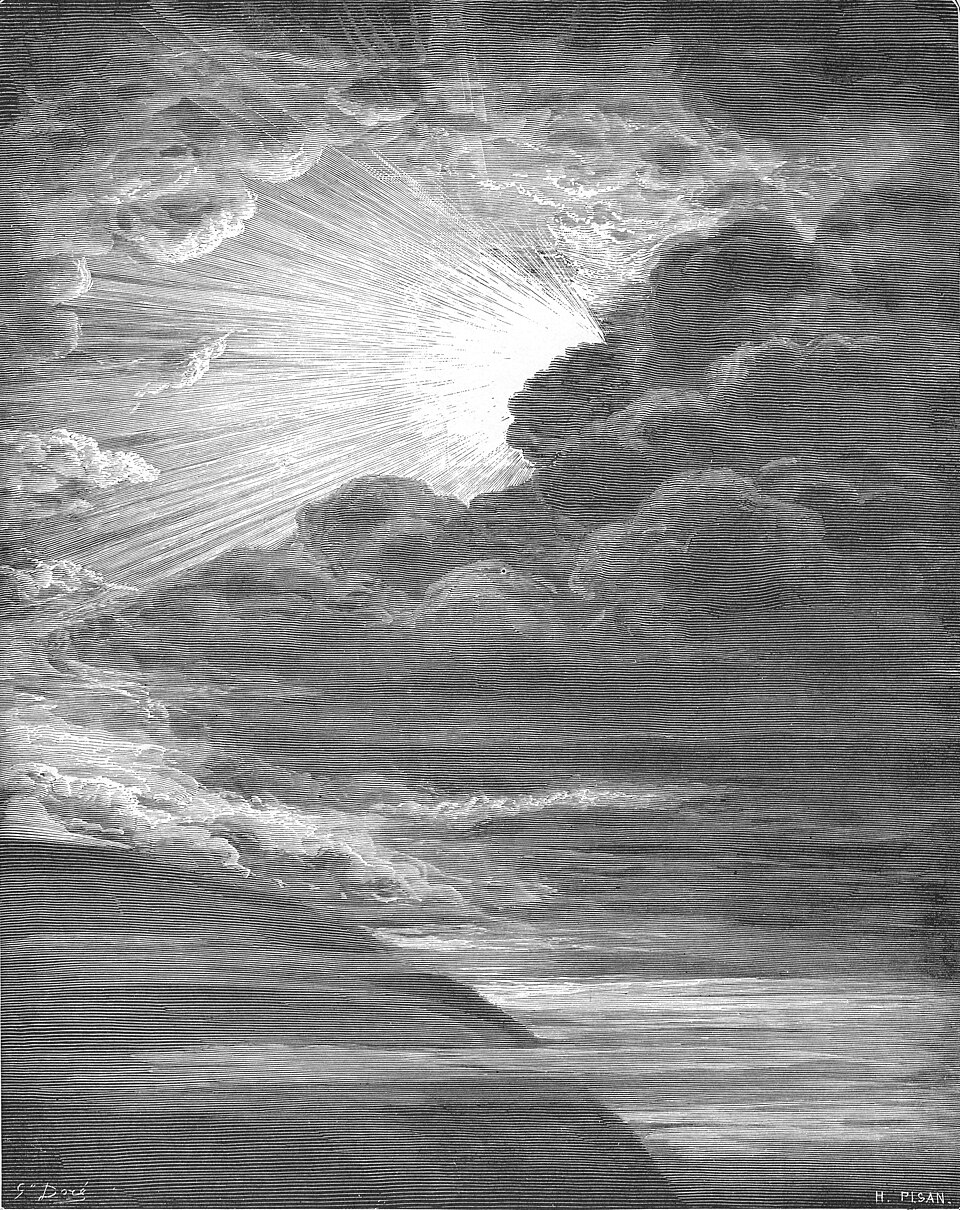
The Creation of Light, Gustave Doré, 1866. Image: Wikimedia Commons, public domain Do this: Look at the picture together for a quiet minute before anyone talks.
Read aloud: This is the first picture in Doré’s great Bible. He did not try to draw God; instead he drew the light itself, breaking through the darkness at God’s word.
Point and find:
- Where is the light coming from?
- Which parts of the picture are still dark?
- Find the sea.
- Why do you think there are no people in this picture?
Ask:
- “What would it have been like to see the first light?”
- “How is God’s word like light?”
Show: Read: מָ
Say this: “The letter is mem: m.”
Say this: “The vowel is qamets: ah.”
Answer: mah.
Show: Read: בַּ
Say this: “The letter is bet with a dot: b.”
Say this: “The vowel is patach: ah.”
Answer: bah.
Show: Read: יָד
Say this: “yod + qamets = yah.”
Say this: “Then dalet: d.”
Answer: yahd (yad, hand).
Do this: Ask out loud. Let your child try first; help only after a real try.
Ask: Read: לָ
Listen for: lah.
Ask: Read: נַ
Listen for: nah.
Ask: Which vowel looks like a little T?
Listen for: Qamets.
3 more on the lesson page.
Read aloud: Use a fingertip to stamp letters and vowels.
Steps:
- Write five letters in a row with space under each: ב ד מ ל נ.
- Under each, draw a qamets (a little T).
- Read: ba, da, ma, la, na.
- In a new row, draw patach (a short line) under each, and read again.
Tips for you:
- The vowel goes under the middle of the letter.
Done when your child can say:
- I wrote five letters with qamets and five with patach.
- I can read them all.
Do this: Your child picks one or more; you write the date.
- Write patach and qamets large and label them ah. Copy יָד and בַּת.
Read aloud: In a Torah scroll read in a synagogue today, there are still no vowel points: the reader must know the words. The points appear in printed Bibles and in books like the Leningrad Codex.
- Saying the vowel before the letter. Read the letter first, then the vowel under it.
- Missing the dot in bet: בּ b, ב v.
Lay letter cards with qamets or patach in a row. Hop to each and read it: bah, dah, gah… If you read it right, you may hop on. Time yourself.
Say this: “Tell me what you learned today.”
Listen for: Know that Hebrew vowels are little marks under and over the letters.; Find patach ַ and qamets ָ and say ah.; Read a letter with patach or qamets.
And God said, Let there be light: and there was light.
In Hebrew, from the Leningrad Codex: <span class="heb-block" lang="he" dir="rtl">וַיֹּאמֶר אֱלֹהִים יְהִי אוֹר</span> These are God’s first spoken words in the Bible. Find the patach under the first letter, vav: va-, and.
Spread over the week
3 sessions of 15–20 minutes. Stop while it is still going well.
- Session 1. Warm-up, then read and teach the new idea and the new words. Picture study and show how.
- Session 2. Practice together, then start the project. Finish the project, then the sketchbook.
- Session 3. Narration, the game and the Scripture.