Parent guide · Grade 3 Biblical Hebrew · Unit 1
Lesson 1.1 Review: Letters and Four Vowels
Written for the parent. The Read aloud parts are written to your child; read them as they are. Do this parts are for you. Answers for you are marked Listen for.
At a glance
- Time
- 3 sessions of 20–30 minutes
- Goal
- Read all 22 letters and the dagesh pairs. Read patach, qamets, segol and tsere under any letter. Read Psalm 126:5 word by word with help.
- You need
- Small envelopes or folded paper
- Dried beans
- A marker
- A sketchbook or plain paper, and crayons
- A King James Bible
- Worksheet A · the lesson page (it also has a short video (2:12))
Steps
Do this together: Grab a handful of dried beans and pretend to sow seed across the floor, the way farmers did before machines. In Bible times farmers sowed by hand, and harvest came months later.
Read aloud: The story. When God brought His people home from captivity in Babylon, they sang Psalm 126: They that sow in tears shall reap in joy. Sowing seed is hard work, and the harvest is slow to come. But God brings joy in the end. Learning to read Hebrew is a little like sowing: one letter and one vowel at a time, and then the joy of reading God’s word.
Read aloud: Review. The letters: א ב ג ד ה ו ז ח ט י כ ל מ נ ס ע פ צ ק ר ש ת. The dot pairs: בּ ב b v, כּ כ k kh, פּ פ p f, שׁ שׂ sh s. The vowels: בַ בָ ah, בֶ eh, בֵ ey.
Read aloud: Read it. בָּ דָּ גָּ bah dah gah; מֶ לֶ meh leh; שֵׁ בֵּ shey bey; הַר דָּג מֶלֶךְ בֵּן har, dag, melekh, ben.
Do this: Say each word clearly; your child says it back twice. Point to a picture or the real thing when you can.
- מֶלֶךְ (melekh) [MEH-lekh]: king
- בֵּן (ben) [BAYN]: son
- הַר (har) [HAHR]: mountain
- זָרַע (zara‘) [zah-RAH]: he sowed
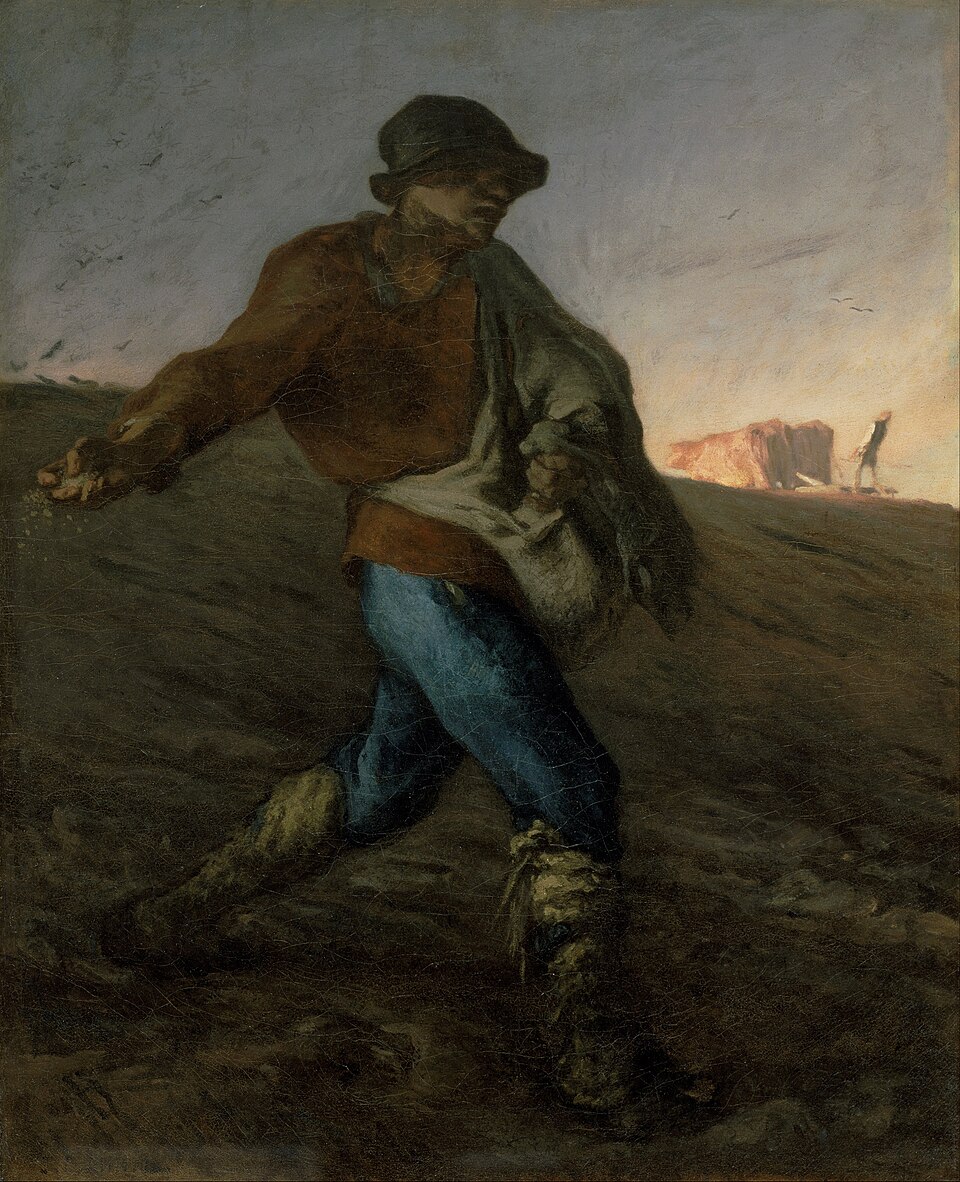
The Sower, Jean-François Millet, 1850. Image: Wikimedia Commons, public domain Do this: Look at the picture together for a quiet minute before anyone talks.
Read aloud: Millet grew up on a farm in Normandy and painted the hard work of country people with great respect. The Sower reminded many people of Jesus’ parable of the sower, whose seed is the word of God (Luke 8:11).
Point and find:
- What is the sower doing with his right hand?
- Find the bag of seed.
- Find the man ploughing in the distance.
- What time of day is it?
Ask:
- “Why does the sower walk so boldly?”
- “How is reading God’s word like sowing seed?”
Show: Read: מֶלֶךְ
Say this: “mem + segol = meh.”
Say this: “lamed + segol = leh.”
Say this: “end-kaf = kh.”
Answer: MEH-lekh (king).
Show: Read: בְּרִנָּה
Say this: “The first beat is a quick be-.”
Say this: “resh + hireq = ree; nun with dagesh + qamets = nah; he is silent.”
Answer: be-reen-NAH (with joy). Hireq is the new vowel in Lesson 1.2.
Do this: Ask out loud. Let your child try first; help only after a real try.
Ask: Read: דָּ
Listen for: dah.
Ask: Read: לֶ
Listen for: leh.
Ask: Read: שֵׁ
Listen for: shey.
3 more on the lesson page.
Read aloud: Make seed packets labeled with Hebrew syllables.
Steps:
- Write one syllable on each packet: בַּ, בֶּ, בֵּ, דָּ, מֶ, לֵ, שָׁ, נַ.
- Put a few beans in each.
- Read each packet before you “sow” its beans into a pot.
Tips for you:
- Read the letter, then the vowel under it.
Done when your child can say:
- I read all eight packets.
- I know which vowels say ah, eh and ey.
Do this: Your child picks one or more; you write the date.
- Write the four vowels under the letter bet and read them: בַּ בָּ בֶּ בֵּ.
Read aloud: Psalm 126 is one of the fifteen “Songs of Degrees” (Psalms 120–134), probably sung by pilgrims going up to Jerusalem.
- Forgetting the dagesh: בּ b, ב v.
- Mixing segol (three dots) and tsere (two dots).
Make a 3×3 bingo card of syllables (בַּ בֶּ בֵּ דָּ דֶּ דֵּ מַ מֶ מֵ). The parent calls out sounds; cover the matching syllable. Three in a row wins.
Say this: “Tell me what you learned today.”
Listen for: Read all 22 letters and the dagesh pairs.; Read patach, qamets, segol and tsere under any letter.; Read Psalm 126:5 word by word with help.
They that sow in tears shall reap in joy.
Hebrew (Westminster Leningrad Codex, vowel points shown, cantillation marks left out): <span class="heb-block" lang="he" dir="rtl">הַזֹּרְעִים בְּדִמְעָה בְּרִנָּה יִקְצֹרוּ׃</span> Four Hebrew words: hazzor‘im (they that sow), bedim‘ah (in tears), berinnah (in joy), yiqtsoru (shall reap). Read the vowels you know in each.
Spread over the week
3 sessions of 20–30 minutes. Stop while it is still going well.
- Session 1. Warm-up, then read and teach the new idea and the new words. Picture study and show how.
- Session 2. Practice together, then start the project. Finish the project, then the sketchbook.
- Session 3. Narration, the game and the Scripture.