Parent guide · Grade 3 Biblical Hebrew · Unit 4
Lesson 4.1 Reading Bible Names
Written for the parent. The Read aloud parts are written to your child; read them as they are. Do this parts are for you. Answers for you are marked Listen for.
At a glance
- Time
- 3 sessions of 20–30 minutes
- Goal
- Read Bible names syllable by syllable. Find God’s name, -el or -yah, inside names. Read the names in Daniel 1:6.
- You need
- Paper strips
- Markers
- Tape
- A sketchbook or plain paper, and crayons
- A King James Bible
- Worksheet A · the lesson page (it also has a short video (2:07))
Steps
Do this together: Do you know what your name means? Many Bible names have meanings, and many contain a name of God. Today you will read the names of Bible heroes in Hebrew.
Read aloud: The story. When Daniel and his friends were taken to Babylon as young men, the king’s officer gave them new Babylonian names. But their Hebrew names told the truth about them: Daniel, God is my judge; Hananiah, the LORD is gracious; Mishael, who is like God?; Azariah, the LORD has helped. Even in a foreign land, they stayed faithful to God, and God shut the lions’ mouths for Daniel.
Read aloud: Reading names. Read syllable by syllable: אַבְרָהָם av-rah-HAHM; יִצְחָק yits-KHAHK; מֹשֶׁה moh-SHEH; שְׁמוּאֵל sh’moo-AYL; דָּנִיֵּאל dah-nee-YAYL. Names usually lean on the last syllable.
Read aloud: God in the names. אֵל (El) means God: Shemu-el, Dani-el, Yisra-el. -yah is a short form of the LORD’s name: Hanan-yah, Azar-yah. Hallelu-yah means praise the LORD.
Do this: Say each word clearly; your child says it back twice. Point to a picture or the real thing when you can.
- אֵל (El) [AYL]: God
- דָּנִיֵּאל (Daniyyel) [dah-nee-YAYL]: Daniel
- יִצְחָק (Yitschaq) [yits-KHAHK]: Isaac
- אַבְרָהָם (Avraham) [av-rah-HAHM]: Abraham
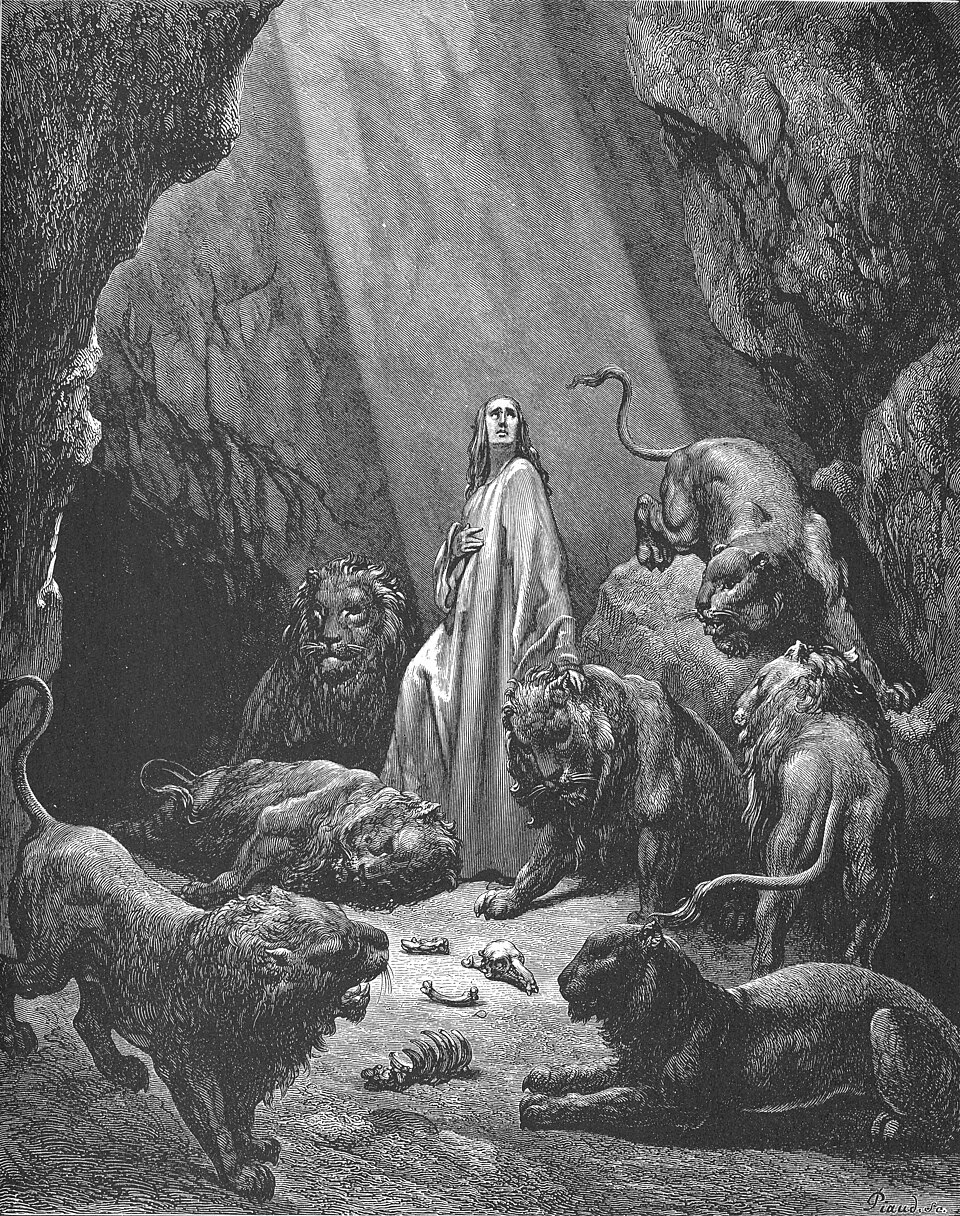
Daniel in the Lions’ Den, Gustave Doré, 1866. Image: Wikimedia Commons, public domain Do this: Look at the picture together for a quiet minute before anyone talks.
Read aloud: Doré shows Daniel completely calm, looking up toward God, while the lions around him do nothing. Daniel told the king: My God hath sent his angel, and hath shut the lions’ mouths (Daniel 6:22).
Point and find:
- Where is the light coming from?
- Count the lions.
- How is Daniel standing?
- Find the bones on the floor.
Ask:
- “Why is Daniel not afraid?”
- “What does Daniel’s name tell us about his faith?”
Show: Read: יִצְחָק
Say this: “yod + hireq = yi; tsade + silent shewa = ts: yits.”
Say this: “chet + qamets = khah; qof = k.”
Answer: yits-KHAHK (Isaac).
Show: Find God’s name in מִישָׁאֵל.
Say this: “Look at the end.”
Answer: -el (God): Mishael, who is like God?
Do this: Ask out loud. Let your child try first; help only after a real try.
Ask: Read: דָּוִד
Listen for: dah-VEED (David).
Ask: Read: מֹשֶׁה
Listen for: moh-SHEH (Moses).
Ask: What does El mean?
Listen for: God.
3 more on the lesson page.
Read aloud: Make paper crowns for Bible heroes with their Hebrew names.
Steps:
- Write a Hebrew name on each strip: דָּנִיֵּאל, דָּוִד, מֹשֶׁה, שְׁמוּאֵל.
- Under it, write its sound and meaning.
- Tape into crowns and wear them for a Bible-hero play.
Tips for you:
- Read each name syllable by syllable before you write it.
Done when your child can say:
- My crowns have four Hebrew names.
- I can read and explain them.
Do this: Your child picks one or more; you write the date.
- Copy the names in Daniel 1:6 and circle -el and -yah.
Read aloud: English Bible names come to us through Greek and Latin: Yitschaq became Isaac, Moshe became Moses, and Yehoshua became Joshua, and in Greek, Jesus.
- Stressing the first syllable as in English (DAN-iel). Hebrew leans on the last: dah-nee-YAYL.
- Reading the silent shewa in יִצְחָק.
The parent reads a Hebrew name card silently and gives a clue (“I fought a giant”). Guess the hero, then read the card.
Say this: “Tell me what you learned today.”
Listen for: Read Bible names syllable by syllable.; Find God’s name, -el or -yah, inside names.; Read the names in Daniel 1:6.
Now among these were of the children of Judah, Daniel, Hananiah, Mishael, and Azariah:
Hebrew (Westminster Leningrad Codex, vowel points shown, cantillation marks left out): <span class="heb-block" lang="he" dir="rtl">דָּנִיֵּאל חֲנַנְיָה מִישָׁאֵל וַעֲזַרְיָה</span> Find the four names at the end: Daniyyel, Chananyah, Misha’el, ‘Azaryah. Two end in -el and two in -yah.
Spread over the week
3 sessions of 20–30 minutes. Stop while it is still going well.
- Session 1. Warm-up, then read and teach the new idea and the new words. Picture study and show how.
- Session 2. Practice together, then start the project. Finish the project, then the sketchbook.
- Session 3. Narration, the game and the Scripture.