Parent guide · Grade 1 Mandarin · Unit 1
Lesson 1.1 谢谢 and 对不起: Thank You and Sorry
Written for the parent. The Read aloud parts are written to your child; read them as they are. Do this parts are for you. Answers for you are marked Listen for.
At a glance
- Time
- 3 sessions of 15–20 minutes
- Goal
- Say 谢谢 (thank you) and answer 不客气 (you’re welcome). Say 对不起 (sorry) and answer 没关系 (that’s all right). Remember to be kind with words, as God is kind to us.
- You need
- Index cards or paper
- Crayons
- A sketchbook or plain paper, and crayons
- A King James Bible
- Worksheet A · the lesson page (it also has a short video (5:16))
Steps
Do this together: Act it out: the parent drops a spoon, and the child picks it up and hands it back. What do we say? Kind words are like gifts we give each other.
Read aloud: The story. The Bible says, “Be ye kind one to another.” Kind words make a home happy. In China, as in our homes, children learn to say thank you and sorry, and to answer kindly when someone else says them.
Read aloud: How Chinese works. Polite words come in pairs. When someone says 谢谢, answer 不客气. When someone says 对不起, answer 没关系.
Read aloud: Say it out loud. xièxie (SHYEH-shyeh), bú kèqi (boo-KUH-chee), duìbuqǐ (dway-boo-CHEE), méi guānxi (may-GWAHN-shee). Practice the pairs with a parent.
Do this: Say each word clearly; your child says it back twice. Point to a picture or the real thing when you can.
- 谢谢 (xièxie) [SHYEH-shyeh]: thank you
- 不客气 (bú kèqi) [boo KUH-chee]: you’re welcome
- 对不起 (duìbuqǐ) [dway-boo-CHEE]: sorry; excuse me
- 没关系 (méi guānxi) [may GWAHN-shee]: that’s all right
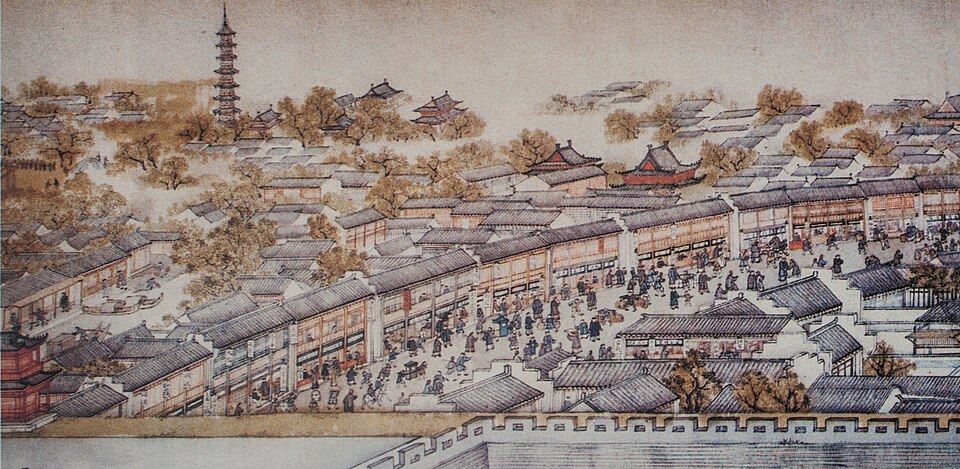
Prosperous Suzhou (detail: Changmen Street), Xu Yang, 1759 (Qing dynasty). Image: Wikimedia Commons, public domain Do this: Look at the picture together for a quiet minute before anyone talks.
Read aloud: Xu Yang was a painter from the city of Suzhou who worked for the emperor about two hundred and sixty years ago. He painted his whole hometown on one very long scroll: canals, bridges, boats and busy shops, with thousands of tiny people going about their day.
Point and find:
- Find someone carrying something on a pole across his shoulders.
- Find the shop signs. What do you think they sell?
- Find two people who look like they are greeting each other.
- Can you see water? Boats?
Ask:
- “What polite words do you think people used in these shops?”
- “Would you like to visit this street? What would you buy?”
Show: Your sister gives you a crayon. What do you say? What does she answer?
Say this: “A gift: say thank you.”
Say this: “The answer to 谢谢 is 不客气.”
Answer: 谢谢! 不客气!
Show: You step on Dad’s toe by accident. What do you say? What does Dad answer?
Say this: “An accident: say sorry.”
Say this: “The answer to 对不起 is 没关系.”
Answer: 对不起! 没关系!
Do this: Ask out loud. Let your child try first; help only after a real try.
Ask: Say thank you in Chinese.
Listen for: 谢谢 (xièxie).
Ask: Say sorry in Chinese.
Listen for: 对不起 (duìbuqǐ).
Ask: Someone says 谢谢 to you. What do you say?
Listen for: 不客气 (bú kèqi).
2 more on the lesson page.
Read aloud: Make four little cards with polite words to use all week.
Steps:
- A parent writes 谢谢, 不客气, 对不起 and 没关系 on four cards, with pinyin.
- Draw a picture on each: a gift, a smile, a bump, a hug.
- Put them on the fridge.
- Each time you use one this week, put a sticker on it.
Tips for you:
- Use the words for real, not just in practice.
Done when your child can say:
- I made four cards.
- I used the words this week.
Do this: Your child picks one or more; you write the date.
- Draw someone giving you a gift. Write or trace 谢谢 under the picture.
Read aloud: In China, it is polite to give and receive a gift with both hands. Try it: hold out a gift with two hands and say 请 (please, here you are).
- Answering 谢谢 with 谢谢. The answer is 不客气.
- Saying 不客气 with bù. Before kè, 不 is said bú.
The parent says one word of a pair, and the child answers with the other: 谢谢 → 不客气; 对不起 → 没关系. Speed up, then switch.
Say this: “Tell me what you learned today.”
Listen for: Say 谢谢 (thank you) and answer 不客气 (you’re welcome).; Say 对不起 (sorry) and answer 没关系 (that’s all right).; Remember to be kind with words, as God is kind to us.
And be ye kind one to another, tenderhearted, forgiving one another, even as God for Christ’s sake hath forgiven you.
In the Chinese Bible (Chinese Union Version), this verse reads: <span class="zh-block" lang="zh-Hans">并要以恩慈相待,存怜悯的心,彼此饶恕</span><span class="py-line">Bìng yào yǐ ēn cí xiāng dài, cún lián mǐn de xīn, bǐ cǐ ráo shù</span> God tells us to be kind and to forgive one another, because God forgave us in Christ.
Spread over the week
3 sessions of 15–20 minutes. Stop while it is still going well.
- Session 1. Warm-up, then read and teach the new idea and the new words. Picture study and show how.
- Session 2. Practice together, then start the project. Finish the project, then the sketchbook.
- Session 3. Narration, the game and the Scripture.