Parent guide · Grade 1 Mandarin · Unit 2
Lesson 2.1 爸爸 妈妈: Dad, Mom, Brothers and Sisters
Written for the parent. The Read aloud parts are written to your child; read them as they are. Do this parts are for you. Answers for you are marked Listen for.
At a glance
- Time
- 3 sessions of 15–20 minutes
- Goal
- Say 爸爸, 妈妈, 哥哥, 姐姐, 弟弟 and 妹妹. Say 这是我的… (this is my…). Know that Chinese has different words for older and younger brothers and sisters.
- You need
- Paper strips or an old glove
- Crayons and tape
- A sketchbook or plain paper, and crayons
- A King James Bible
- Worksheet A · the lesson page (it also has a short video (5:43))
Steps
Do this together: Hold up a family photo. Who is this? Who is that? Today we learn to name our family in Chinese.
Read aloud: The story. God made families. He gave children a father and a mother to love and teach them. In Chinese families, children show respect by calling each person by a family title.
Read aloud: How Chinese works. Chinese does not have just one word for brother: an older brother is 哥哥 and a younger brother is 弟弟. Sisters too: 姐姐 (older) and 妹妹 (younger). Most family words say the same sound twice.
Read aloud: Say it out loud. To introduce someone, say 这是我的 + the family word: 这是我的爸爸 (this is my dad).
Do this: Say each word clearly; your child says it back twice. Point to a picture or the real thing when you can.
- 爸爸 (bàba) [BAH-bah]: dad
- 妈妈 (māma) [MAH-mah]: mom
- 哥哥 (gēge) [GUH-guh]: older brother
- 姐姐 (jiějie) [JYEH-jyeh]: older sister
- 弟弟 (dìdi) [DEE-dee]: younger brother
- 妹妹 (mèimei) [MAY-may]: younger sister
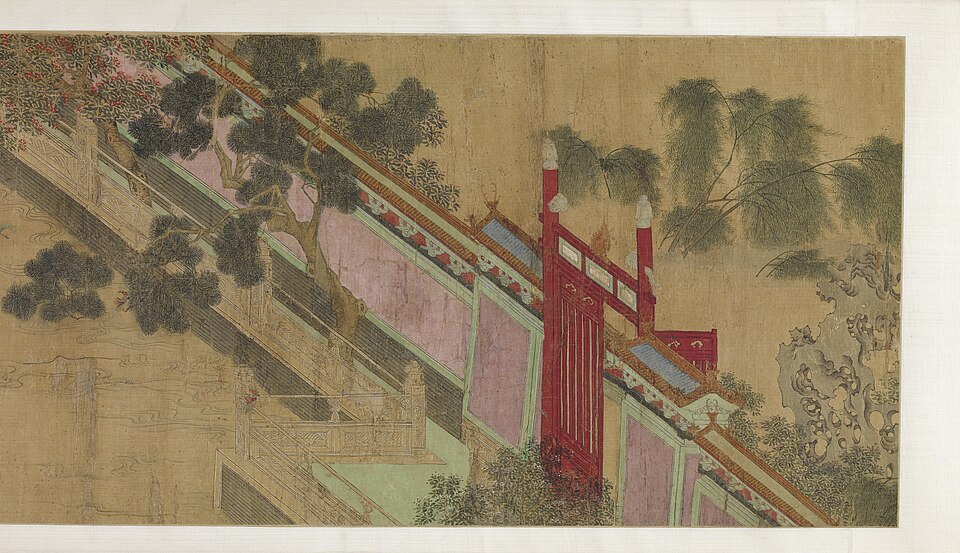
Spring Morning in the Han Palace (copy), after Qiu Ying, Qing dynasty copy of a Ming painting. Image: Wikimedia Commons, public domain Do this: Look at the picture together for a quiet minute before anyone talks.
Read aloud: Qiu Ying was a famous painter about five hundred years ago. This long scroll, copied by a later artist, shows a palace household on a spring morning: mothers, sisters and children busy with music, games and chores.
Point and find:
- Find a child. Who is looking after the child?
- Find someone playing music.
- What colors do the robes have?
- Find a tree with blossoms.
Ask:
- “Who do you think is the oldest person here?”
- “What would your family be doing on a spring morning?”
Show: Ben is older than you. What do you call him if he is your brother?
Say this: “An older brother.”
Say this: “Older brother is 哥哥.”
Answer: 哥哥 (gēge).
Show: Introduce your mom in Chinese.
Say this: “This is my… = 这是我的…”
Say this: “Mom is 妈妈.”
Answer: 这是我的妈妈.
Do this: Ask out loud. Let your child try first; help only after a real try.
Ask: Say Dad in Chinese.
Listen for: 爸爸 (bàba).
Ask: Say Mom in Chinese.
Listen for: 妈妈 (māma).
Ask: What is a younger sister in Chinese?
Listen for: 妹妹 (mèimei).
2 more on the lesson page.
Read aloud: Make a puppet for each person in your family.
Steps:
- Draw a face for each family member on a paper strip.
- Tape each strip into a ring that fits a finger.
- A parent writes the Chinese word on each.
- Wiggle each finger and say 这是我的…
Tips for you:
- Use the right word: older or younger.
Done when your child can say:
- I made a puppet for each person.
- I introduced my family in Chinese.
Do this: Your child picks one or more; you write the date.
- Draw your family. Label each person with the Chinese word.
Read aloud: In Chinese, even cousins and friends’ children are often called 哥哥 or 姐姐 if they are older. It is a way of showing honor and closeness.
- Mixing 哥哥 (older brother) and 弟弟 (younger brother). Ask: is he older or younger than me?
- Saying 妈妈 with two strong beats. The second ma is light.
The parent pretends to be a family member (a deep voice for 爸爸, a cane for 爷爷…). The child guesses in Chinese.
Say this: “Tell me what you learned today.”
Listen for: Say 爸爸, 妈妈, 哥哥, 姐姐, 弟弟 and 妹妹.; Say 这是我的… (this is my…).; Know that Chinese has different words for older and younger brothers and sisters.
Children, obey your parents in the Lord: for this is right.
In the Chinese Bible (Chinese Union Version), this verse reads: <span class="zh-block" lang="zh-Hans">你们作儿女的,要在主里听从父母,这是理所当然的。</span><span class="py-line">Nǐ men zuò ér nǚ de, yào zài zhǔ lǐ tīng cóng fù mǔ, zhè shì lǐ suǒ dāng rán de.</span> God asks children to obey their parents in the Lord. It is right, and it pleases God.
Spread over the week
3 sessions of 15–20 minutes. Stop while it is still going well.
- Session 1. Warm-up, then read and teach the new idea and the new words. Picture study and show how.
- Session 2. Practice together, then start the project. Finish the project, then the sketchbook.
- Session 3. Narration, the game and the Scripture.