Parent guide · Grade 1 Mandarin · Unit 4
Lesson 4.1 苹果 香蕉: Fruit, and 我要
Written for the parent. The Read aloud parts are written to your child; read them as they are. Do this parts are for you. Answers for you are marked Listen for.
At a glance
- Time
- 3 sessions of 15–20 minutes
- Goal
- Say 苹果 (apple), 香蕉 (banana), 西瓜 (watermelon) and 葡萄 (grapes). Ask with 我要… (I want…). Say 我不要 (I don’t want) politely.
- You need
- Several fruits
- A bowl, a spoon, a child-safe knife
- A grown-up helper
- A sketchbook or plain paper, and crayons
- A King James Bible
- Worksheet A · the lesson page (it also has a short video (0:41))
Steps
Do this together: Put out a bowl of fruit. Which one would you like? Point to it. Today we learn how to ask for it in Chinese.
Read aloud: The story. God filled the garden of Eden with trees “good for food.” The Bible also talks about another kind of fruit: the fruit of the Spirit, love, joy and peace, that grows in the lives of God’s people.
Read aloud: How Chinese works. To ask for something, say 我要 + the thing: 我要香蕉 (I want a banana). To say no, put 不 in front: 我不要. Add 请 or 谢谢 to be polite.
Read aloud: Say it out loud. píngguǒ (ping-GWOH), xiāngjiāo (shyahng-JYOW), xīguā (shee-GWAH), pútao (POO-tow). 我要苹果, 谢谢!
Do this: Say each word clearly; your child says it back twice. Point to a picture or the real thing when you can.
- 苹果 (píngguǒ) [ping-GWOH]: apple
- 香蕉 (xiāngjiāo) [shyahng-JYOW]: banana
- 西瓜 (xīguā) [shee-GWAH]: watermelon
- 葡萄 (pútao) [POO-tow]: grapes
- 要 (yào) [yow (falling)]: to want
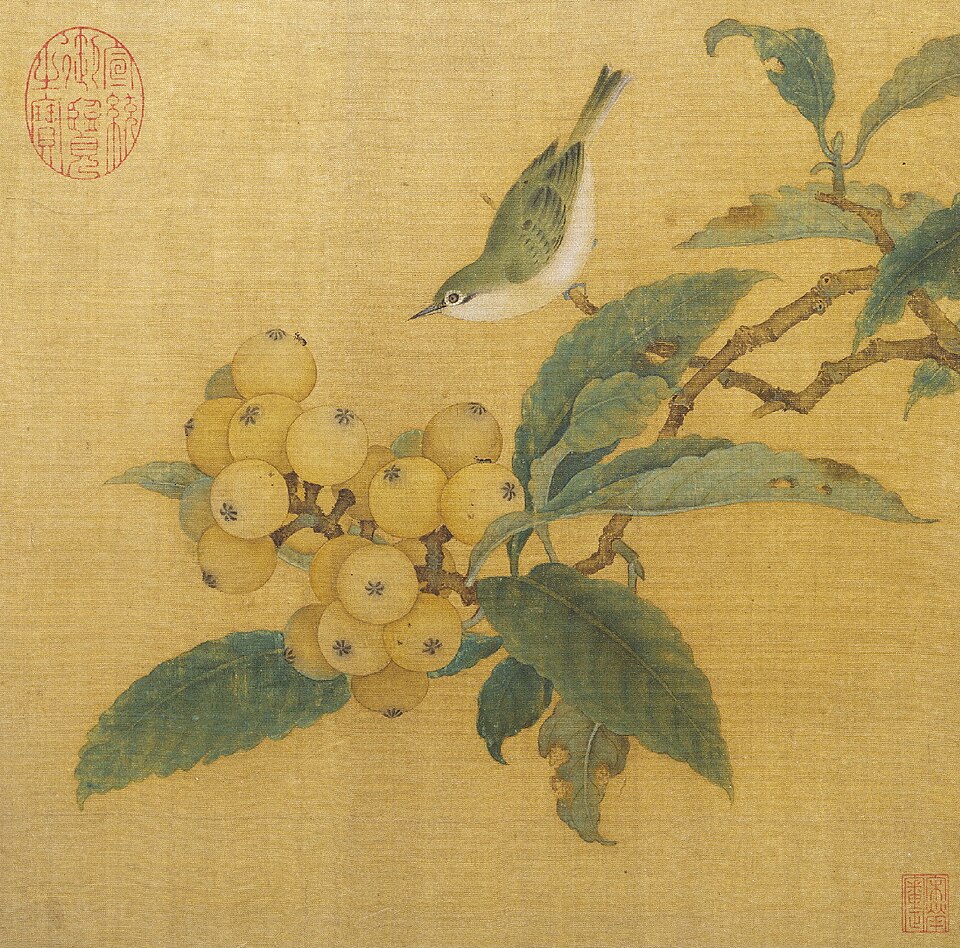
Loquats and Mountain Bird, Lin Chun, late 12th century (Southern Song dynasty). Image: Wikimedia Commons, public domain Do this: Look at the picture together for a quiet minute before anyone talks.
Read aloud: Lin Chun painted small pictures of birds, flowers and fruit about eight hundred years ago, for the emperor’s court. Loquats are sweet orange fruits that grow in southern China. Look how carefully he painted every leaf.
Point and find:
- How many loquats can you count? Count in Chinese.
- What color are the fruits?
- What is the bird looking at?
- Find the biggest leaf.
Ask:
- “Do you think the bird wants a loquat? What would it say in Chinese? (我要!)”
- “What fruit would you paint?”
Show: You want a banana. What do you say?
Say this: “I want = 我要.”
Say this: “Banana = 香蕉.”
Answer: 我要香蕉 (wǒ yào xiāngjiāo).
Show: You don’t want grapes. Say it politely.
Say this: “Put 不 before 要.”
Say this: “Add 谢谢.”
Answer: 我不要葡萄, 谢谢.
Do this: Ask out loud. Let your child try first; help only after a real try.
Ask: Say apple in Chinese.
Listen for: 苹果 (píngguǒ).
Ask: What does 西瓜 mean?
Listen for: Watermelon.
Ask: Ask for grapes.
Listen for: 我要葡萄.
1 more on the lesson page.
Read aloud: Make a fruit salad and ask for each fruit in Chinese.
Steps:
- Lay out the fruit. The parent is the shopkeeper.
- Ask for each fruit: 我要苹果, 谢谢!
- Help cut and mix the salad.
- Pray and say thank you to God before eating.
Tips for you:
- Say 我不要 politely for any fruit you don’t want.
Done when your child can say:
- I asked for each fruit in Chinese.
- We made a salad together.
Do this: Your child picks one or more; you write the date.
- Draw your favorite fruit. Write 我要 and its name.
Read aloud: Watermelon is called 西瓜, “west melon,” because it came to China from the lands to the west, along the old trade roads.
- Saying 我不要 with bù. Before yào, 不 is said bú.
- Forgetting to be polite. Add 请 or 谢谢.
Each player is a fruit. The caller says 我要苹果! and the apple must run and switch seats. When the caller says 我要水果! (fruit), everyone switches.
Say this: “Tell me what you learned today.”
Listen for: Say 苹果 (apple), 香蕉 (banana), 西瓜 (watermelon) and 葡萄 (grapes).; Ask with 我要… (I want…).; Say 我不要 (I don’t want) politely.
But the fruit of the Spirit is love, joy, peace, longsuffering, gentleness, goodness, faith,
In the Chinese Bible (Chinese Union Version), this verse reads: <span class="zh-block" lang="zh-Hans">圣灵所结的果子,就是仁爱、喜乐、和平</span><span class="py-line">Shènglíng suǒ jié de guǒ zi, jiù shì rén ài, xǐ lè, hé píng</span> The fruit of the Spirit is love, joy, peace and more. God grows good fruit in our hearts.
Spread over the week
3 sessions of 15–20 minutes. Stop while it is still going well.
- Session 1. Warm-up, then read and teach the new idea and the new words. Picture study and show how.
- Session 2. Practice together, then start the project. Finish the project, then the sketchbook.
- Session 3. Narration, the game and the Scripture.