Parent guide · Grade 2 Mandarin · Unit 1
Lesson 1.1 这是书: Book, Pen, Paper, Desk, Chair
Written for the parent. The Read aloud parts are written to your child; read them as they are. Do this parts are for you. Answers for you are marked Listen for.
At a glance
- Time
- 3 sessions of 15–20 minutes
- Goal
- Say 书, 笔, 纸, 桌子 and 椅子. Say 这是… (this is…) and 那是… (that is…). Learn about the Four Treasures of the Study.
- You need
- A soft paintbrush
- Black paint or ink in a dish
- Paper (newspaper underneath)
- A sketchbook or plain paper, and crayons
- A King James Bible
- Worksheet A · the lesson page (it also has a short video (2:53))
Steps
Do this together: Look around your school table. What do you use to learn? Put five things in a row and name them in English. Now let’s name them in Chinese.
Read aloud: The story. Long ago in China, every scholar kept four precious things on his desk: a brush, ink, paper and an inkstone. They were called the Four Treasures of the Study. Paper itself was invented in China almost two thousand years ago!
Read aloud: How Chinese works. Point to something near you and say 这是 + its name: 这是书. For something farther away, say 那是: 那是椅子. Chinese does not need “a” or “the.”
Read aloud: Say it out loud. shū (shoo), bǐ (bee), zhǐ (jr), zhuōzi (JWOH-dzuh), yǐzi (EE-dzuh).
Do this: Say each word clearly; your child says it back twice. Point to a picture or the real thing when you can.
- 书 (shū) [shoo (high)]: book
- 笔 (bǐ) [bee (dipping)]: pen; pencil; brush
- 纸 (zhǐ) [jr (dipping)]: paper
- 桌子 (zhuōzi) [JWOH-dzuh]: table; desk
- 椅子 (yǐzi) [EE-dzuh]: chair
- 这是 (zhè shì) [juh SHR]: this is
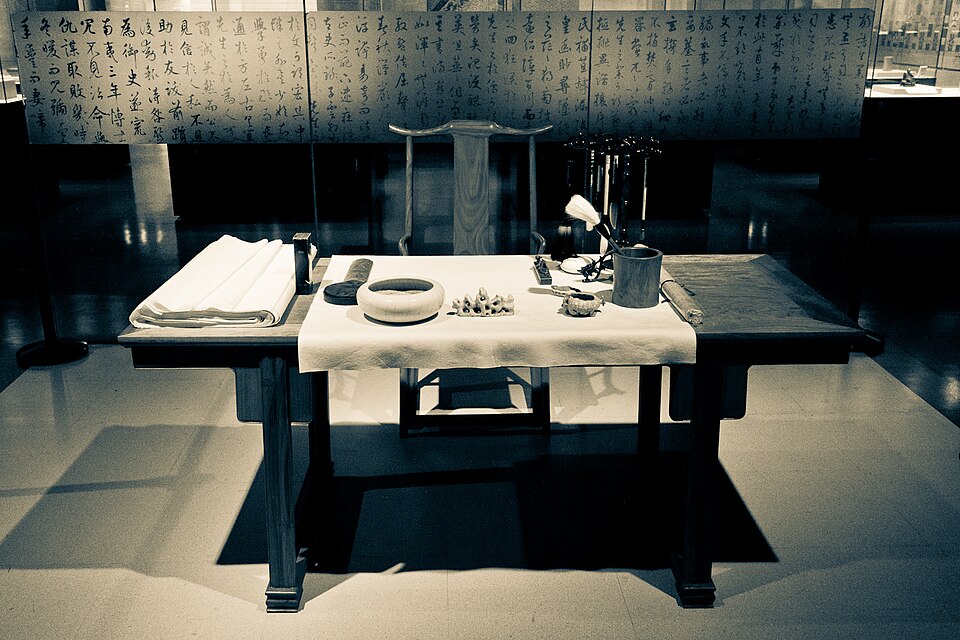
Four Treasures of the Study, photograph by ahen0barbus, 2012. Image: Wikimedia Commons, photograph, CC BY-SA 3.0 (credit: Wikimedia Commons contributor; see the file page) Do this: Look at the picture together for a quiet minute before anyone talks.
Read aloud: This photograph shows the Four Treasures of the Study: brush (笔), ink (墨), paper (纸) and inkstone (砚). The writer rubs the ink stick on the wet stone to make ink, dips the soft brush, and writes on the paper. Chinese children still learn to write with a brush.
Point and find:
- Find the brushes. Which is the biggest?
- Find the ink stick and the stone.
- Which treasure is paper?
- Which treasure do you use at school?
Ask:
- “Why do you think scholars called these things treasures?”
- “What are the treasures on your own desk?”
Show: Hold up a book and say what it is.
Say this: “Near you: 这是.”
Say this: “Book: 书.”
Answer: 这是书 (zhè shì shū).
Show: Point to a chair across the room and say what it is.
Say this: “Far away: 那是.”
Say this: “Chair: 椅子.”
Answer: 那是椅子 (nà shì yǐzi).
Do this: Ask out loud. Let your child try first; help only after a real try.
Ask: Say book in Chinese.
Listen for: 书 (shū).
Ask: Say paper in Chinese.
Listen for: 纸 (zhǐ).
Ask: Hold up a pencil and say “This is a pencil.”
Listen for: 这是笔.
1 more on the lesson page.
Read aloud: Paint a character with a brush, like a Chinese scholar.
Steps:
- Hold the brush straight up.
- Dip it and press gently to make a thick stroke, then lift to make it thin.
- Paint 一, 二, 三 and 十.
- Hang your best page up to dry.
Tips for you:
- Go slowly; each stroke goes top to bottom or left to right.
Done when your child can say:
- I painted four characters.
- I can name the four treasures.
Do this: Your child picks one or more; you write the date.
- Draw your desk with a book, pen and paper on it. Label 书, 笔, 纸, 桌子.
Read aloud: A Chinese official named Cai Lun is remembered for making paper from bark, rags and old fishing nets about the year 105. Paper later spread to the rest of the world.
- Mixing 这 (this, near) and 那 (that, far).
- Saying 纸 zhǐ like “zee.” It is jr, with the tongue curled.
Put some things near and some far. The parent points; the child says 这是… for near things and 那是… for far things.
Say this: “Tell me what you learned today.”
Listen for: Say 书, 笔, 纸, 桌子 and 椅子.; Say 这是… (this is…) and 那是… (that is…).; Learn about the Four Treasures of the Study.
Train up a child in the way he should go: and when he is old, he will not depart from it.
In the Chinese Bible (Chinese Union Version), this verse reads: <span class="zh-block" lang="zh-Hans">教养孩童,使他走当行的道,就是到老他也不偏离。</span><span class="py-line">Jiào yǎng hái tóng, shǐ tā zǒu dāng xíng de dào, jiù shì dào lǎo tā yě bù piān lí.</span> Parents teach their children the right way, and God blesses that teaching for a whole life.
Spread over the week
3 sessions of 15–20 minutes. Stop while it is still going well.
- Session 1. Warm-up, then read and teach the new idea and the new words. Picture study and show how.
- Session 2. Practice together, then start the project. Finish the project, then the sketchbook.
- Session 3. Narration, the game and the Scripture.