Parent guide · Grade 2 Mandarin · Unit 3
Lesson 3.1 十一 to 一百: Counting to 100
Written for the parent. The Read aloud parts are written to your child; read them as they are. Do this parts are for you. Answers for you are marked Listen for.
At a glance
- Time
- 3 sessions of 15–20 minutes
- Goal
- Build numbers 11–19: 十 + one more (十一, 十二…). Build tens: 二十, 三十… 九十, and numbers like 四十五. Say 一百 (100).
- You need
- Two pipe cleaners or strings
- Twenty beads or cereal loops
- A sketchbook or plain paper, and crayons
- A King James Bible
- Worksheet A · the lesson page (it also has a short video (6:28))
Steps
Do this together: Count to ten in Chinese with your fingers. What comes after 十? Chinese numbers are like building blocks: once you know one to ten, you can build all the way to 99!
Read aloud: The story. Jesus told about a shepherd with a hundred sheep. One got lost. He left the ninety-nine and searched until he found the one! That is how much Jesus loves each person.
Read aloud: How Chinese works. 11 is ten-one: 十一. 20 is two-ten: 二十. 25 is two-ten-five: 二十五. 99 is nine-ten-nine: 九十九. And 100 is 一百.
Read aloud: Say it out loud. Count by tens: 十, 二十, 三十, 四十, 五十, 六十, 七十, 八十, 九十, 一百!
Do this: Say each word clearly; your child says it back twice. Point to a picture or the real thing when you can.
- 十一 (shíyī) [shr-EE]: eleven
- 二十 (èrshí) [are-SHR]: twenty
- 五十 (wǔshí) [woo-SHR]: fifty
- 百 (bǎi) [bye (dipping)]: hundred
- 一百 (yìbǎi) [ee-BYE]: one hundred
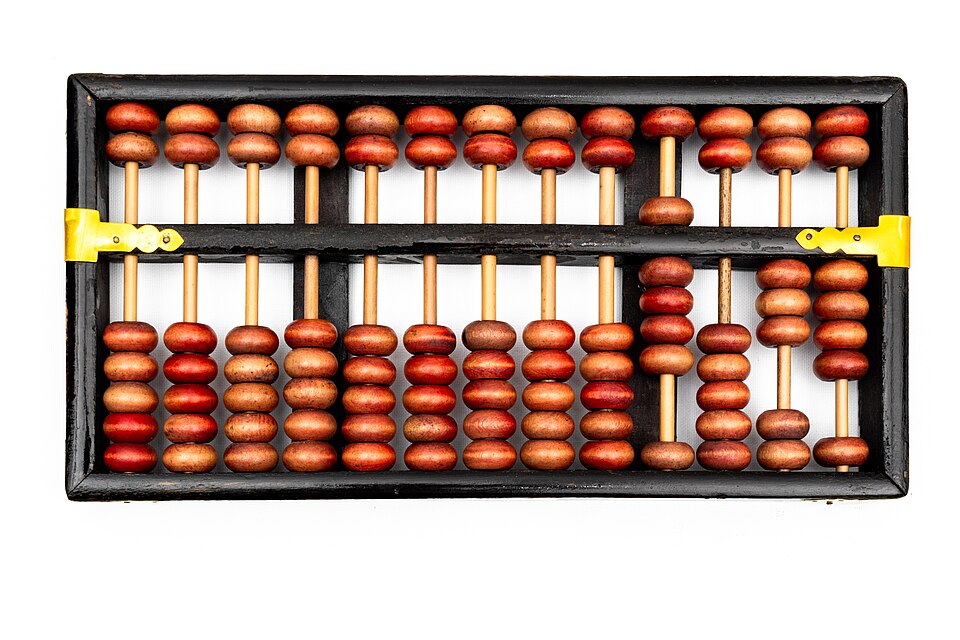
A Chinese abacus (suanpan), photograph by Felix Winkelnkemper, 2019. Image: Wikimedia Commons, photograph, CC BY-SA 4.0 (credit: Wikimedia Commons contributor; see the file page) Do this: Look at the picture together for a quiet minute before anyone talks.
Read aloud: This is a 算盘 (suànpán), a Chinese abacus. Each rod is a place: ones, tens, hundreds. A bead above the bar counts five, and each bead below counts one. Shopkeepers in China used the abacus for hundreds of years, and some still use it today.
Point and find:
- How many beads are above the bar on each rod? How many below?
- Find a rod where beads are pushed to the bar.
- Is it made of wood or plastic?
- Count the rods.
Ask:
- “Why might an abacus be faster than counting on fingers?”
- “What would you count with an abacus?”
Show: Say 47 in Chinese.
Say this: “47 is four tens and seven.”
Say this: “Four-ten-seven.”
Answer: 四十七 (sìshíqī).
Show: How many sheep did the shepherd leave behind?
Say this: “Ninety-nine.”
Say this: “Nine-ten-nine.”
Answer: 九十九 (jiǔshíjiǔ).
Do this: Ask out loud. Let your child try first; help only after a real try.
Ask: Say 12 in Chinese.
Listen for: 十二 (shí’èr).
Ask: Say 30 in Chinese.
Listen for: 三十 (sānshí).
Ask: Say 58 in Chinese.
Listen for: 五十八 (wǔshíbā).
1 more on the lesson page.
Read aloud: Make a simple bead counter to build numbers.
Steps:
- Put ten beads on each pipe cleaner.
- The first is the tens, the second is the ones.
- The parent says a number in Chinese, like 三十四.
- Slide 3 tens and 4 ones, then say it back.
Tips for you:
- Say the number before and after moving the beads.
Done when your child can say:
- I can build numbers to 99.
- I can say them in Chinese.
Do this: Your child picks one or more; you write the date.
- Draw ten groups of ten dots. Write 一百 underneath.
Read aloud: The abacus was so important that Chinese children once learned it at school the way you learn a calculator. Abacus experts could add long lists of numbers in seconds.
- Saying 11 as 一十一. Just say 十一.
- Mixing 十四 (14) and 四十 (40). The first part is the tens.
Write tens on paper squares (十 to 一百). The parent calls a ten in Chinese; the child hops onto it. Then add ones by clapping: 三十 + three claps = 三十三.
Say this: “Tell me what you learned today.”
Listen for: Build numbers 11–19: 十 + one more (十一, 十二…).; Build tens: 二十, 三十… 九十, and numbers like 四十五.; Say 一百 (100).
What man of you, having an hundred sheep, if he lose one of them, doth not leave the ninety and nine in the wilderness, and go after that which is lost, until he find it?
In the Chinese Bible (Chinese Union Version), this verse reads: <span class="zh-block" lang="zh-Hans">你们中间谁有一百只羊失去一只</span><span class="py-line">Nǐ men zhōng jiān shuí yǒu yì bǎi zhī yáng shī qù yì zhī</span> The shepherd left ninety-nine sheep to find the one that was lost. Jesus seeks and saves the lost.
Spread over the week
3 sessions of 15–20 minutes. Stop while it is still going well.
- Session 1. Warm-up, then read and teach the new idea and the new words. Picture study and show how.
- Session 2. Practice together, then start the project. Finish the project, then the sketchbook.
- Session 3. Narration, the game and the Scripture.