Parent guide · Grade 3 Mandarin · Unit 3
Lesson 3.1 多少钱? How Much Is It?
Written for the parent. The Read aloud parts are written to your child; read them as they are. Do this parts are for you. Answers for you are marked Listen for.
At a glance
- Time
- 3 sessions of 20–30 minutes
- Goal
- Say 钱 (money), 块 (yuan, spoken), 毛 (ten cents) and 多少钱?; Say prices like 五块 and 三块五.; Remember where our real treasure is.
- You need
- Small items or pictures
- Paper price tags
- Play money (paper slips with 一块, 五块, 十块, 五毛)
- A King James Bible
- Worksheet A · the lesson page (it also has a short video (9:12))
Steps
Do this together: Set out a few things with price tags in dollars. How do you ask how much something costs? Chinese has a short, handy question for it.
Read aloud: The big idea. To ask a price, point and say 多少钱? (how-much money?). Or name the thing: 这个多少钱? The answer: 五块 (five yuan).
Read aloud: Money words. The written unit is 元 (yuán), but people say 块. A tenth of a yuan is 角 in writing and 毛 in speech. ¥3.50 is 三块五毛, or just 三块五. Taiwan uses the New Taiwan dollar (新台币) and Hong Kong the Hong Kong dollar (港币), and people there say 块 and 元 too.
Read aloud: Shopping words. 太贵了! (tài guì le, too expensive!), 便宜 (piányi, cheap), 我要这个 (I want this one).
Do this: Say each word clearly; your child says it back twice. Point to a picture or the real thing when you can.
- 钱 (qián) [chyen (rising)]: money
- 块 (kuài) [kwai (falling)]: yuan (spoken)
- 毛 (máo) [mao (rising)]: ten cents (spoken)
- 多少 (duōshao) [DWOH-shao]: how much; how many
- 贵 (guì) [gway (falling)]: expensive
- 便宜 (piányi) [PYEN-yee]: cheap
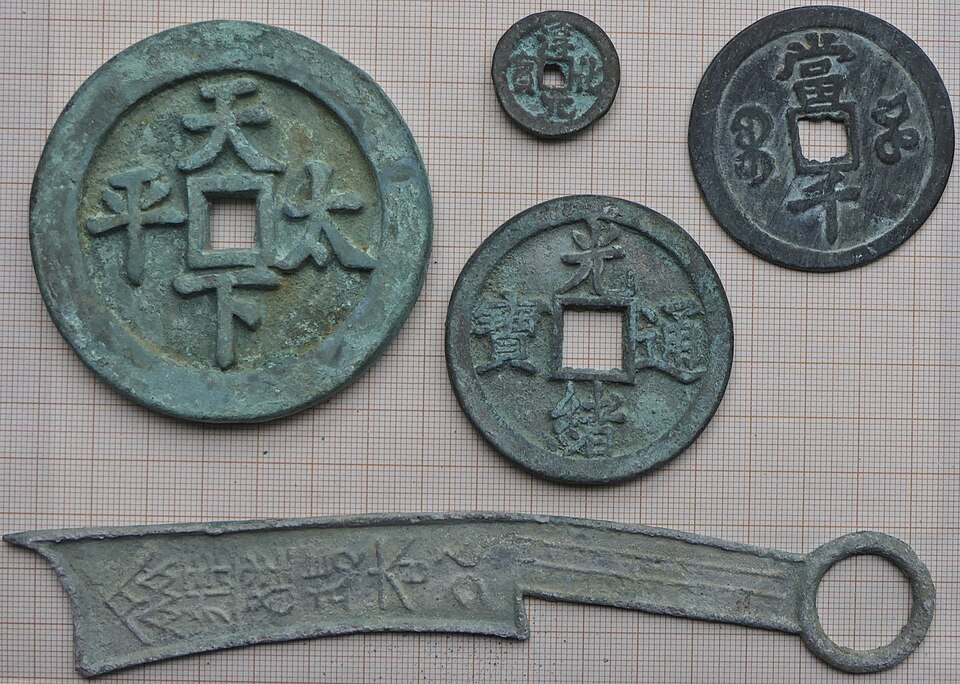
Old Chinese coins, photograph by 5snake5, coins from various periods. Image: Wikimedia Commons, public domain Do this: Look at the picture together for a quiet minute before anyone talks.
Read aloud: For more than two thousand years, Chinese coins were round with a square hole, so they could be strung together on a cord. The biggest coin here reads 天下太平, “peace under heaven.” The long one is knife money, an even older kind of coin shaped like a little knife. Some coins like these are later copies.
Point and find:
- Why do you think the coins have square holes?
- Find the characters on each coin. Do you know any?
- Which coin is shaped like a knife?
- Which coin is the smallest?
Ask:
- “How would you carry a thousand of these coins?”
- “Jesus said our treasure should be in heaven. What does that mean?”
Show: Say ¥12.80 in spoken Chinese.
Say this: “12 = 十二, then 块.”
Say this: “8 tenths = 八毛.”
Answer: 十二块八 (毛).
Show: Ask how much an apple costs.
Say this: “An apple = 苹果.”
Say this: “How much money = 多少钱.”
Answer: 苹果多少钱?
Do this: Ask out loud. Let your child try first; help only after a real try.
Ask: What does 多少钱 mean?
Listen for: How much money? How much is it?
Ask: Say ¥20 in spoken Chinese.
Listen for: 二十块.
Ask: Say ¥6.50.
Listen for: 六块五 (毛).
2 more on the lesson page.
Read aloud: Run a little shop with Chinese price tags.
Steps:
- Make price tags in characters: 三块, 十块五.
- One person is the shopkeeper, one the customer.
- Customer: 这个多少钱? Shopkeeper: 三块.
- Customer pays and says 谢谢; shopkeeper says 不客气.
Tips for you:
- Try 太贵了! and see if the shopkeeper gives a better price.
Done when your child can say:
- I asked 多少钱 five times.
- I paid the right amount.
Read aloud: China was the first country to use paper money, about a thousand years ago in the Song dynasty, because heavy strings of coins were hard to carry.
- Saying 元 in speech. People say 块.
- Saying 两块 vs 二块: for 2 yuan say 两块.
Show a picture of something. Each player guesses its price in Chinese (in 块). Closest guess without going over wins.
Say this: “Tell me what you learned today.”
Listen for: Say 钱 (money), 块 (yuan, spoken), 毛 (ten cents) and 多少钱?; Say prices like 五块 and 三块五.; Remember where our real treasure is.
For where your treasure is, there will your heart be also.
Chinese Union Version (和合本): <span class="zh-block" lang="zh-Hans">因为你的财宝在哪里,你的心也在那里。</span><span class="py-line">Yīn wèi nǐ de cái bǎo zài nǎ lǐ, nǐ de xīn yě zài nà lǐ.</span> Jesus said our hearts follow our treasure. Store up treasure in heaven.
Spread over the week
3 sessions of 20–30 minutes. Stop while it is still going well.
- Session 1. Warm-up, then read and teach the new idea and the new words. Picture study and show how.
- Session 2. Practice together, then start the project. Finish the project, then the sketchbook.
- Session 3. Narration, the game and the Scripture.