Parent guide · Grade 3 Mandarin · Unit 4
Lesson 4.1 我有…: I Have, I Don’t Have
Written for the parent. The Read aloud parts are written to your child; read them as they are. Do this parts are for you. Answers for you are marked Listen for.
At a glance
- Time
- 3 sessions of 20–30 minutes
- Goal
- Say 我有… and 我没有….; Ask 你有…吗?; Use 个 between a number and a noun.
- You need
- A survey sheet with questions
- Pencil
- A King James Bible
- Worksheet A · the lesson page (it also has a short video (1:02))
Steps
Do this together: Empty your backpack or pencil case. What do you have? What don’t you have? Make two piles.
Read aloud: The big idea. 我有 means I have. The opposite is 我没有. Never say 不有: 有 always uses 没.
Read aloud: Measure words. In Chinese you cannot say “two brother.” You need a measure word between the number and the noun: 两个哥哥. The most common is 个. Remember: two is 两 before a measure word.
Read aloud: Asking. 你有哥哥吗? Answer: 有 (yes) or 没有 (no). Notice the answer repeats the verb.
Do this: Say each word clearly; your child says it back twice. Point to a picture or the real thing when you can.
- 有 (yǒu) [yoh (dipping)]: to have; there is
- 没有 (méiyǒu) [may-YOH]: not have; there isn’t
- 个 (gè) [guh (often light: ge)]: general measure word
- 朋友 (péngyou) [PUNG-yoh]: friend
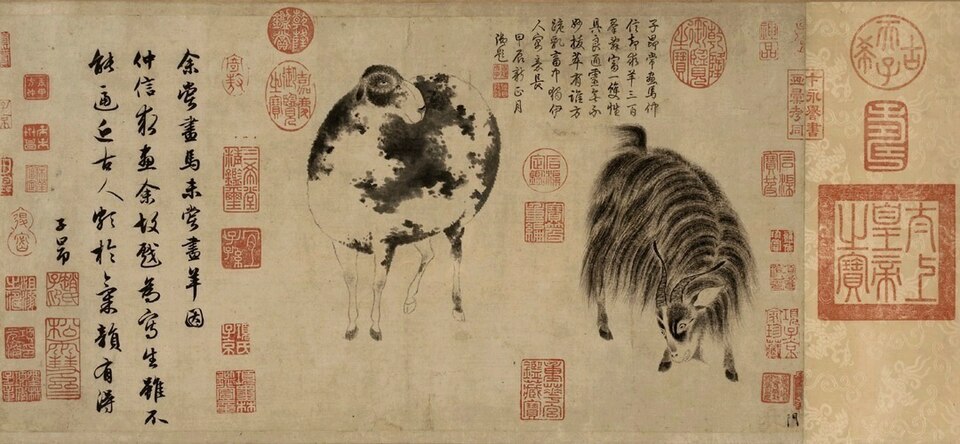
Sheep and Goat, Zhao Mengfu, about 1300 (Yuan dynasty). Image: Wikimedia Commons, public domain Do this: Look at the picture together for a quiet minute before anyone talks.
Read aloud: Zhao Mengfu was one of the greatest painters and calligraphers of China, about seven hundred years ago. He painted this sheep and goat with just black ink, and then wrote a note beside them. In Chinese, both animals are called 羊 (yáng); a sheep is 绵羊 and a goat is 山羊.
Point and find:
- How many animals are there? Say it with a measure word: 两只羊.
- Which one is the sheep and which the goat?
- Find the writing. What do you think the painter wrote about?
- Did the painter use color?
Ask:
- “Jesus called Himself the Good Shepherd. What does a shepherd do for his sheep?”
- “Why might a painter use only black ink?”
Show: Say “I have one older sister and two younger brothers.”
Say this: “一个姐姐.”
Say this: “两个弟弟 (two = 两).”
Answer: 我有一个姐姐和两个弟弟.
Show: Make it negative: 我有猫.
Say this: “有 → 没有.”
Answer: 我没有猫.
Do this: Ask out loud. Let your child try first; help only after a real try.
Ask: What does 没有 mean?
Listen for: Don’t have; there isn’t.
Ask: Say “I have a book.”
Listen for: 我有书 (or 我有一本书).
Ask: Ask “Do you have a younger sister?”
Listen for: 你有妹妹吗?
2 more on the lesson page.
Read aloud: Survey your family and friends with 有 and 没有.
Steps:
- Write three questions: 你有哥哥吗? 你有狗吗? 你有书吗?
- Ask at least four people.
- Record answers: 有 or 没有, and how many.
- Report: 爸爸有一个哥哥. 妈妈没有狗.
Tips for you:
- Use 个 for people.
Done when your child can say:
- I asked twelve questions.
- I reported the answers in Chinese.
Read aloud: Chinese families were often large in the past. Grandparents, parents, aunts, uncles and cousins sometimes all lived in one compound.
- Saying 不有. Always 没有.
- Leaving out the measure word: 三哥哥 should be 三个哥哥.
- Saying 二个. Before a measure word, two is 两: 两个.
Play Go Fish with picture cards. Ask 你有猫吗? Answer 有 (and hand it over) or 没有 (go fish!).
Say this: “Tell me what you learned today.”
Listen for: Say 我有… and 我没有….; Ask 你有…吗?; Use 个 between a number and a noun.
The thief cometh not, but for to steal, and to kill, and to destroy: I am come that they might have life, and that they might have it more abundantly.
Chinese Union Version (和合本): <span class="zh-block" lang="zh-Hans">我来了,是要叫羊得生命,并且得的更丰盛</span><span class="py-line">Wǒ lái le, shì yào jiào yáng dé shēng mìng, bìng qiě dé de gèng fēng shèng</span> Jesus came to give His sheep life, and life more abundantly.
Spread over the week
3 sessions of 20–30 minutes. Stop while it is still going well.
- Session 1. Warm-up, then read and teach the new idea and the new words. Picture study and show how.
- Session 2. Practice together, then start the project. Finish the project, then the sketchbook.
- Session 3. Narration, the game and the Scripture.