Parent guide · Grade 1 Math · Unit 8
Lesson 8.4 Tally Charts and Bar Graphs
Written for the parent. Read the Say this lines aloud as they are, or in your own words. Answers for you are marked Listen for.
At a glance
- Time
- 5 sessions of 20–25 minutes
- Goal
- Read tally charts and bar graphs. Answer questions from a graph.
- You need
- A few real coins
- Craft sticks and rubber bands
- Pencil and crayons
- Worksheet A · Worksheet B · the lesson page
Steps
Do this: Ask these out loud. Your child answers out loud; no paper needed.
- Ask: “5 + 6” Listen for: 11
- Ask: “2 + 1” Listen for: 3
- Ask: “2 + 3” Listen for: 5
- Ask: “1 + 5” Listen for: 6
- Ask: “4 + 9” Listen for: 13
Say this: “Tally marks are grouped in fives, so they are quick to count.”
Say this: “On a bar graph, read across from the top of the bar to the number.”
Say this: “Tally: a mark for each thing counted; every fifth mark crosses four.”
Say this: “Bar graph: a graph that uses bars to show amounts.”
Show: How many Hens and Ducks in all?
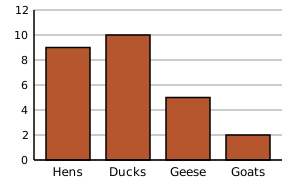
Say this: “Hens: 9. Ducks: 10.”
Say this: “9 + 10 = 19”
Answer: 19
Show: How many Pears?
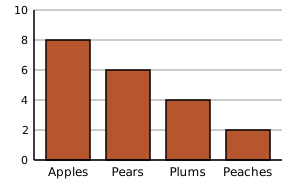
Say this: “Read the Pears bar against the scale: 6.”
Answer: 6
Do this: Your child does these with you. Let them try first; help only after a real try.
Ask: How many Oats and Barley in all?
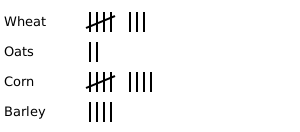
Listen for: 6
If stuck: Oats: 2. Barley: 4.
Ask: How many more Mon than Tue?
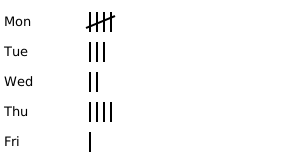
Listen for: 2
If stuck: Mon: 5. Tue: 3.
Ask: How many Corn and Barley in all?
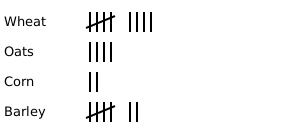
Listen for: 9
If stuck: Corn: 2. Barley: 7.
7 more practice items on the lesson page, and on Worksheet A and Worksheet B.
- Counting a bundle of five tallies as four.
Grab a small handful of coins. Sort, count from the coin worth the most, and say the total. Highest total wins the round.
Say this: “Tell me what you learned today. Show me with your hands or the counters if you like.”
Listen for: Read tally charts and bar graphs.; Answer questions from a graph.
Count by fives and tens to 100, then mixed: 10, 20, 25, 30 (as when counting dimes and nickels).
Spread over the week
5 sessions of 20–25 minutes. Stop while it is still going well.
- Session 1. Warm-up, then teach the new idea (steps 1 and 2).
- Session 2. Warm-up again, then show how with the examples.
- Session 3. Practice together, then play the game.
- Session 4. More practice on the worksheet, and the daily habit.
- Session 5. Quick check: narration and a few practice items. Move on when it is mostly right.