Parent guide · Grade 2 Math · Unit 7
Lesson 7.4 A.M., P.M. and Elapsed Hours
Written for the parent. Read the Say this lines aloud as they are, or in your own words. Answers for you are marked Listen for.
At a glance
- Time
- 5 sessions of 20–25 minutes
- Goal
- Use a.m. and p.m. Find how much time has passed.
- You need
- A clock face
- Pencil and crayons
- Worksheet A · Worksheet B · the lesson page (it also has a short video (1:48))
Steps
Do this: Ask these out loud. Your child answers out loud; no paper needed.
- Ask: “21 + 60” Listen for: 81
- Ask: “77 + 20” Listen for: 97
- Ask: “45 + 20” Listen for: 65
- Ask: “68 + 10” Listen for: 78
- Ask: “11 + 70” Listen for: 81
Say this: “Morning times are a.m.; afternoon and evening times are p.m.”
Say this: “To find elapsed time, count the hours forward on the clock.”
Say this: “A.m.: from midnight to noon.”
Say this: “P.m.: from noon to midnight.”
Say this: “Elapsed time: how much time passes.”
Show: Father starts planting at 9:00. He works for 3 hours and 30 minutes. What time does he finish?
Say this: “Add the hours first: 9:00 plus 3 hours is 12:00.”
Say this: “Add the minutes: 0 + 30 = 30.”
Say this: “He finishes at 12:30.”
Answer: 12:30
Show: Father starts planting at 5:00. He works for 2 hours and 10 minutes. What time does he finish?
Say this: “Add the hours first: 5:00 plus 2 hours is 7:00.”
Say this: “Add the minutes: 0 + 10 = 10.”
Say this: “He finishes at 7:10.”
Answer: 7:10
Do this: Your child does these with you. Let them try first; help only after a real try.
Ask: What time does the clock show?
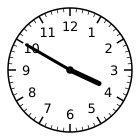
Listen for: 3:50
If stuck: The short hand is past the 3, so the hour is 3.
Ask: What time does the clock show?
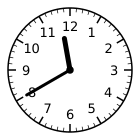
Listen for: 11:40
If stuck: The short hand is past the 11, so the hour is 11.
Ask: What time does the clock show?
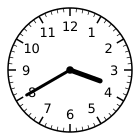
Listen for: 3:40
If stuck: The short hand is past the 3, so the hour is 3.
7 more practice items on the lesson page, and on Worksheet A and Worksheet B.
- Counting the starting hour as one hour.
Each player guesses the length of a household object, then measures it. Closest guess earns a point. Use inches one day and centimeters the next.
Say this: “Tell me what you learned today. Show me with your hands or the counters if you like.”
Listen for: Use a.m. and p.m.; Find how much time has passed.
Recite: 12 inches make a foot, 3 feet make a yard, 100 centimeters make a meter, 60 minutes make an hour.
Spread over the week
5 sessions of 20–25 minutes. Stop while it is still going well.
- Session 1. Warm-up, then teach the new idea (steps 1 and 2).
- Session 2. Warm-up again, then show how with the examples.
- Session 3. Practice together, then play the game.
- Session 4. More practice on the worksheet, and the daily habit.
- Session 5. Quick check: narration and a few practice items. Move on when it is mostly right.