Parent guide · Grade 3 Math · Unit 6
Lesson 6.1 Unit Fractions and Fractions of a Set
Written for the parent. Read the Say this lines aloud as they are, or in your own words. Answers for you are marked Listen for.
At a glance
- Time
- 5 sessions of 25–30 minutes
- Goal
- Name unit fractions and fractions of a shape. Find a fraction of a group.
- You need
- Pencil and crayons
- A King James Bible
- Worksheet A · Worksheet B · the lesson page (it also has a short video (12:04))
Steps
Do this: Ask these out loud. Your child answers out loud; no paper needed.
- Ask: “8 × 8” Listen for: 64
- Ask: “7 × 3” Listen for: 21
- Ask: “4 × 7” Listen for: 28
- Ask: “9 × 4” Listen for: 36
- Ask: “2 × 5” Listen for: 10
Say this: “A fraction names equal parts of a whole. ¾ means 3 of 4 equal parts.”
Say this: “The bigger the denominator, the smaller each part.”
Say this: “A fraction of a group: to find ⅔ of 12, divide by the denominator (12 ÷ 3 = 4), then multiply by the numerator (4 × 2 = 8).”
Say this: “Numerator: the top number: how many parts.”
Say this: “Denominator: the bottom number: how many equal parts in the whole.”
Say this: “Unit fraction: one part, like ⅓.”
Show: What is \tfrac{2}{6} of 24 loaves?
Say this: “Split 24 into 6 equal groups: 24 ÷ 6 = 4 in each group.”
Say this: “Take 2 groups: 4 × 2 = 8”
Answer: 8 loaves
Show: Jesus fed the crowd, and the disciples gathered 4 baskets of pieces. If \tfrac{1}{2} of the baskets held bread and the rest fish, how many baskets held bread?
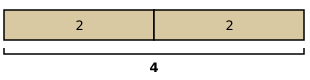
Say this: “Unknown: the part.”
Say this: “Bar model: 4 split into 2 equal parts; take 1 of them.”
Say this: “One part: 4 ÷ 2 = 2”
Say this: “1 parts: 2 × 1 = 2”
Say this: “Answer: 2 baskets held bread.”
Answer: 2 baskets. 2 baskets held bread.
Do this: Your child does these with you. Let them try first; help only after a real try.
Ask: What fraction of the shape is shaded?

Listen for: \tfrac{1}{8}
If stuck: The whole has 8 equal parts.
Ask: What fraction of the shape is shaded?

Listen for: \tfrac{1}{4}
If stuck: The whole has 4 equal parts.
Ask: What fraction of the shape is shaded?
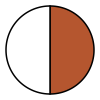
Listen for: \tfrac{1}{2}
If stuck: The whole has 2 equal parts.
7 more practice items on the lesson page, and on Worksheet A and Worksheet B.
- Counting unequal parts.
Each player rolls a die (1–6) and takes that many sixths, or halves of that number in thirds. First to build one whole exactly wins.
Say this: “Tell me what you learned today. Show me with your hands or the counters if you like.”
Listen for: Name unit fractions and fractions of a shape.; Find a fraction of a group.
And it shall come to pass in the increase, that ye shall give the fifth part unto Pharaoh, and four parts shall be your own, for seed of the field, and for your food, and for them of your households, and for food for your little ones.
Joseph had the people give one fifth of the harvest and keep four fifths. That is fractions at work in a real economy.
Fact drill (× and ÷) twice a week. Count by halves and fourths on the number line.
Spread over the week
5 sessions of 25–30 minutes. Stop while it is still going well.
- Session 1. Warm-up, then teach the new idea (steps 1 and 2).
- Session 2. Warm-up again, then show how with the examples.
- Session 3. Practice together, then play the game.
- Session 4. More practice on the worksheet, and the daily habit.
- Session 5. Quick check: narration and a few practice items. Move on when it is mostly right.