Parent guide · Grade 3 Math · Unit 7
Lesson 7.4 Area and Perimeter Word Problems
Written for the parent. Read the Say this lines aloud as they are, or in your own words. Answers for you are marked Listen for.
At a glance
- Time
- 5 sessions of 25–30 minutes
- Goal
- Decide whether a problem asks for area or perimeter, then solve it.
- You need
- Pencil and crayons
- Worksheet A · Worksheet B · the lesson page
Steps
Do this: Ask these out loud. Your child answers out loud; no paper needed.
- Ask: “10 × 4” Listen for: 40
- Ask: “7 × 4” Listen for: 28
- Ask: “9 × 9” Listen for: 81
- Ask: “4 × 4” Listen for: 16
- Ask: “5 × 9” Listen for: 45
Say this: “Fencing, a frame or a border is perimeter. Carpet, paint or planting is area.”
Say this: “Draw and label a sketch first.”
Say this: “Fence: goes around: perimeter.”
Say this: “Cover: goes on top: area.”
Show: Find the perimeter of a rectangle 8 yd long and 3 yd wide.
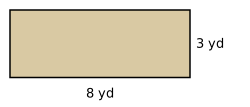
Say this: “Add all four sides: 8 + 3 + 8 + 3 = 22”
Say this: “Perimeter = 22 yd”
Answer: 22 yd
Show: A garden is a 10 m by 5 m rectangle with a 6 m by 2 m corner taken out for a shed. What is the area of the garden?
Say this: “Whole rectangle: 10 × 5 = 50”
Say this: “Shed corner: 6 × 2 = 12”
Say this: “50 − 12 = 38”
Answer: 38 square meters
Do this: Your child does these with you. Let them try first; help only after a real try.
Ask: Find the area of a rectangle 4 ft long and 3 ft wide.
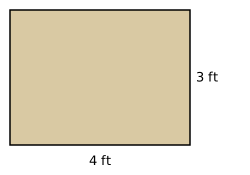
Listen for: 12 square feet
If stuck: Area = length × width
Ask: Find the area of a rectangle 7 ft long and 3 ft wide.
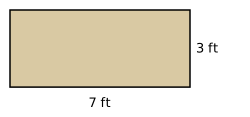
Listen for: 21 square feet
If stuck: Area = length × width
Ask: Find the area of a rectangle 3 ft long and 9 ft wide.
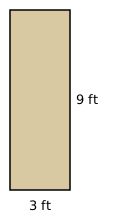
Listen for: 27 square feet
If stuck: Area = length × width
7 more practice items on the lesson page, and on Worksheet A and Worksheet B.
- Using the wrong units.
On graph paper, design a garden bed with an area of 24 squares. How many different rectangles can you make? Which has the shortest fence (perimeter)?
Say this: “Tell me what you learned today. Show me with your hands or the counters if you like.”
Listen for: Decide whether a problem asks for area or perimeter, then solve it.
Fact drill. Square numbers: 1, 4, 9, 16, 25, 36, 49, 64, 81, 100.
Spread over the week
5 sessions of 25–30 minutes. Stop while it is still going well.
- Session 1. Warm-up, then teach the new idea (steps 1 and 2).
- Session 2. Warm-up again, then show how with the examples.
- Session 3. Practice together, then play the game.
- Session 4. More practice on the worksheet, and the daily habit.
- Session 5. Quick check: narration and a few practice items. Move on when it is mostly right.