Parent guide · Grade 3 Math · Unit 8
Lesson 8.4 Scaled Bar Graphs
Written for the parent. Read the Say this lines aloud as they are, or in your own words. Answers for you are marked Listen for.
At a glance
- Time
- 5 sessions of 25–30 minutes
- Goal
- Read scaled bar graphs and pictographs.
- You need
- Pencil and crayons
- Worksheet A · Worksheet B · the lesson page (it also has a short video (12:38))
Steps
Do this: Ask these out loud. Your child answers out loud; no paper needed.
- Ask: “7 × 6” Listen for: 42
- Ask: “4 × 10” Listen for: 40
- Ask: “9 × 6” Listen for: 54
- Ask: “2 × 6” Listen for: 12
- Ask: “8 × 8” Listen for: 64
Say this: “When each picture stands for 5, multiply.”
Say this: “Read the bar against the scale, then compare by subtracting.”
Say this: “Scale: how much each line or picture stands for.”
Show: Which has the most?
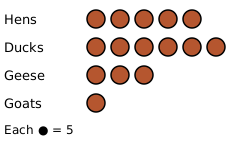
Say this: “Each circle stands for 5.”
Say this: “The biggest count is Ducks, with 30.”
Answer: Ducks
Show: Which has the most?
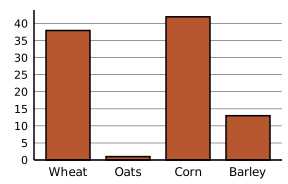
Say this: “The biggest count is Corn, with 42.”
Answer: Corn
Do this: Your child does these with you. Let them try first; help only after a real try.
Ask: How many Oats?
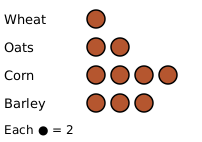
Listen for: 4
If stuck: Each circle stands for 2.
Ask: How many Barley and Wheat in all?
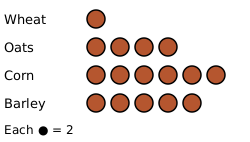
Listen for: 12
If stuck: Each circle stands for 2.
Ask: How many more Corn than Barley?
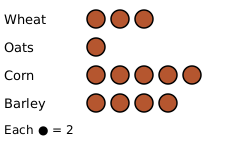
Listen for: 2
If stuck: Each circle stands for 2.
7 more practice items on the lesson page, and on Worksheet A and Worksheet B.
- Counting pictures without using the key.
Weigh five kitchen items in grams. Order them lightest to heaviest. Estimate first, then weigh.
Say this: “Tell me what you learned today. Show me with your hands or the counters if you like.”
Listen for: Read scaled bar graphs and pictographs.
Fact drill. Recite: 60 minutes = 1 hour, 1,000 grams = 1 kilogram, 1,000 milliliters = 1 liter.
Spread over the week
5 sessions of 25–30 minutes. Stop while it is still going well.
- Session 1. Warm-up, then teach the new idea (steps 1 and 2).
- Session 2. Warm-up again, then show how with the examples.
- Session 3. Practice together, then play the game.
- Session 4. More practice on the worksheet, and the daily habit.
- Session 5. Quick check: narration and a few practice items. Move on when it is mostly right.