Parent guide · Kindergarten Math · Unit 8
Lesson 8.2 Heavy and Light; Full and Empty
Written for the parent. Read the Say this lines aloud as they are, or in your own words. Answers for you are marked Listen for.
At a glance
- Time
- 5 sessions of 15–20 minutes
- Goal
- Compare weights. Compare how much containers hold.
- You need
- A few real coins
- A few cups
- Pencil and crayons
- Worksheet A · Worksheet B · the lesson page (it also has a short video (2:43))
Steps
Do this: Ask these out loud. Your child answers out loud; no paper needed.
- Ask: “2 + 1” Listen for: 3
- Ask: “2 + 2” Listen for: 4
- Ask: “5 + 1” Listen for: 6
- Ask: “2 + 4” Listen for: 6
- Ask: “4 + 4” Listen for: 8
Say this: “A balance tips down on the heavier side.”
Say this: “Big things are not always heavier: a balloon is big and light.”
Say this: “Heavier: weighs more.”
Say this: “Lighter: weighs less.”
Show: Which is heavier: an empty cup or a full bucket?
Say this: “A full bucket is much heavier than an empty cup.”
Say this: “So the heavier one is a full bucket.”
Answer: a full bucket
Show: Which is taller, A or B?
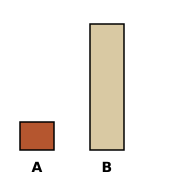
Say this: “Both stand on the same line. Compare the tops.”
Say this: “B is taller.”
Answer: B
Do this: Your child does these with you. Let them try first; help only after a real try.
Ask: Which is lighter: an ox or a mouse?
Listen for: a mouse
If stuck: An ox is much heavier than a mouse.
Ask: Which is lighter: a leaf or a millstone?
Listen for: a leaf
If stuck: A millstone is much heavier than a leaf.
Ask: Which is lighter: a pea or a pumpkin?
Listen for: a pea
If stuck: A pumpkin is much heavier than a pea.
10 more practice items on the lesson page, and on Worksheet A and Worksheet B.
- Thinking bigger always means heavier.
Set up a shop with toys priced 1¢ to 10¢. Your child pays with pennies, nickels and dimes; you make sure the coins match the price.
Say this: “Tell me what you learned today. Show me with your hands or the counters if you like.”
Listen for: Compare weights.; Compare how much containers hold.
Say the days of the week in order each morning, and name today, yesterday and tomorrow.
Spread over the week
5 sessions of 15–20 minutes. Stop while it is still going well.
- Session 1. Warm-up, then teach the new idea (steps 1 and 2).
- Session 2. Warm-up again, then show how with the examples.
- Session 3. Practice together, then play the game.
- Session 4. More practice on the worksheet, and the daily habit.
- Session 5. Quick check: narration and a few practice items. Move on when it is mostly right.