Parent guide · Grade 1 Russian · Unit 3
Lesson 3.1 Понеде́льник, вто́рник, среда́
Written for the parent. The Read aloud parts are written to your child; read them as they are. Do this parts are for you. Answers for you are marked Listen for.
At a glance
- Time
- 3 sessions of 15–20 minutes
- Goal
- Say Monday, Tuesday and Wednesday in Russian. Say Сего́дня… (today is…). Look at a painting of a village school reading.
- You need
- Seven strips of colored paper
- Tape or glue
- Crayons
- A sketchbook or plain paper, and crayons
- A King James Bible
- Worksheet A · the lesson page (it also has a short video ())
Steps
Do this together: How many days are in a week? Count them on your fingers. Today you learn the first three in Russian.
Read aloud: The story. More than a hundred years ago, the painter Nikolai Bogdanov-Belsky was a poor village boy who was taught by a kind teacher at a country school. When he grew up, he painted that school again and again. In this painting, the grown-ups of the village have come to the school on a Sunday. The teacher sits at the table reading aloud, and fathers, mothers, grandfathers and children crowd in to listen.
Read aloud: How Russian sounds. Понеде́льник is a long word: puh-nee-DYEL’-neek. Вто́рник is FTOHR-neek. Среда́ is sree-DAH. To say today is Monday, say Сего́дня понеде́льник. Сего́дня is a funny word: the г sounds like v, see-VOHD-nyuh.
Read aloud: Say it and move. Stretch and yawn, the week is starting: понеде́льник! Hold up two fingers: вто́рник! Put your hands in the middle: среда́! (Среда́ is the middle of the week.)
Do this: Say each word clearly; your child says it back twice. Point to a picture or the real thing when you can.
- понеде́льник (ponedelnik) [puh-nee-DYEHL-neek]: Monday
- вто́рник (vtornik) [FTOHR-neek]: Tuesday
- среда́ (sreda) [sree-DAH]: Wednesday
- сего́дня (segodnya) [see-VOHD-nyuh]: today
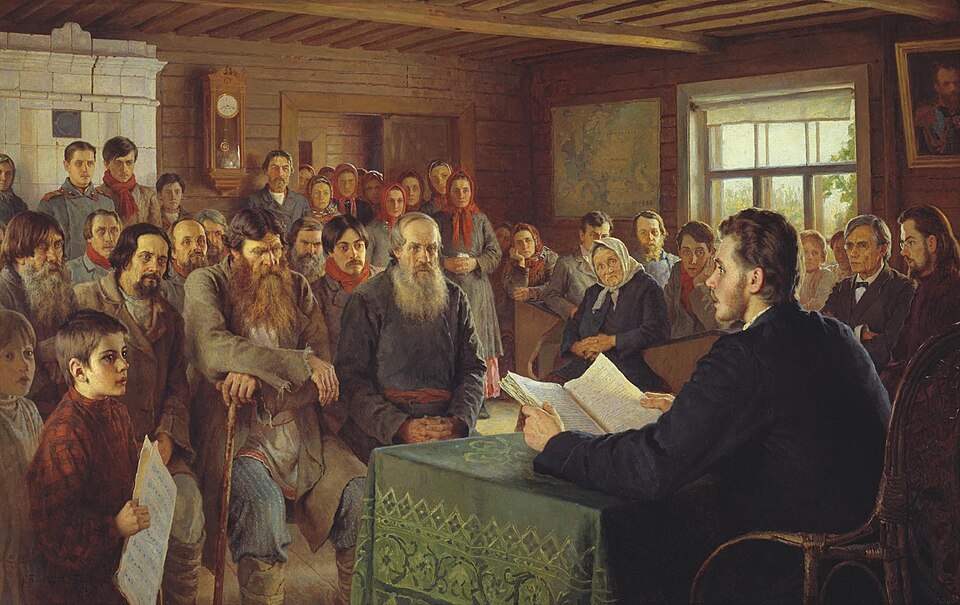
Sunday Reading in a Village School, Nikolai Bogdanov-Belsky, 1895. Image: Wikimedia Commons, public domain Do this: Look at the picture together for a quiet minute before anyone talks.
Read aloud: Bogdanov-Belsky never forgot the teacher who helped him. Here everyone, young and old, has come to listen and learn. Look how close together they stand!
Point and find:
- Who is reading?
- Find the children. What are they doing?
- How many grown-ups can you count?
- Is it bright or dark in the room?
Ask:
- “What do you do on Sunday?”
- “Who reads to you?”
Show: What day comes after Monday? Say it in Russian.
Say this: “After Monday comes Tuesday.”
Say this: “Tuesday is вто́рник.”
Answer: Вто́рник.
Show: Today is Wednesday. Say it in Russian.
Say this: “Today is сего́дня.”
Say this: “Wednesday is среда́.”
Answer: Сего́дня среда́.
Do this: Ask out loud. Let your child try first; help only after a real try.
Ask: Say Monday in Russian.
Listen for: Понеде́льник.
Ask: Say Tuesday in Russian.
Listen for: Вто́рник.
Ask: Say Wednesday in Russian.
Listen for: Среда́.
3 more on the lesson page.
Read aloud: Make a paper chain with one link for each day of the week.
Steps:
- A parent writes one Russian day on each strip: понеде́льник, вто́рник, среда́, четве́рг, пя́тница, суббо́та, воскресе́нье.
- Today, make the first three links in order and say each day.
- Next lesson, add the other four.
- Hang the chain and touch today’s link each morning: Сего́дня….
Tips for you:
- Make Sunday’s link gold or yellow.
Done when your child can say:
- My chain has the first days in order.
- I can say them in Russian.
Do this: Your child picks one or more; you write the date.
- In your picture dictionary, draw what you do on Monday, Tuesday and Wednesday. A parent writes понеде́льник, вто́рник and среда́.
Read aloud: The Russian names of the days tell a story. Вто́рник comes from the word for second, and среда́ means the middle. So Tuesday is “the second day” and Wednesday is “the middle day.”
- Saying the г in сего́дня like a g. It sounds like v: see-VOHD-nyuh.
- Saying VTOR-nik with a v. Before т the в sounds like f: FTOHR-neek.
Lay three papers on the floor with the first three days. The child hops from one to the next, saying each day. Then a parent calls a day and the child jumps on it.
Say this: “Tell me what you learned today.”
Listen for: Say Monday, Tuesday and Wednesday in Russian.; Say Сего́дня… (today is…).; Look at a painting of a village school reading.
This is the day which the LORD hath made; we will rejoice and be glad in it.
In the Russian Bible (Synodal translation), this verse reads: <i class="ru-bible" lang="ru">Сей день сотворил Господь: возрадуемся и возвеселимся в оный</i> (Psalm 117:24 in the Russian numbering) Every day is a gift from God, Monday as much as Sunday. We can be glad in each one.
Spread over the week
3 sessions of 15–20 minutes. Stop while it is still going well.
- Session 1. Warm-up, then read and teach the new idea and the new words. Picture study and show how.
- Session 2. Practice together, then start the project. Finish the project, then the sketchbook.
- Session 3. Narration, the game and the Scripture.