Parent guide · Grade 2 Russian · Unit 1
Lesson 1.1 А, О, К, М, Т, Е: Friendly Letters
Written for the parent. The Read aloud parts are written to your child; read them as they are. Do this parts are for you. Answers for you are marked Listen for.
At a glance
- Time
- 3 sessions of 15–20 minutes
- Goal
- Name and sound out А, О, К, М, Т and Е. Read кот, мак and ма́ма. Tell who gave the Slavs their alphabet.
- You need
- A baking tray
- Salt, sugar or sand
- Letter cards (a parent writes А, О, К, М, Т, Е )
- A sketchbook or plain paper, and crayons
- A King James Bible
- Worksheet A · the lesson page (it also has a short video (2:33))
Steps
Do this together: Write your name in big letters. Russian children use different letters, called Cyrillic. Some of them look just like ours! Today you meet the friendly ones.
Read aloud: The story. More than eleven hundred years ago, two brothers named Cyril and Methodius lived in the Greek city of Thessalonica. They loved God and they knew the language of the Slavic people. A Slavic prince asked for teachers who could tell his people about Jesus in their own language, but the Slavs had no letters to write with. So Cyril made an alphabet for them, and the brothers translated the Gospels. Their students later made the alphabet Russians use today, and they named it Cyrillic after Cyril.
Read aloud: How Russian letters work. Some Cyrillic letters are friendly: they look and sound like ours. А says ah, О says oh, and К, М and Т say k, m and t. Put them together: К-О-Т says кот (cat)! М-А-К says мак (a poppy flower). Е is almost friendly: it looks like E, but it says yeh.
Read aloud: Say it and move. Make an А with your arms over your head. Make an О with your hands. Make a Т with your arms straight out. Then read the cat word and meow: кот! Мя́у!
Do this: Say each word clearly; your child says it back twice. Point to a picture or the real thing when you can.
- кот (kot) [koht]: cat
- мак (mak) [mahk]: poppy
- ма́ма (mama) [MAH-muh]: mom
- бу́ква (bukva) [BOOK-vuh]: letter (of the alphabet)
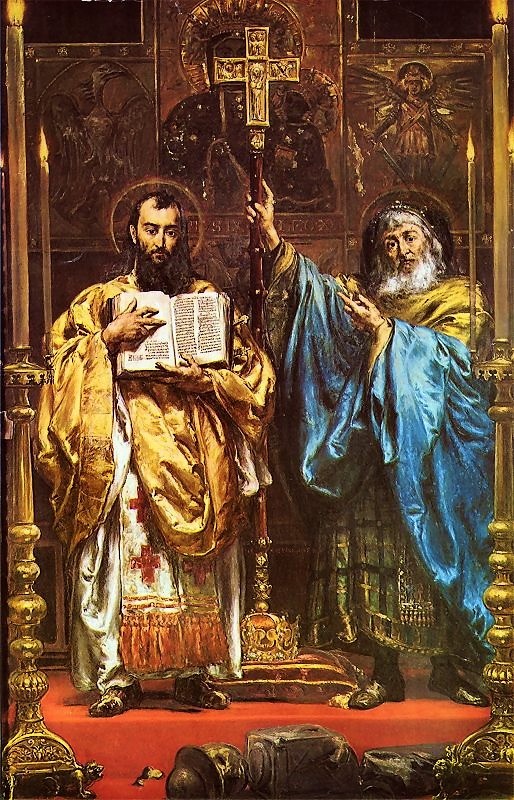
Saints Cyril and Methodius, Jan Matejko, 1885. Image: Wikimedia Commons, public domain Do this: Look at the picture together for a quiet minute before anyone talks.
Read aloud: Jan Matejko was a Polish painter who painted the great stories of the Slavic peoples. Here he shows the two brothers with the book they worked so hard to give: the Gospels in a language the Slavs could read.
Point and find:
- Find the book. What book do you think it is?
- Which brother is wearing blue?
- What is he doing with his hand?
- What do you see behind them?
Ask:
- “Why did the brothers want the Slavs to have letters?”
- “What book would you most like to be able to read?”
Show: Read this word: К-О-Т.
Say this: “К says k, О says oh, Т says t.”
Say this: “Put them together: kot.”
Answer: Кот : cat.
Show: Read this word: М-А-М-А.
Say this: “М says m and А says ah.”
Say this: “Two times: ma-ma.”
Answer: Ма́ма : mom.
Do this: Ask out loud. Let your child try first; help only after a real try.
Ask: What sound does А make?
Listen for: ah
Ask: What sound does М make?
Listen for: m
Ask: Read: кот.
Listen for: kot (cat)
3 more on the lesson page.
Read aloud: Write Cyrillic letters with your finger in a tray of salt or sand.
Steps:
- Pour a thin layer of salt in the tray.
- Look at a letter card, say its sound, and write it in the salt with your finger.
- Shake the tray to erase and try the next one.
- Now write the whole word кот and read it out loud.
Tips for you:
- Try мак and ма́ма too.
Done when your child can say:
- I wrote six letters.
- I can read кот.
Do this: Your child picks one or more; you write the date.
- Start a Russian letter page in your notebook: write А, О, К, М, Т and Е big, and draw a cat next to кот.
Read aloud: Russians celebrate the Day of Slavic Writing and Culture every year on May 24, the feast of Saints Cyril and Methodius. Statues of the two brothers stand in Moscow and in many other Slavic cities.
- Reading Е as ee, the way English E sounds in me. Russian Е says yeh.
- Thinking the letters are hard. Six of them are already friends!
A parent hides letter cards (А, О, К, М, Т, Е) around the room. The child finds each one and says its sound. Can you make кот from the cards you found?
Say this: “Tell me what you learned today.”
Listen for: Name and sound out А, О, К, М, Т and Е.; Read кот, мак and ма́ма.; Tell who gave the Slavs their alphabet.
In the beginning was the Word, and the Word was with God, and the Word was God.
In the Russian Bible (Synodal translation), this verse reads: <i class="ru-bible" lang="ru">В начале было Слово</i> Jesus is called the Word. Cyril and Methodius made letters so that people could read God’s Word and know Jesus.
Spread over the week
3 sessions of 15–20 minutes. Stop while it is still going well.
- Session 1. Warm-up, then read and teach the new idea and the new words. Picture study and show how.
- Session 2. Practice together, then start the project. Finish the project, then the sketchbook.
- Session 3. Narration, the game and the Scripture.