Parent guide · Grade 3 Russian · Unit 1
Lesson 1.1 Здра́вствуйте и приве́т: Вы and Ты
Written for the parent. The Read aloud parts are written to your child; read them as they are. Do this parts are for you. Answers for you are marked Listen for.
At a glance
- Time
- 3 sessions of 20–30 minutes
- Goal
- Greet grown-ups and friends correctly in Russian.; Choose between вы and ты.; Ask and answer Как дела́?
- You need
- Eight index cards
- Markers
- A sketchbook or plain paper, and crayons
- A King James Bible
- Worksheet A · the lesson page (it also has a short video (4:14))
Steps
Do this together: How do you greet your pastor? How do you greet your best friend? English uses different words too (Good morning, sir! / Hey!). Russian has a polite way and a friendly way, and today you learn both.
Read aloud: The story. Russian children grow up with the fairy tale of Снегу́рочка, the Snow Maiden, a girl made of snow who came to life in the winter forest. The tale is old and has many versions, and children know it as a story, not as something true. In 1899 the painter Viktor Vasnetsov painted her: a girl in a white fur coat and hat, standing alone among the snowy trees at night, with the moon shining through the branches. She looks as if she is about to greet someone coming down the path.
Read aloud: How Russian works: вы and ты. Russian has two words for you. Ты is for one friend, a child, a brother or sister, Mom and Dad, and for God in prayer. Вы is polite: for a grown-up you do not know well, a teacher, an older person, and for any group. With вы you say Здра́вствуйте! With ты you can say Приве́т! or Здра́вствуй! (the short form).
Read aloud: Как дела́? To ask how someone is, say Как дела́? The usual answers are Хорошо́! (good), Отли́чно! (great), Норма́льно (fine) or Пло́хо (bad). Then ask back: А у тебя́? to a friend, А у вас? to a grown-up.
Do this: Say each word clearly; your child says it back twice. Point to a picture or the real thing when you can.
- здра́вствуйте (zdravstvuyte) [ZDRAHST-vooy-tee]: hello
- приве́т (privet) [pree-VYEHT]: hi
- вы (vy) [vih]: you (polite or plural)
- ты (ty) [tih]: you (friendly, one person)
- как дела́? (kak dela?) [kahk dee-LAH]: how are you?
- хорошо́ (khorosho) [khuh-rah-SHOH]: good, well
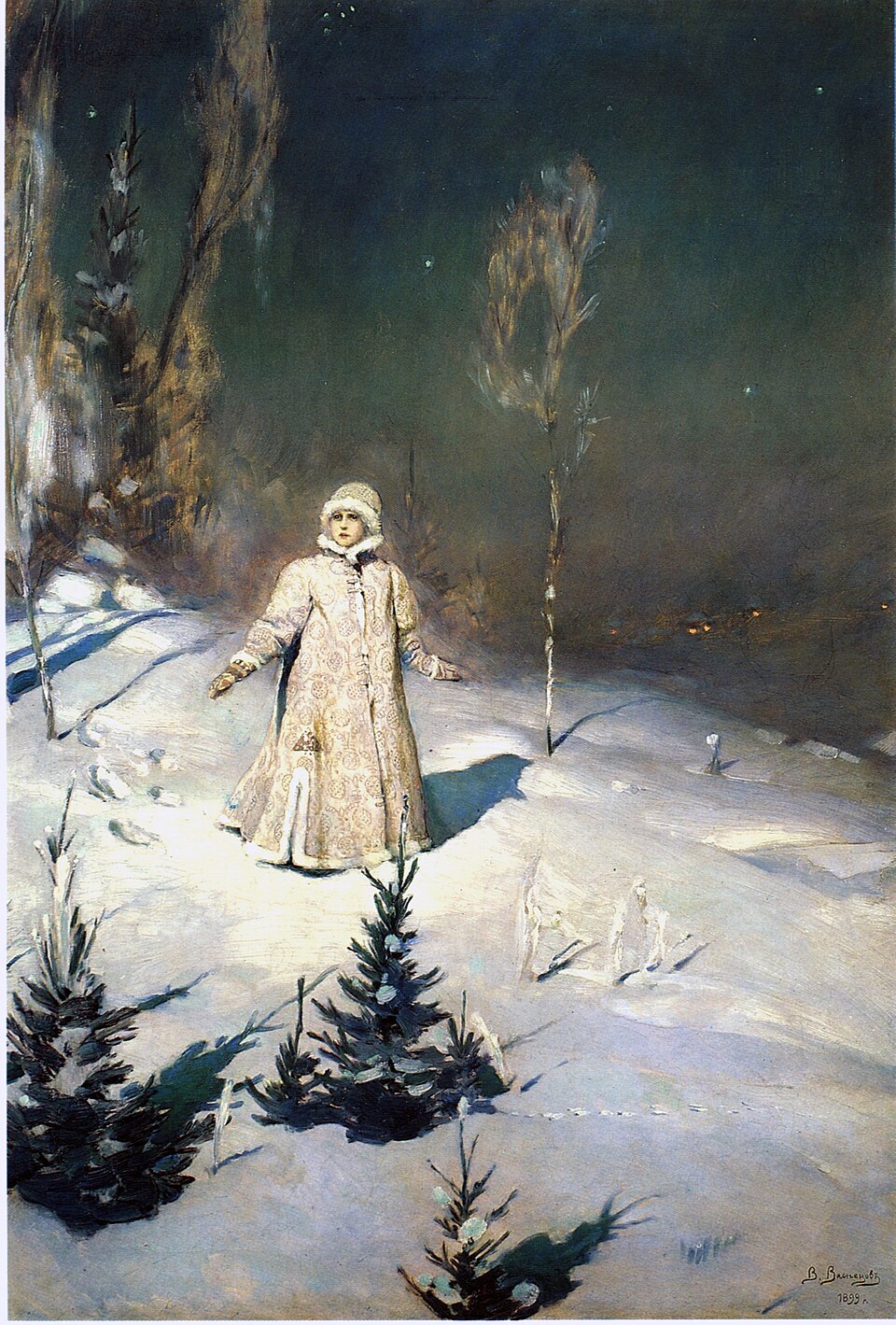
The Snow Maiden, Viktor Vasnetsov, 1899. Image: Wikimedia Commons, public domain Do this: Look at the picture together for a quiet minute before anyone talks.
Read aloud: Vasnetsov loved Russian fairy tales and painted many of their heroes. Here everything is white, blue and silver. The Snow Maiden stands very still, as quiet as the snow.
Point and find:
- What is she wearing? Why?
- What time of day is it? How can you tell?
- What trees stand around her?
- Does she look friendly, shy or sad?
Ask:
- “If you met her on the path, would you say Здра́вствуйте! or Приве́т! ? Why?”
- “Which fairy tales do you know from other countries?”
Show: You meet your friend’s mother for the first time. Greet her and ask how she is.
Say this: “She is a grown-up you do not know well: use вы.”
Say this: “Polite hello: Здра́вствуйте!”
Answer: Здра́вствуйте! Как дела́? (Or more politely: Как у вас дела́? )
Show: Your friend says Приве́т! Как дела́? Answer and ask back.
Say this: “Answer: Хорошо́, спаси́бо!”
Say this: “Ask back to a friend: А у тебя́?”
Answer: Хорошо́, спаси́бо! А у тебя́?
Do this: Ask out loud. Let your child try first; help only after a real try.
Ask: Say hello politely in Russian.
Listen for: Здра́вствуйте!
Ask: Say hi to a friend in Russian.
Listen for: Приве́т!
Ask: Ask how someone is in Russian.
Listen for: Как дела́?
3 more on the lesson page.
Read aloud: Make cards for people you might meet, and practice the right greeting for each.
Steps:
- On each card draw or write a person: your friend, your teacher, a new neighbor, your grandma, a shop clerk, a baby, your pastor, a group of children.
- On the back, write ты or вы and the right greeting (Приве́т! or Здра́вствуйте!).
- Shuffle the cards. Draw one, greet the person and ask Как дела́? the right way.
- Check the back of the card.
Tips for you:
- Ask a parent to answer as the person on the card.
Done when your child can say:
- I made eight cards.
- I chose ты or вы correctly for each person.
Do this: Your child picks one or more; you write the date.
- Start your Russian notebook: write Здра́вствуйте!, Приве́т!, Как дела́? and four answers. Mark each greeting “вы” or “ты”.
Read aloud: In Russian prayers, God is always called Ты, the close family word, even though Russians say вы to any grown-up they do not know. Russian Christians see this as a sign that God is our Father and we may come close to Him.
- Saying Приве́т! to a teacher. Use Здра́вствуйте! with grown-ups and groups.
- Answering Как дела́? with Меня́ зову́т…. It asks how you are, not your name.
A parent names a person (your cousin, the mail carrier, a group of friends, your dog…). The student points to a card that says ТЫ or ВЫ and gives the right greeting. One point for each correct greeting.
Say this: “Tell me what you learned today.”
Listen for: Greet grown-ups and friends correctly in Russian.; Choose between вы and ты.; Ask and answer Как дела́?
Be kindly affectioned one to another with brotherly love; in honour preferring one another;
Russian Synodal Bible (1876): <i class="ru-bible" lang="ru">в почтительности друг друга предупреждайте</i> Showing honor to others is part of loving them. Choosing the polite <span lang="ru">вы</span> is one way to honor a grown-up.
Spread over the week
3 sessions of 20–30 minutes. Stop while it is still going well.
- Session 1. Warm-up, then read and teach the new idea and the new words. Picture study and show how.
- Session 2. Practice together, then start the project. Finish the project, then the sketchbook.
- Session 3. Narration, the game and the Scripture.