Parent guide · Grade 3 Russian · Unit 2
Lesson 2.1 Ноль, оди́н, два… де́сять
Written for the parent. The Read aloud parts are written to your child; read them as they are. Do this parts are for you. Answers for you are marked Listen for.
At a glance
- Time
- 3 sessions of 20–30 minutes
- Goal
- Count from zero to ten in Russian. Ask Ско́лько? (how many?) and answer with a number. Look closely at a painting of a village arithmetic lesson.
- You need
- Sidewalk chalk or tape on the floor
- A small stone or beanbag
- A sketchbook or plain paper, and crayons
- A King James Bible
- Worksheet A · the lesson page (it also has a short video (3:48))
Steps
Do this together: Count to ten as fast as you can in English. Can you count backward? Today you count in Russian.
Read aloud: The story. At the village school of the teacher Sergei Rachinsky, children learned to do arithmetic in their heads. Rachinsky wrote hard problems on the blackboard and the pupils worked them out without paper. One of his old pupils, the painter Nikolai Bogdanov-Belsky, painted this scene: boys in bast shoes and peasant shirts stand around the board, thinking hard. One boy whispers the answer in the teacher’s ear. The problem on the board is real, and you can solve it too!
Read aloud: How Russian sounds. Оди́н (ah-DEEN), два (dvah), три (tree), четы́ре (chee-TUY-ree), пять (pyaht’), шесть (shehst’), семь (syehm’), во́семь (VOH-seem’), де́вять (DYEH-veet’), де́сять (DYEH-seet’). Zero is ноль. Notice the soft ending ь on пять to де́сять.
Read aloud: Ско́лько? To ask how many, say Ско́лько? and point: Ско́лько ма́льчиков? (how many boys?) Answer with just the number: Пять. (The word after ско́лько changes its ending; for now just answer with the number.)
Do this: Say each word clearly; your child says it back twice. Point to a picture or the real thing when you can.
- ноль [nohl]: zero
- оди́н [ah-DEEN]: one
- два [dvah]: two
- три [tree]: three
- четы́ре [chee-TIH-ree]: four
- пять [pyaht]: five
- де́сять [DYEH-suht]: ten
- ско́лько? [SKOHL-kuh]: how many? how much?
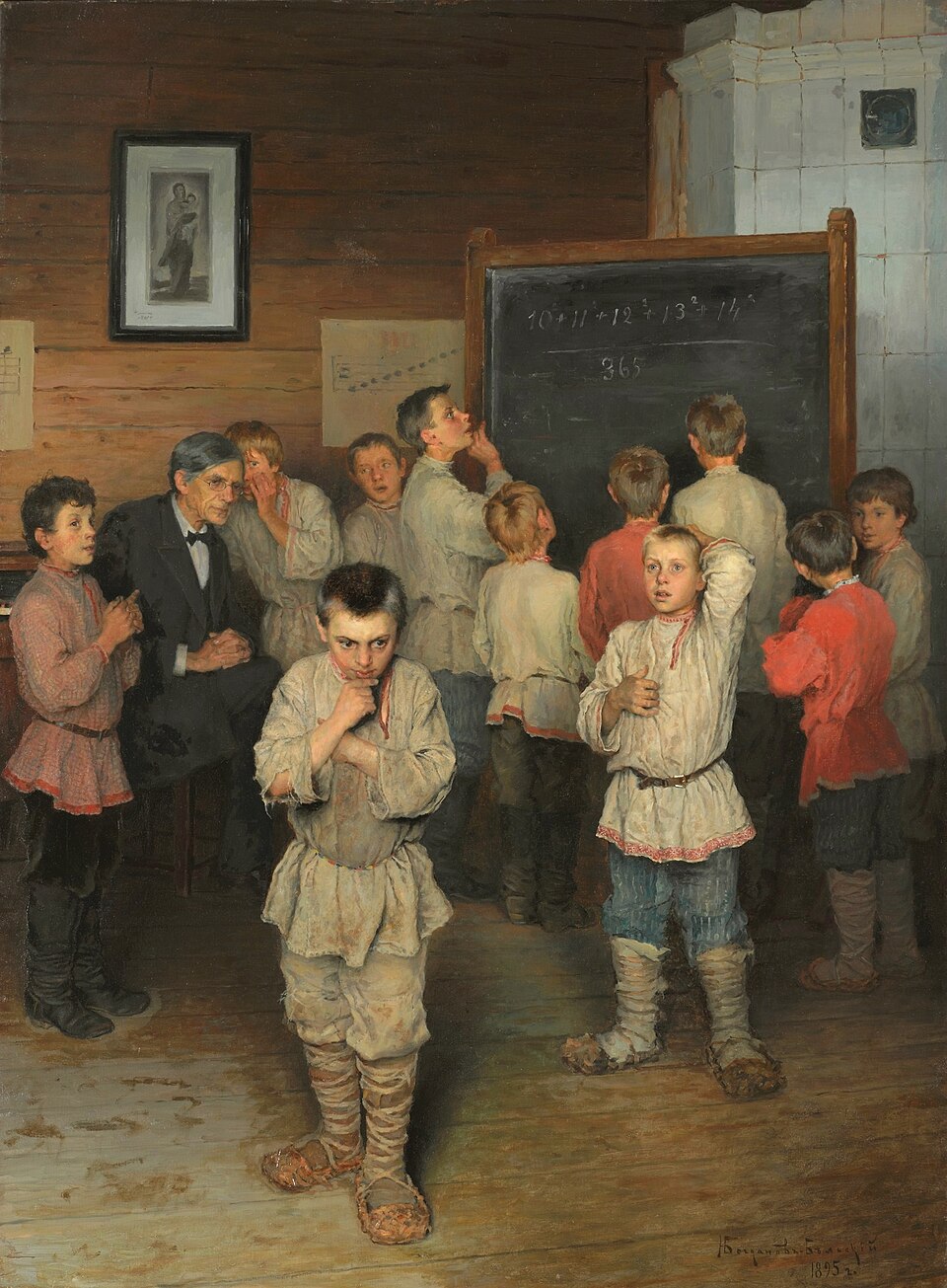
Mental Arithmetic (In the Public School of S. A. Rachinsky), Nikolai Bogdanov-Belsky, 1895. Image: Wikimedia Commons, public domain Do this: Look at the picture together for a quiet minute before anyone talks.
Read aloud: The problem on the board is (10² + 11² + 12² + 13² + 14²) ÷ 365. Rachinsky’s pupils solved it in their heads. (The answer is 2.) Look at each boy’s face: they are all thinking in different ways.
Point and find:
- How many boys can you count? Say the number in Russian.
- Who is the man sitting at the side?
- What is the boy in front doing with his hand?
- Which boy do you think has the answer?
Ask:
- “How do you like to solve hard problems: in your head, on paper or with someone?”
- “Why do you think the painter remembered this teacher his whole life?”
Show: Count the boys in a group of seven and answer Ско́лько?
Say this: “Count: оди́н, два, три…”
Say this: “The seventh is семь.”
Answer: Семь.
Show: Say your phone number or a family member’s birthday digits in Russian.
Say this: “Say each digit separately.”
Say this: “Remember ноль for 0.”
Answer: For example: пять, ноль, три…
Do this: Ask out loud. Let your child try first; help only after a real try.
Ask: Count from one to five in Russian.
Listen for: Оди́н, два, три, четы́ре, пять.
Ask: Say zero in Russian.
Listen for: Ноль.
Ask: Say ten in Russian.
Listen for: Де́сять.
3 more on the lesson page.
Read aloud: Draw a hopscotch from 0 to 10 and hop it in Russian.
Steps:
- Draw eleven squares numbered 0 to 10.
- Toss the stone. Hop to it, saying each number in Russian as you land.
- Pick up the stone and hop back, counting down.
- Ask a partner Ско́лько? after each turn: how many squares did you hop?
Tips for you:
- Write the Russian words in the squares instead of numerals.
Done when your child can say:
- I hopped from 0 to 10 in Russian.
- I can count down from 10 too.
Do this: Your child picks one or more; you write the date.
- In your notebook, write the numerals 0–10 with the Russian word beside each. Mark the stress in each word.
Read aloud: Many Russian children learned to count with an abacus called the счёты. Shopkeepers used счёты to add up prices until computers came along, and some old shops still have them on the counter.
- Saying CHE-ty-re. The loud part is in the middle: chee-TUY-ree.
- Saying VO-sem with a hard m. The ь makes it soft: VOH-seem’.
Spread number cards 0–10 on the table. A parent says a number in Russian; the first to slap the right card keeps it. Then switch: the student calls the numbers.
Say this: “Tell me what you learned today.”
Listen for: Count from zero to ten in Russian.; Ask Ско́лько? (how many?) and answer with a number.; Look closely at a painting of a village arithmetic lesson.
So teach us to number our days, that we may apply our hearts unto wisdom.
Russian Synodal Bible (1876): <i class="ru-bible" lang="ru">Научи нас так счислять дни наши, чтобы нам приобрести сердце мудрое</i> (Psalm 89:12 in the Russian numbering) Moses asked God to teach us to number our days, so that we would use our time wisely.
Spread over the week
3 sessions of 20–30 minutes. Stop while it is still going well.
- Session 1. Warm-up, then read and teach the new idea and the new words. Picture study and show how.
- Session 2. Practice together, then start the project. Finish the project, then the sketchbook.
- Session 3. Narration, the game and the Scripture.