Parent guide · Grade 3 Russian · Unit 3
Lesson 3.1 Кра́сный, кра́сная, кра́сное: Colors That Match
Written for the parent. The Read aloud parts are written to your child; read them as they are. Do this parts are for you. Answers for you are marked Listen for.
At a glance
- Time
- 3 sessions of 20–30 minutes
- Goal
- Name twelve colors in Russian. Match a color word to a masculine, feminine or neuter noun. Look closely at a Russian winter fair.
- You need
- Three small boxes or bowls labeled - ый, -ая, -ое
- Cards with nouns: стол, кот, шар, ша́пка, ко́шка, кни́га, я́блоко, окно́, со́лнце
- A sketchbook or plain paper, and crayons
- A King James Bible
- Worksheet A · the lesson page (it also has a short video (2:40))
Steps
Do this together: Name all the colors you see in the room in English. Do you know any in Russian already? Today you learn more, and you learn a Russian secret: color words change their endings!
Read aloud: The story. Boris Kustodiev loved the bright, happy side of old Russian life. In 1916, though he was ill and could not walk, he painted a whole town on the last days before Lent. Russians call this week Ма́сленица, and they eat stacks of pancakes and ride in sleighs before the forty days of fasting begin. The snow is white and pink, the sky is gold and blue, horses pull red and green sleighs, and the churches shine on the hill.
Read aloud: How Russian works: colors that match. Every Russian noun is masculine, feminine or neuter. A color word changes its ending to match. Masculine words often end in a consonant: кра́сный шар (a red ball). Feminine words often end in -а or -я: кра́сная ша́пка (a red hat). Neuter words often end in -о or -е: кра́сное я́блоко (a red apple). So the endings are -ый, -ая, -ое.
Read aloud: More colors. Russian has two words for blue: си́ний is dark blue and голубо́й is light blue, and to Russians they are as different as red and pink. Pink is ро́зовый (from the word for rose), brown is кори́чневый (from the word for cinnamon), gray is се́рый, and purple is фиоле́товый (from the violet flower).
Do this: Say each word clearly; your child says it back twice. Point to a picture or the real thing when you can.
- голубо́й [guh-loo-BOHY]: light blue
- ро́зовый [ROH-zuh-vihy]: pink
- кори́чневый [kah-REECH-nee-vihy]: brown
- се́рый [SYEH-rihy]: gray
- фиоле́товый [fee-ah-LYEH-tuh-vihy]: purple
- кра́сная [KRAHS-nuh-yuh]: red (with a feminine noun)
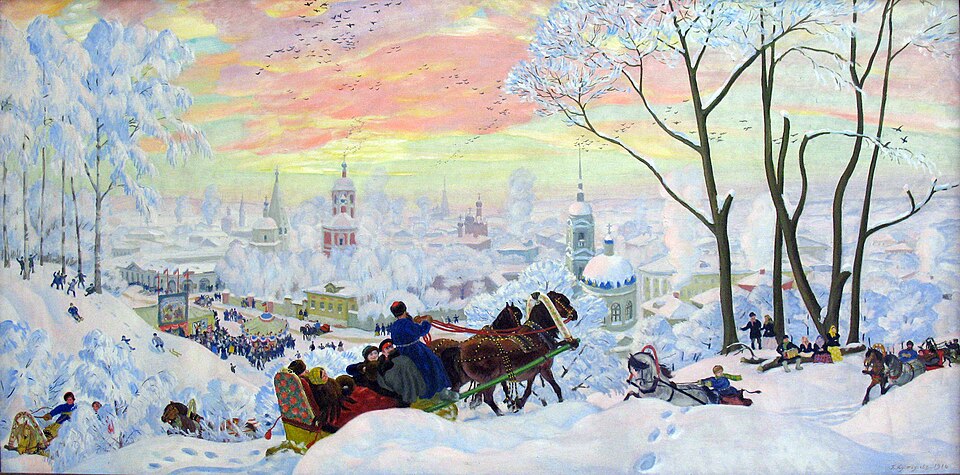
Shrovetide (Maslenitsa), Boris Kustodiev, 1916. Image: Wikimedia Commons, public domain Do this: Look at the picture together for a quiet minute before anyone talks.
Read aloud: Kustodiev painted this from memory and imagination while sick in bed. He filled it with every color he could. Look for the sleighs, the churches and the crowds at the fair.
Point and find:
- Find something кра́сное (red) and say it.
- What color is the sky? Use two Russian colors.
- Find a sleigh. What color is it?
- How many churches can you count?
Ask:
- “Why do you think Kustodiev painted such a happy picture while he was sick?”
- “What is the most colorful day of the year in your family?”
Show: Say “a gray cat” and “a gray mouse (мышь, feminine)”.
Say this: “Кот is masculine: се́рый.”
Say this: “Мышь is feminine: се́рая.”
Answer: Се́рый кот, се́рая мышь.
Show: Say “a pink apple” in Russian.
Say this: “Я́блоко ends in - о : neuter.”
Say this: “Neuter ending: - ое.”
Answer: Ро́зовое я́блоко.
Do this: Ask out loud. Let your child try first; help only after a real try.
Ask: Say pink and brown in Russian.
Listen for: Ро́зовый, кори́чневый.
Ask: Which blue is the sky: си́ний or голубо́й?
Listen for: Голубо́й (light blue).
Ask: Say “a green table” (стол).
Listen for: Зелёный стол.
3 more on the lesson page.
Read aloud: Sort nouns into three boxes and give each one a color.
Steps:
- Read each noun card and decide: masculine, feminine or neuter?
- Put it in the right box.
- Pick a color for each and say it with the right ending: зелёный стол, бе́лая ко́шка, жёлтое со́лнце.
- Write three of your phrases in your notebook.
Tips for you:
- Mix in the new colors: ро́зовая кни́га, се́рый кот.
Done when your child can say:
- I sorted nine nouns.
- I said a matching color for each one.
Do this: Your child picks one or more; you write the date.
- In your notebook, make a color chart with twelve colors: a crayon stripe and the Russian word beside it. Then write three phrases with -ый, -ая and -ое.
Read aloud: Ма́сленица is the week before Great Lent in the Orthodox Church. It is named for butter (ма́сло), because it is the last week before the fast when butter, milk and cheese may be eaten. Families make piles of thin pancakes, блины́, and ask one another’s forgiveness on the last Sunday, called Forgiveness Sunday.
- Using the same ending for every noun: кра́сный ша́пка. Match it: кра́сная ша́пка.
- Calling the sky си́ний. A clear sky is голубо́е не́бо; си́ний is dark blue.
Say Я ви́жу что-то … (I see something …) and a color with the right ending. The others guess the object. Whoever guesses gives the next clue.
Say this: “Tell me what you learned today.”
Listen for: Name twelve colors in Russian.; Match a color word to a masculine, feminine or neuter noun.; Look closely at a Russian winter fair.
Now Israel loved Joseph more than all his children, because he was the son of his old age: and he made him a coat of many colours.
Russian Synodal Bible (1876): <i class="ru-bible" lang="ru">и сделал ему разноцветную одежду</i> Jacob gave Joseph a coat of many colours to show his love. God made a world of colors to show His goodness to us.
Spread over the week
3 sessions of 20–30 minutes. Stop while it is still going well.
- Session 1. Warm-up, then read and teach the new idea and the new words. Picture study and show how.
- Session 2. Practice together, then start the project. Finish the project, then the sketchbook.
- Session 3. Narration, the game and the Scripture.