Parent guide · Grade 3 Russian · Unit 4
Lesson 4.1 За́втрак, обе́д, у́жин: Я ем, я пью
Written for the parent. The Read aloud parts are written to your child; read them as they are. Do this parts are for you. Answers for you are marked Listen for.
At a glance
- Time
- 3 sessions of 20–30 minutes
- Goal
- Name breakfast, lunch and dinner in Russian. Say what you eat and drink with я ем and я пью. Look closely at a painting of tea in the garden.
- You need
- Your notebook
- Colored pencils
- A sketchbook or plain paper, and crayons
- A King James Bible
- Worksheet A · the lesson page (it also has a short video (1:36))
Steps
Do this together: What did you eat for breakfast today? For lunch yesterday? Today you learn to say it in Russian.
Read aloud: The story. Vladimir Makovsky liked to paint everyday Russian people. In this painting an old husband and wife sit together in their garden in the afternoon. On the table is a white cloth, a shining samovar, cups and a little bowl of jam. The wife pours the tea. They do not need to say much; they have had tea together like this for many years.
Read aloud: Meals. Russians eat за́втрак (ZAHF-truk) in the morning, обе́д (ah-BYET) in the middle of the day, and у́жин (OO-zheen) in the evening. Обе́д is traditionally the big meal, with soup first. To say “for breakfast”, say на за́втрак.
Read aloud: How Russian works: я ем, я пью. Я ем means I eat and я пью means I drink: На за́втрак я ем ка́шу и пью молоко́. Notice that ка́ша became ка́шу: feminine words ending in -а change to -у when you eat or drink them (they are the object). Хлеб, суп, чай and молоко́ do not change.
Do this: Say each word clearly; your child says it back twice. Point to a picture or the real thing when you can.
- за́втрак [ZAHF-truhk]: breakfast
- обе́д [ah-BYEHT]: lunch
- у́жин [OO-zhihn]: dinner
- я ем [yah yehm]: I eat
- я пью [yah pyoo]: I drink
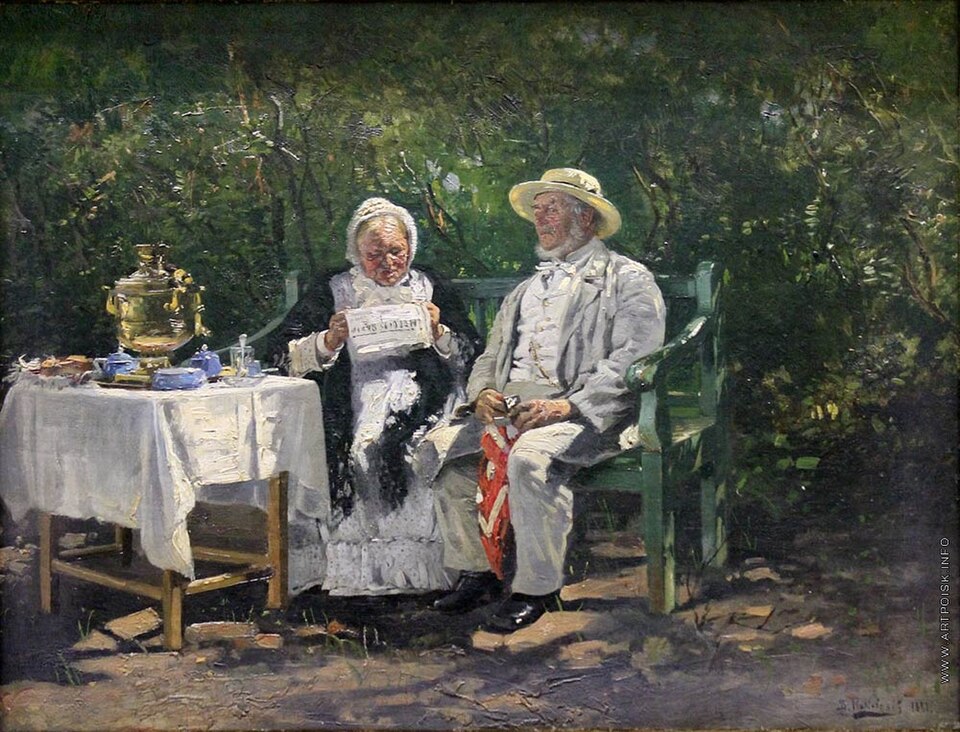
Old People (Tea Party), Vladimir Makovsky, 1881. Image: Wikimedia Commons, public domain Do this: Look at the picture together for a quiet minute before anyone talks.
Read aloud: Makovsky painted many kind, ordinary moments. Look at the samovar, the cups and the faces. This couple has shared thousands of meals.
Point and find:
- Find the samovar. What is it for?
- What is the wife doing?
- Where are they sitting?
- What time of day do you think it is?
Ask:
- “Who do you like to eat with?”
- “How can you make a family meal happy?”
Show: Say what you eat and drink for breakfast: porridge and milk.
Say this: “For breakfast: на за́втрак.”
Say this: “Ка́ша becomes ка́шу after я ем.”
Answer: На за́втрак я ем ка́шу и пью молоко́.
Show: Say that for dinner you eat soup and drink tea.
Say this: “For dinner: на у́жин.”
Say this: “Суп and чай do not change.”
Answer: На у́жин я ем суп и пью чай.
Do this: Ask out loud. Let your child try first; help only after a real try.
Ask: Say breakfast in Russian.
Listen for: За́втрак.
Ask: Say lunch and dinner in Russian.
Listen for: Обе́д, у́жин.
Ask: Say I eat bread.
Listen for: Я ем хлеб.
3 more on the lesson page.
Read aloud: Keep a diary of your meals for three days in Russian.
Steps:
- Make a chart with three rows: за́втрак, обе́д, у́жин.
- For three days, write what you eat and drink at each meal, in Russian where you can (draw the rest).
- Each evening, read your day aloud: На за́втрак я ем … и пью ….
- Circle your favorite meal of the three days.
Tips for you:
- Look up one new food word each day in Wiktionary.
Done when your child can say:
- My diary has three days of meals.
- I can read it aloud with я ем and я пью.
Do this: Your child picks one or more; you write the date.
- In your notebook, write the three meals and one sentence for each: На за́втрак я ем … и пью ….
Read aloud: A Russian обе́д usually starts with soup. Борщ (beet soup) and щи (cabbage soup) are the most famous. There is even a saying: Щи да ка́ша — пи́ща на́ша (cabbage soup and porridge are our food).
- Saying я ем ка́ша. After я ем, a feminine word in -а changes to -у: я ем ка́шу.
- Saying o-BED with a d. At the end, д sounds like t: ah-BYET.
A parent names a food in Russian (ка́ша, суп, блины́, хлеб, чай). The student says which meal it belongs to and makes a sentence: На за́втрак я ем ка́шу!
Say this: “Tell me what you learned today.”
Listen for: Name breakfast, lunch and dinner in Russian.; Say what you eat and drink with я ем and я пью.; Look closely at a painting of tea in the garden.
Whether therefore ye eat, or drink, or whatsoever ye do, do all to the glory of God.
Russian Synodal Bible (1876): <i class="ru-bible" lang="ru">Итак, едите ли, пьете ли или иное что делаете, все делайте в славу Божию</i> Even eating and drinking can be done to the glory of God, with thankful hearts.
Spread over the week
3 sessions of 20–30 minutes. Stop while it is still going well.
- Session 1. Warm-up, then read and teach the new idea and the new words. Picture study and show how.
- Session 2. Practice together, then start the project. Finish the project, then the sketchbook.
- Session 3. Narration, the game and the Scripture.