Parent guide · Grade 3 Russian · Unit 5
Lesson 5.1 Грач, воробе́й, ла́сточка, сова́
Written for the parent. The Read aloud parts are written to your child; read them as they are. Do this parts are for you. Answers for you are marked Listen for.
At a glance
- Time
- 3 sessions of 20–30 minutes
- Goal
- Name six birds and a nest in Russian. Look closely at The Rooks Have Returned. Know that God cares for the smallest bird.
- You need
- A paper bowl or small basket
- Brown paper strips or yarn
- Glue
- Paper for birds and eggs
- A sketchbook or plain paper, and crayons
- A King James Bible
- Worksheet A · the lesson page (it also has a short video (2:23))
Steps
Do this together: Look out the window or step outside. Can you see or hear a bird? Today you learn bird names in Russian.
Read aloud: The story. In Russia, the first sign of spring is not flowers but birds. The rooks, big black birds, fly back from the south in March, while the snow is still on the ground. In 1871 Alexei Savrasov painted a little village at that moment: the snow is melting, the birch trees are still bare, and the rooks are busy building nests high in the branches. Behind them stands a white church with a bell tower. Russians love this painting so much that every child knows its name: Грачи́ прилете́ли, The Rooks Have Returned.
Read aloud: How Russian sounds. Пти́ца is PTEE-tsuh: say both p and t. Грач is grahch. Воробе́й is vuh-rah-BYAY. Ла́сточка is LAHS-tuch-kuh. Сова́ is sah-VAH. Гнездо́ is gneez-DOH: say the g!
Read aloud: Gender again. Грач and воробе́й are masculine, пти́ца, ла́сточка and сова́ are feminine, and гнездо́ is neuter. So: чёрный грач, ма́ленький воробе́й, бе́лая сова́, большо́е гнездо́.
Do this: Say each word clearly; your child says it back twice. Point to a picture or the real thing when you can.
- пти́ца [PTEE-tsuh]: bird
- грач [grahch]: rook
- воробе́й [vuh-rah-BYEHY]: sparrow
- ла́сточка [LAHS-tuhch-kuh]: swallow
- сова́ [sah-VAH]: owl
- гнездо́ [gneez-DOH]: nest
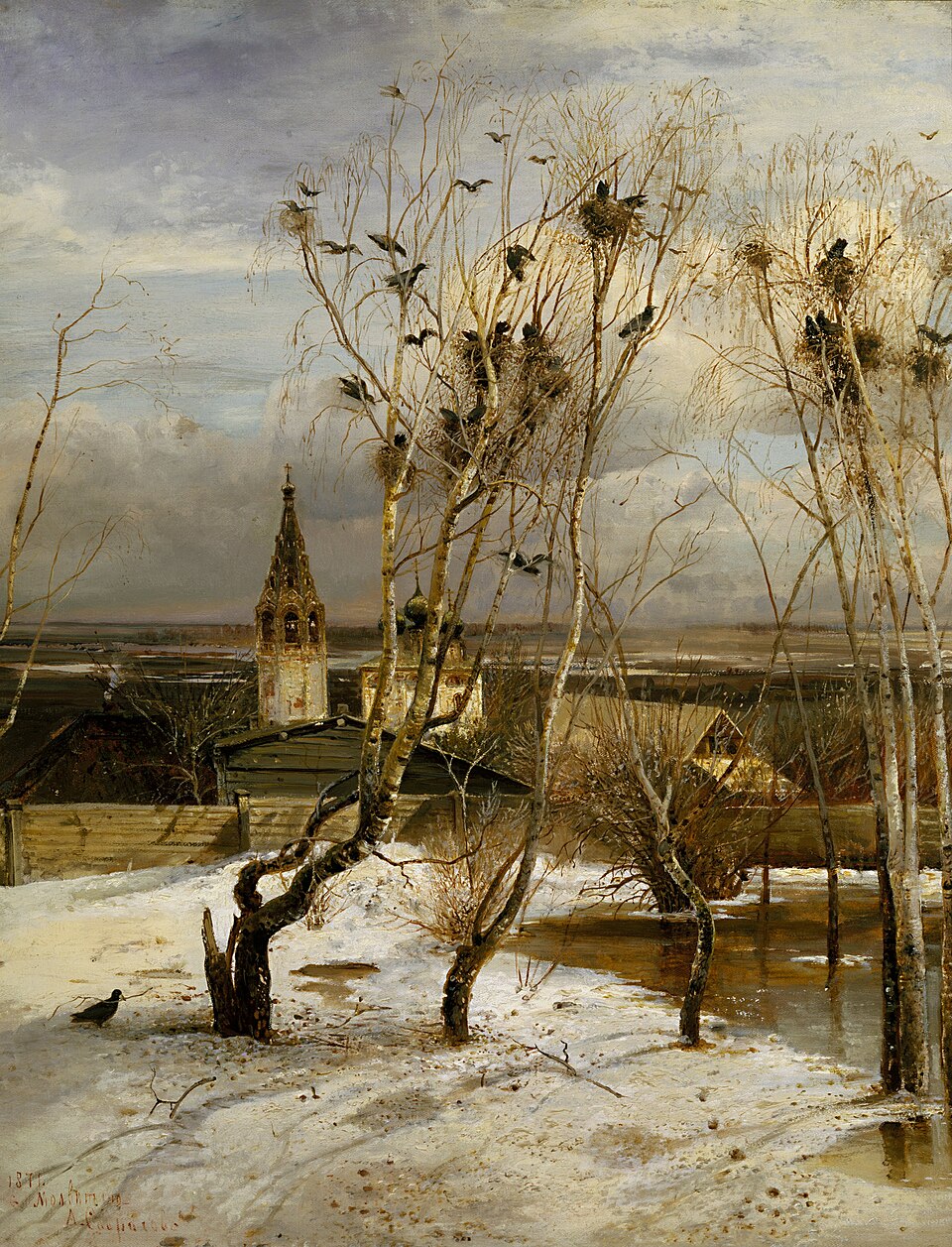
The Rooks Have Returned, Alexei Savrasov, 1871. Image: Wikimedia Commons, public domain Do this: Look at the picture together for a quiet minute before anyone talks.
Read aloud: This painting is small and quiet, but it became the most famous spring painting in Russia. It is all grays, browns and whites, and yet it feels full of hope, because the birds have come back.
Point and find:
- Find the rooks. What are they building?
- Is the snow fresh or melting? How can you tell?
- Find the church and its bell tower.
- What kind of trees are these?
Ask:
- “What is the first sign of spring where you live?”
- “Why does this picture feel hopeful?”
Show: Name the big black bird that comes back first in spring.
Say this: “It is the rook.”
Say this: “Rook is грач.”
Answer: Грач.
Show: Say “a small gray sparrow”.
Say this: “Воробе́й is masculine.”
Say this: “Masculine endings: ма́ленький, се́рый.”
Answer: Ма́ленький се́рый воробе́й.
Do this: Ask out loud. Let your child try first; help only after a real try.
Ask: Say bird in Russian.
Listen for: Пти́ца.
Ask: Say owl in Russian.
Listen for: Сова́.
Ask: Say sparrow and swallow in Russian.
Listen for: Воробе́й, ла́сточка.
3 more on the lesson page.
Read aloud: Make a nest with paper strips and paper birds, labeled in Russian.
Steps:
- Glue brown strips all around the bowl to make a nest.
- Make two paper birds (rooks or sparrows) and three small eggs.
- Label: гнездо́, пти́ца, грач or воробе́й.
- Tell the family in Russian: Э́то гнездо́. Э́то грач.
Tips for you:
- Look up the Russian word for egg (яйцо́) and label the eggs.
Done when your child can say:
- My nest has birds and labels.
- I can name the birds and the nest in Russian.
Do this: Your child picks one or more; you write the date.
- In your notebook, draw four birds and a nest, and label each in Russian with a color word that matches (чёрный грач, се́рый воробе́й…).
Read aloud: The swallow is a beloved spring bird in Russia. A Russian saying goes: Ла́сточка весну́ начина́ет (the swallow begins the spring). Children in old villages baked bird-shaped buns called жа́воронки (larks) to welcome the birds back.
- Saying tee-tsa without the p. Say both: PTEE-tsuh.
- Saying vo-RO-bey. The loud part is at the end: vuh-rah-BYAY.
Make bingo cards with pictures of the six birds and the nest. A parent calls the Russian words; the student marks them. Bingo is called in Russian: Гнездо́!
Say this: “Tell me what you learned today.”
Listen for: Name six birds and a nest in Russian.; Look closely at The Rooks Have Returned.; Know that God cares for the smallest bird.
Are not two sparrows sold for a farthing? and one of them shall not fall on the ground without your Father.
Russian Synodal Bible (1876): <i class="ru-bible" lang="ru">Не две ли малые птицы продаются за ассарий? И ни одна из них не упадет на землю без воли Отца вашего</i> Sparrows were cheap, but not one falls without God knowing. Jesus said we are worth more than many sparrows.
Spread over the week
3 sessions of 20–30 minutes. Stop while it is still going well.
- Session 1. Warm-up, then read and teach the new idea and the new words. Picture study and show how.
- Session 2. Practice together, then start the project. Finish the project, then the sketchbook.
- Session 3. Narration, the game and the Scripture.