Parent guide · Grade 1 Spanish · Unit 5
Lesson 5.2 The Fruits God Made
Written for the parent. The Read aloud parts are written to your child; read them as they are. Do this parts are for you. Answers for you are marked Listen for.
At a glance
- Time
- 3 sessions of 15–20 minutes
- Goal
- Name fruits in Spanish: la manzana, la naranja, el plátano, las uvas, la fresa, la pera. Say Me gusta... (I like...). Learn the fruit of the Spirit.
- You need
- A large sheet of paper
- Colored paper for fruits
- Crayons, scissors and glue
- A sketchbook or plain paper, and crayons
- A King James Bible
- Worksheet A · the lesson page (it also has a short video (3:51))
Steps
Do this together: What is your favorite fruit? Is it red, yellow, orange or purple? Today you learn the names of fruits in Spanish, and a different kind of fruit that grows in a Christian's heart.
Read aloud: The story. Luis Meléndez was a Spanish painter who lived in Madrid about two hundred and fifty years ago. He wanted very much to be the king's own painter, but the job always went to someone else, and he was never rich. So he painted what he loved: plain, good food. For the prince of Spain, he painted a whole set of pictures of the fruits and foods that grew in Spain, so that the prince could see the good gifts of his country. In this painting there are bright, round oranges, some with green leaves still on their stems, a plate piled high with walnuts, a big green melon, wooden boxes of sweets, and clay jugs with paper tied over their tops. Meléndez painted the oranges so well that their bumpy skin seems to shine in the light. God made every fruit, and gave them to us to enjoy.
Read aloud: How Spanish sounds. Naranja has the breathy j: nah-RAHN-hah. Plátano leans on the first part, as the accent shows: PLAH-tah-noh. To say what you like, use Me gusta with one thing (Me gusta la manzana) and Me gustan with more than one (Me gustan las uvas).
Read aloud: Say it and move. Pretend to bite an apple: la manzana. Peel an orange: la naranja. Peel a banana: el plátano. Pop grapes in your mouth: las uvas. Rub your tummy and smile: ¡Me gusta!
Do this: Say each word clearly; your child says it back twice. Point to a picture or the real thing when you can.
- la manzana [lah mahn-SAH-nah]: the apple
- la naranja [lah nah-RAHN-hah]: the orange
- el plátano [ehl PLAH-tah-noh]: the banana
- las uvas [lahs OO-bahs]: the grapes
- la fresa [lah FREH-sah]: the strawberry
- la pera [lah PEH-rah]: the pear
- me gusta [meh GOO-stah]: I like
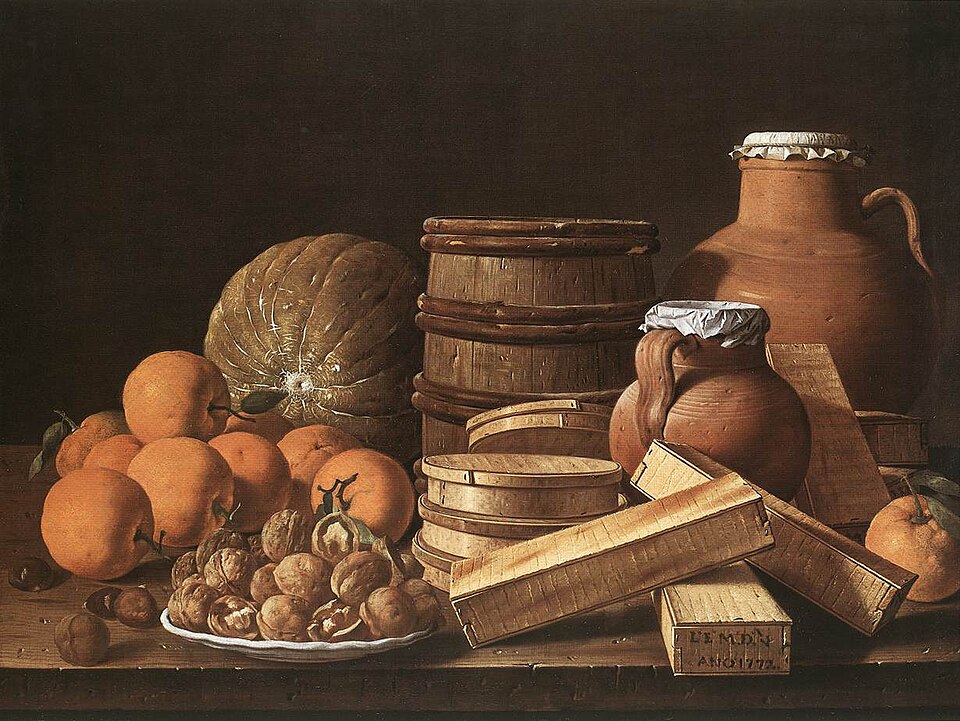
Still Life with Oranges and Walnuts, Luis Egidio Meléndez, 1772. Image: Wikimedia Commons, public domain Do this: Look at the picture together for a quiet minute before anyone talks.
Read aloud: Luis Meléndez signed his name on one of the wooden boxes in this painting. He set ordinary things on a plain table and lit them so that each one seems real enough to touch. The oranges glow against the dark background like little suns.
Point and find:
- Count the oranges in Spanish.
- Find the walnuts. What are they sitting on?
- Find the big melon. What color is it?
- Find the wooden boxes. Can you see writing on one of them?
Ask:
- “Which food in this painting would you most like to eat?”
- “Why do you think Meléndez painted plain food instead of grand things?”
Show: You love apples. Say it in Spanish.
Say this: “Apple is la manzana.”
Say this: “For one thing, say me gusta.”
Answer: Me gusta la manzana.
Show: You love grapes. Say it in Spanish.
Say this: “Grapes are las uvas: more than one.”
Say this: “For more than one, say me gustan.”
Answer: Me gustan las uvas.
Do this: Ask out loud. Let your child try first; help only after a real try.
Ask: What is la manzana?
Listen for: The apple.
Ask: What is el plátano?
Listen for: The banana.
Ask: How do you say the orange in Spanish?
Listen for: La naranja.
3 more on the lesson page.
Read aloud: Make a tree with paper fruits. On the front of each fruit, write the fruit's Spanish name; on the back, one fruit of the Spirit.
Steps:
- Draw a big tree trunk and branches on the paper.
- Cut out fruits: a red apple, an orange, a yellow banana, purple grapes, a red strawberry, a green pear.
- A parent writes the Spanish name on each fruit: la manzana, la naranja, el plátano, las uvas, la fresa, la pera. Trace them.
- On the back of each fruit write one fruit of the Spirit in English: love, joy, peace, patience, kindness, goodness.
- Glue the fruits on the tree. Name each fruit in Spanish, then turn it over and read the fruit of the Spirit.
Tips for you:
- Ask: how can I show love (or joy, or kindness) today?
- Hang your tree where the family eats.
Done when your child can say:
- My tree has six fruits with Spanish names.
- I can name the fruits in Spanish and say Me gusta...
Do this: Your child picks one or more; you write the date.
- Draw six fruits and label them in Spanish.
- Draw your favorite fruit and write Me gusta... under it.
Read aloud: Oranges have grown in Spain for more than a thousand years, and the city of Valencia, by the sea, is famous for its orange groves. The Spanish brought orange trees to the Americas, to Florida and California, where they grow to this day.
- Saying naranja with an English j. It is a breathy h: nah-RAHN-hah.
- Saying me gusta las uvas. For more than one thing, say me gustan: Me gustan las uvas.
Sit in a circle; each player is a fruit (la manzana, la naranja, el plátano, las uvas). The leader calls out two fruits in Spanish, and those two players switch seats. When the leader calls ¡Canasta de frutas! (fruit basket!), everyone switches. Name your fruit each time you sit down.
Say this: “Tell me what you learned today.”
Listen for: Name fruits in Spanish: la manzana, la naranja, el plátano, las uvas, la fresa, la pera.; Say Me gusta... (I like...).; Learn the fruit of the Spirit.
But the fruit of the Spirit is love, joy, peace, longsuffering, gentleness, goodness, faith,
In the Spanish Bible this verse begins Mas el fruto del Espíritu es: caridad, gozo, paz: but the fruit of the Spirit is love, joy, peace. Fruta is the fruit we eat; fruto is the fruit God grows in our hearts.
Spread over the week
3 sessions of 15–20 minutes. Stop while it is still going well.
- Session 1. Warm-up, then read and teach the new idea and the new words. Picture study and show how.
- Session 2. Practice together, then start the project. Finish the project, then the sketchbook.
- Session 3. Narration, the game and the Scripture.