Parent guide · Grade 2 Spanish · Unit 5
Lesson 5.2 Christmas
Written for the parent. The Read aloud parts are written to your child; read them as they are. Do this parts are for you. Answers for you are marked Listen for.
At a glance
- Time
- 3 sessions of 15–20 minutes
- Goal
- Name the people of the Christmas story in Spanish: María, José, el niño Jesús, los pastores, el ángel, los Reyes Magos.; Say ¡Feliz Navidad!; Learn Luke 2:11, the good news of the Savior's birth.
- You need
- Cardstock
- Crayons, scissors and tape
- A shoebox for the stable
- A sketchbook or plain paper, and crayons
- A King James Bible
- Worksheet A · the lesson page (it also has a short video (4:14))
Steps
Do this together: What is the best day of the year? Why do we celebrate Christmas? Who came to see the baby Jesus? Today you learn the Christmas story in Spanish.
Read aloud: The story. On the night Jesus was born in Bethlehem, shepherds were watching their sheep in the fields. An angel appeared to them, and said: Fear not: for, behold, I bring you good tidings of great joy. For unto you is born this day in the city of David a Saviour, which is Christ the Lord. The shepherds hurried to Bethlehem and found Mary, Joseph and the baby lying in a manger. Murillo painted that moment. In a dark stable, Mary gently lifts the white cloth so the shepherds can see her baby. The light seems to shine from the child himself. Joseph stands behind her. An old shepherd kneels and bows low before the baby, and others crowd close, bringing gifts from the fields: a lamb with its feet tied, a basket, a jug. Up above, angels hover in the dark. Later, the wise men, los Reyes Magos, followed a star and brought gold, frankincense and myrrh.
Read aloud: How Spanish sounds. Navidad ends with a soft d, almost like the th in this: nah-bee-DAHD. Jesús begins with the breathy j: heh-SOOS. To wish someone Merry Christmas, say ¡Feliz Navidad!, using feliz, the happy word you already know.
Read aloud: Say it and move. Rock a baby in your arms: el niño Jesús. Lean on a pretend staff: los pastores. Flap your wings: el ángel. Wear a pretend crown and carry a gift: los Reyes Magos. Throw your arms wide: ¡Feliz Navidad!
Do this: Say each word clearly; your child says it back twice. Point to a picture or the real thing when you can.
- la Navidad [lah nah-bee-DAHD]: Christmas
- el niño Jesús [ehl NEE-nyoh heh-SOOS]: the baby Jesus
- el pastor [ehl pahs-TOHR]: the shepherd
- la oveja [lah oh-BEH-hah]: the sheep
- el ángel [ehl AHN-hehl]: the angel
- los Reyes Magos [lohs REH-yehs MAH-gohs]: the wise men, the three kings
- la estrella [lah ehs-TREH-yah]: the star
- el Salvador [ehl sahl-bah-DOHR]: the Savior
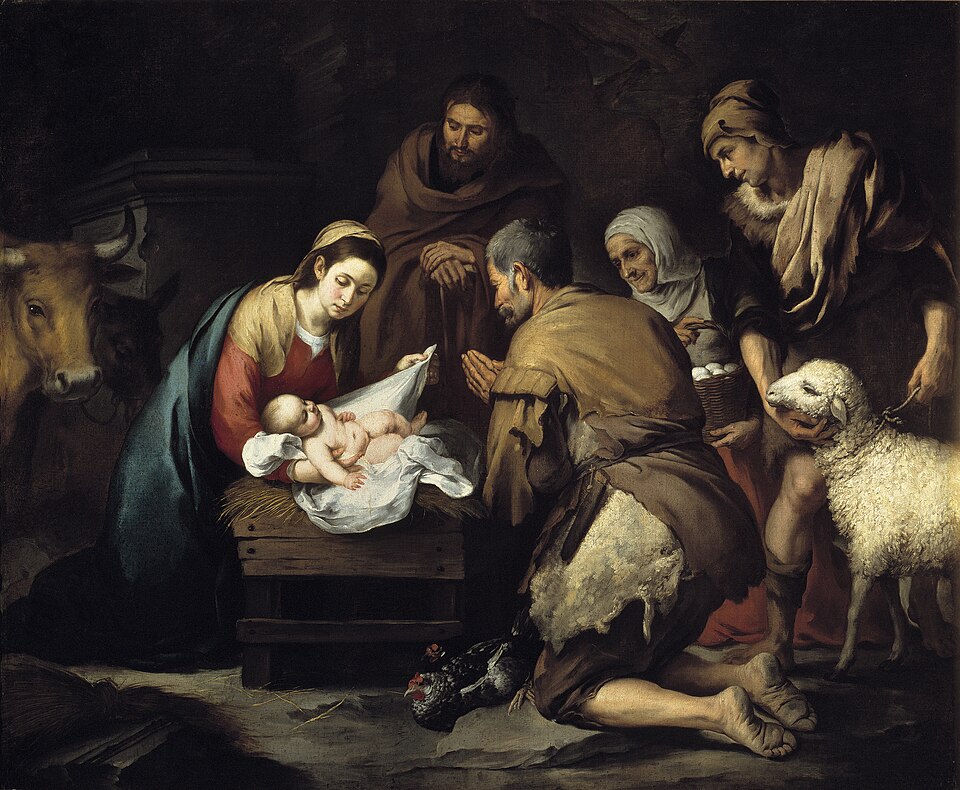
The Adoration of the Shepherds, Bartolomé Esteban Murillo, about 1650. Image: Wikimedia Commons, public domain Do this: Look at the picture together for a quiet minute before anyone talks.
Read aloud: Murillo painted this while he was young, using strong light and deep shadows. He gave the shepherds the faces and rough clothes of the country people of Andalusia, the region around Seville, so that people in his day would feel that they, too, were kneeling at the manger.
Point and find:
- Find Mary. What is she doing?
- Find the baby Jesus. Where does the light come from?
- Find the lamb. Say la oveja.
- Find the old shepherd. How is he showing honor to Jesus?
Ask:
- “Why do you think the shepherds brought a lamb?”
- “What gift can you bring to Jesus this Christmas?”
Show: Who came first to see the baby, after the angel told them? Answer in Spanish.
Say this: “They were watching sheep in the fields.”
Say this: “Shepherds are los pastores.”
Answer: Los pastores.
Show: Wish your grandmother Merry Christmas in Spanish.
Say this: “Happy is feliz; Christmas is Navidad.”
Answer: ¡Feliz Navidad, abuela!
Do this: Ask out loud. Let your child try first; help only after a real try.
Ask: What is la Navidad?
Listen for: Christmas.
Ask: Who are los Reyes Magos?
Listen for: The wise men (the three kings).
Ask: How do you say Merry Christmas in Spanish?
Listen for: ¡Feliz Navidad!
3 more on the lesson page.
Read aloud: Make Nativity figures from paper and label them in Spanish for the Christmas play.
Steps:
- Draw and cut out figures: María, José, el niño Jesús, two pastores, una oveja, el ángel, and three Reyes Magos.
- Write the Spanish name on the back of each figure.
- Fold a strip at the bottom of each so it stands up.
- Turn the shoebox on its side to make the stable, and draw a star (la estrella) above it.
- Set up the Nativity and name each figure in Spanish.
Tips for you:
- Bring the Reyes Magos in slowly from across the room, one day at a time, as families do in Spain.
- Use the figures for the play at the end of the unit.
Done when your child can say:
- I made at least eight Nativity figures labeled in Spanish.
- I can tell the Christmas story with the Spanish names.
Do this: Your child picks one or more; you write the date.
- Draw the stable with Mary, Joseph and the baby, and label them in Spanish.
- Copy: ¡Feliz Navidad!
Read aloud: In Spain and Latin America, Christmas Eve is called Nochebuena, the good night, and families eat a big supper together and go to midnight Mass or church. On January 6, the day of los Reyes Magos, children wake up to find gifts left by the three kings, and families eat a ring-shaped cake called the roscón or rosca de reyes.
- Saying Navidad with a hard English d at the end. It is soft: nah-bee-DAHD.
- Saying Jesús with an English j. It is heh-SOOS.
One player chooses a Nativity figure secretly and acts it out: rocking a baby, holding a staff, carrying a gift, flapping wings. The others guess in Spanish: ¿Eres un pastor? ¿Eres el ángel? The player answers Sí or No.
Say this: “Tell me what you learned today.”
Listen for: Name the people of the Christmas story in Spanish: María, José, el niño Jesús, los pastores, el ángel, los Reyes Magos.; Say ¡Feliz Navidad!; Learn Luke 2:11, the good news of the Savior's birth.
For unto you is born this day in the city of David a Saviour, which is Christ the Lord.
In the Spanish Bible this verse says Que os ha nacido hoy, en la ciudad de David, un Salvador, que es CRISTO el Señor: for unto you is born this day, in the city of David, a Savior, who is Christ the Lord. This is the good news of Navidad.
Spread over the week
3 sessions of 15–20 minutes. Stop while it is still going well.
- Session 1. Warm-up, then read and teach the new idea and the new words. Picture study and show how.
- Session 2. Practice together, then start the project. Finish the project, then the sketchbook.
- Session 3. Narration, the game and the Scripture.