Parent guide · Grade 1 French · Unit 3
Lesson 3.2 Aujourd’hui, Hier, Demain
Written for the parent. The Read aloud parts are written to your child; read them as they are. Do this parts are for you. Answers for you are marked Listen for.
At a glance
- Time
- 3 sessions of 15–20 minutes
- Goal
- Say today, yesterday and tomorrow in French. Sing the rhyme Lundi matin. Tell why Sunday is the Lord’s day.
- You need
- Three index cards
- Crayons
- A sketchbook or plain paper, and crayons
- A King James Bible
- Worksheet A · the lesson page (it also has a short video (2:25))
Steps
Do this together: Say the seven days in French. Then: what day is it today? What day was it yesterday? What day will it be tomorrow?
Read aloud: The story. In France about a hundred and seventy years ago, a farmer and his wife were digging potatoes in a wide field. Far away, the church bell began to ring. It was the Angelus bell, which rang morning, noon and evening to call people to stop and pray. The farmer took off his hat, his wife folded her hands, and they bowed their heads right there in the field. A painter named Jean-François Millet had grown up on a farm and remembered his grandmother stopping to pray when the bell rang. He painted this quiet moment, and it became one of the most famous paintings in France.
Read aloud: How French sounds. Aujourd’hui is a long word: oh-zhoor-DWEE. It really means on the day of today. In demain and matin, the ain and in are hummed through the nose: duh-MAN, mah-TAN.
Read aloud: Say it and move. Point down at the floor: aujourd’hui! Point behind you: hier! Point ahead: demain! Stretch and yawn: le matin!
Do this: Say each word clearly; your child says it back twice. Point to a picture or the real thing when you can.
- aujourd’hui [oh-zhoor-DWEE]: today
- hier [YEHR]: yesterday
- demain [duh-MAN]: tomorrow
- le matin [luh mah-TAN]: morning
- le soir [luh SWAHR]: evening
- la semaine [lah suh-MEN]: week
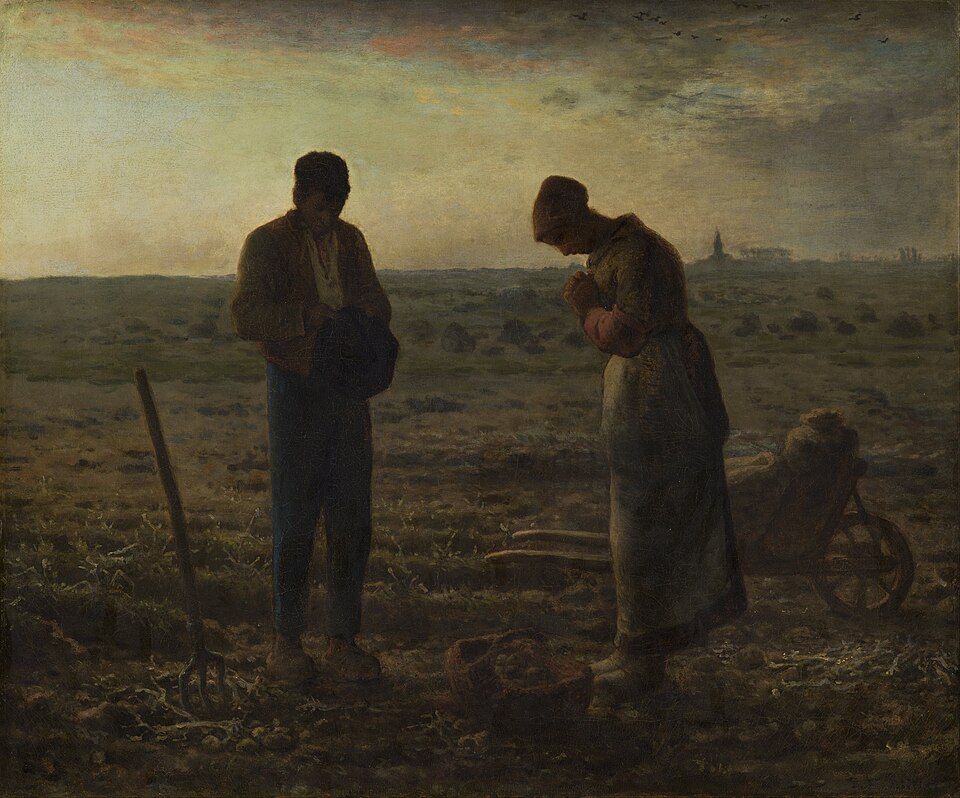
The Angelus, Jean-François Millet, 1857–1859. Image: Wikimedia Commons, public domain Do this: Look at the picture together for a quiet minute before anyone talks.
Read aloud: Millet painted farm people at work, plainly and with respect. Here a couple stops digging potatoes when the evening bell rings from the far-off church. Their heads are bowed, and the light of the setting sun glows behind them. Millet said he remembered how his grandmother, hearing the bell, would make the family stop and pray for the dead.
Point and find:
- Find the church steeple. Where is it?
- What is the farmer holding?
- What are the two people doing?
- Find the basket. What do you think is in it?
Ask:
- “When does your family stop to pray?”
- “Why do you think Millet painted the sky so bright?”
Show: Today is mardi. What day was yesterday?
Say this: “Yesterday is the day before.”
Say this: “Before mardi comes lundi.”
Answer: Hier, c’était lundi.
Show: Today is samedi. What day is tomorrow?
Say this: “Tomorrow is the day after.”
Say this: “After samedi comes dimanche.”
Answer: Demain, c’est dimanche.
Do this: Ask out loud. Let your child try first; help only after a real try.
Ask: Say today in French.
Listen for: Aujourd’hui.
Ask: Say tomorrow in French.
Listen for: Demain.
Ask: Say yesterday in French.
Listen for: Hier.
3 more on the lesson page.
Read aloud: Make three cards and use them each morning to talk about the days.
Steps:
- A parent writes hier, aujourd’hui and demain on the cards.
- Draw an arrow pointing back on hier, a dot on aujourd’hui and an arrow pointing ahead on demain.
- Each morning, lay out the cards and say: Hier, c’était… Aujourd’hui, c’est… Demain, c’est… with the days.
- A parent helps the first few times.
Tips for you:
- Use your calendar from Lesson 3.1 to check.
- On dimanche, add: C’est le jour du Seigneur! (It is the Lord’s day!)
Done when your child can say:
- I made three day cards.
- I can say what day it is today.
Do this: Your child picks one or more; you write the date.
- Draw yourself yesterday, today and tomorrow in three boxes. A parent writes hier, aujourd’hui and demain.
Read aloud: Millet’s Angelus was so loved that it was sold, bought back and fought over by collectors in France and America. Today it hangs in the Musée d’Orsay in Paris.
- Saying the h in hier. It is quiet: YEHR.
- Saying demain with an English ain. It is hummed: duh-MAN.
A parent says something like I went to the park, or We will go to church. Point behind you for hier or ahead for demain, and say the word.
Say this: “Tell me what you learned today.”
Listen for: Say today, yesterday and tomorrow in French.; Sing the rhyme Lundi matin.; Tell why Sunday is the Lord’s day.
Remember the sabbath day, to keep it holy.
In the French Bible of Louis Segond (1910), this verse reads: <i lang="fr">Souviens-toi du jour du repos, pour le sanctifier.</i> God gave us a day of rest to keep holy. Christians worship on dimanche, the day Jesus rose from the dead. It is the Lord’s day.
Spread over the week
3 sessions of 15–20 minutes. Stop while it is still going well.
- Session 1. Warm-up, then read and teach the new idea and the new words. Picture study and show how.
- Session 2. Practice together, then start the project. Finish the project, then the sketchbook.
- Session 3. Narration, the game and the Scripture.