Parent guide · Grade 1 French · Unit 4
Lesson 4.1 J’aime les Fruits
Written for the parent. The Read aloud parts are written to your child; read them as they are. Do this parts are for you. Answers for you are marked Listen for.
At a glance
- Time
- 3 sessions of 15–20 minutes
- Goal
- Name five fruits in French. Say J’aime… (I like…) and Je n’aime pas… (I don’t like…). Look closely at a painting of apples.
- You need
- Three or four pieces of fruit, a cloth or napkin
- Paper and crayons or colored pencils
- A sketchbook or plain paper, and crayons
- A King James Bible
- Worksheet A · the lesson page (it also has a short video (1:53))
Steps
Do this together: Put some fruit on the table, or pictures of fruit. Which is your favorite? Today you learn to name them in French.
Read aloud: The story. Paul Cézanne was a painter from the south of France who loved to paint apples. He would set a few apples on a table with a white cloth and a jug, and then look at them for a long time, days and even weeks, painting slowly. He wanted to show how round and solid and heavy they were. Once he said he wanted to astonish Paris with an apple! Painters all over the world learned from his apples. And who made the apples? God did, on the third day, when He made every tree that bears fruit.
Read aloud: How French sounds. In pomme, the o is short and the e is quiet: PUM. In poire, oi says wah: PWAHR. In fraise, the s between vowels buzzes: FREZ. J’aime sounds like ZHEM.
Read aloud: Say it and move. Rub your tummy and smile: J’aime les pommes! Shake your head and frown: Je n’aime pas… Pretend to peel a banana: la banane! Pick a strawberry from the ground: la fraise!
Do this: Say each word clearly; your child says it back twice. Point to a picture or the real thing when you can.
- la pomme [lah PUM]: apple
- la poire [lah PWAHR]: pear
- la banane [lah bah-NAHN]: banana
- l’orange [loh-RAHNZH]: orange
- la fraise [lah FREZ]: strawberry
- j’aime [ZHEM]: I like
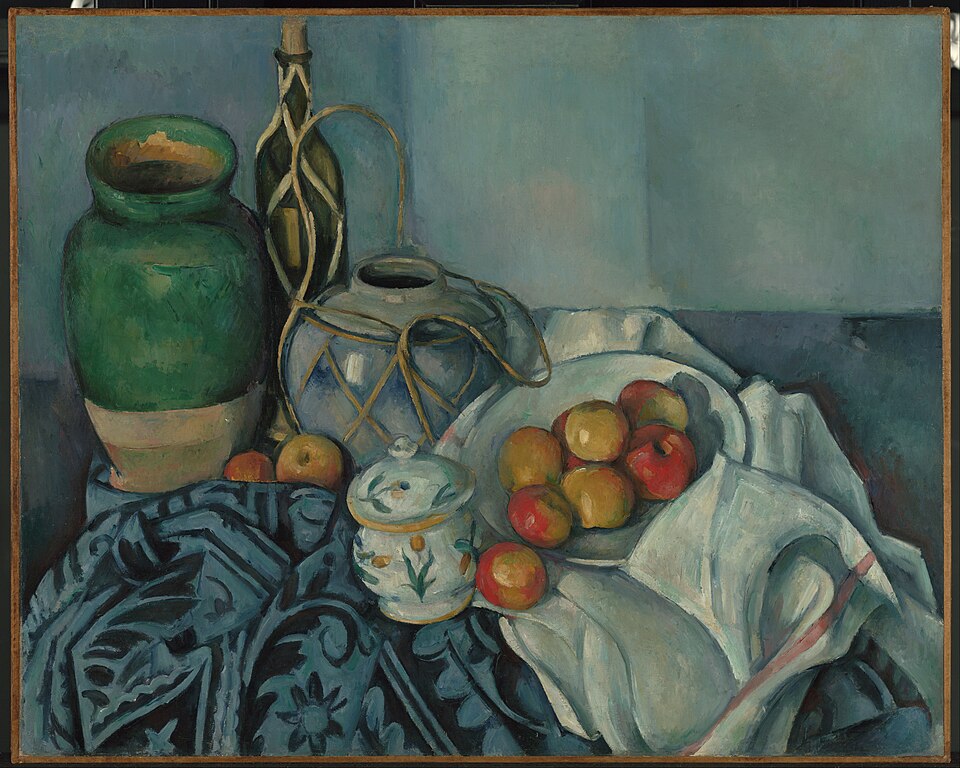
Still Life with Apples, Paul Cézanne, 1893–94. Image: Wikimedia Commons, public domain Do this: Look at the picture together for a quiet minute before anyone talks.
Read aloud: Cézanne set up his apples, cloths and jars very carefully, sometimes propping the fruit up with coins so it would sit just right. Then he painted slowly, building each apple out of little patches of color, red, yellow, green, so it looks round and heavy. The table even seems to tip a little toward us, as if he wanted us to see every apple.
Point and find:
- Count the apples you can see.
- Which colors are the apples?
- Find the white cloth. Is it smooth or wrinkly?
- Find the little white pot with flowers on it. What do you think is inside?
Ask:
- “Which apple would you pick to eat?”
- “Set up some fruit on a cloth and look at it closely. What do you notice?”
Show: How do you say I like strawberries?
Say this: “Strawberries are les fraises.”
Say this: “I like is j’aime.”
Answer: J’aime les fraises.
Show: What fruit is yellow and long?
Say this: “That is a banana.”
Say this: “Banana is la banane.”
Answer: La banane.
Do this: Ask out loud. Let your child try first; help only after a real try.
Ask: Say apple in French.
Listen for: La pomme.
Ask: Say pear in French.
Listen for: La poire.
Ask: Say strawberry in French.
Listen for: La fraise.
3 more on the lesson page.
Read aloud: Set up your own still life like Cézanne and draw it, with French labels.
Steps:
- Put a cloth on the table and arrange the fruit on it.
- Look closely: what colors do you see on each fruit?
- Draw the fruit and the cloth.
- A parent writes the French names next to each fruit: la pomme, la poire…
- Then eat one and say J’aime la pomme!
Tips for you:
- Look for more than one color on each fruit, like Cézanne.
- Sign your picture like a painter.
Done when your child can say:
- My drawing has at least three fruits.
- Each fruit has its French name.
Do this: Your child picks one or more; you write the date.
- Draw five fruits. A parent writes la pomme, la poire, la banane, l’orange and la fraise. Put a heart next to the ones you like.
Read aloud: In French, a potato is a pomme de terre, an apple of the earth.
- Saying pomme like pome. It is short: PUM.
- Forgetting the little ne… pas around aime: Je n’aime pas.
Each player is a fruit: la pomme, la poire, la banane. Sit in a circle. When the caller says a fruit, those players swap seats. When the caller says Corbeille de fruits! (fruit basket!), everyone swaps.
Say this: “Tell me what you learned today.”
Listen for: Name five fruits in French.; Say J’aime… (I like…) and Je n’aime pas… (I don’t like…).; Look closely at a painting of apples.
And God said, Behold, I have given you every herb bearing seed, which is upon the face of all the earth, and every tree, in the which is the fruit of a tree yielding seed; to you it shall be for meat.
In the French Bible of Louis Segond (1910), this verse reads: <i lang="fr">tout arbre ayant en lui du fruit d’arbre et portant de la semence: ce sera votre nourriture.</i> God gave people the fruit of the trees for food. Every apple and strawberry is a gift from Him.
Spread over the week
3 sessions of 15–20 minutes. Stop while it is still going well.
- Session 1. Warm-up, then read and teach the new idea and the new words. Picture study and show how.
- Session 2. Practice together, then start the project. Finish the project, then the sketchbook.
- Session 3. Narration, the game and the Scripture.