Parent guide · Grade 1 French · Unit 5
Lesson 5.2 Quel Temps Fait-il?
Written for the parent. The Read aloud parts are written to your child; read them as they are. Do this parts are for you. Answers for you are marked Listen for.
At a glance
- Time
- 3 sessions of 15–20 minutes
- Goal
- Ask Quel temps fait-il? (What is the weather?). Answer il fait beau, il pleut, il neige, il fait chaud, il fait froid. Choose clothes for the weather in French.
- You need
- A paper plate, a paper arrow and a brass fastener (or a pencil point)
- Crayons
- A sketchbook or plain paper, and crayons
- A King James Bible
- Worksheet A · the lesson page (it also has a short video (1:44))
Steps
Do this together: Look out the window. Is it sunny, rainy, hot or cold? Today you learn to say it in French.
Read aloud: The story. Gustave Caillebotte lived in Paris when the city was being rebuilt with wide new streets and tall cream-colored buildings. One rainy day he painted a street corner where the roads meet like the spokes of a wheel. The paving stones shine with rain. A man in a top hat and a lady in a veil walk together under one big umbrella. Other people hurry by under their umbrellas too. If you asked them Quel temps fait-il?, they would say Il pleut! It is raining!
Read aloud: How French sounds. French talks about weather with il fait, it makes: il fait beau, it makes nice; il fait froid, it makes cold. In pleut, round your lips: PLUH. In froid, oi says wah: FRWAH.
Read aloud: Say it and move. Make a sun with your arms: il fait beau! Wiggle your fingers down like rain: il pleut! Catch snowflakes: il neige! Fan yourself: il fait chaud! Shiver: il fait froid!
Do this: Say each word clearly; your child says it back twice. Point to a picture or the real thing when you can.
- quel temps fait-il? [kel tahn feh-TEEL]: what is the weather like?
- il fait beau [eel feh BOH]: it is nice out
- il pleut [eel PLUH]: it is raining
- il neige [eel NEZH]: it is snowing
- il fait chaud [eel feh SHOH]: it is hot
- il fait froid [eel feh FRWAH]: it is cold
- le parapluie [luh pah-rah-PLWEE]: umbrella
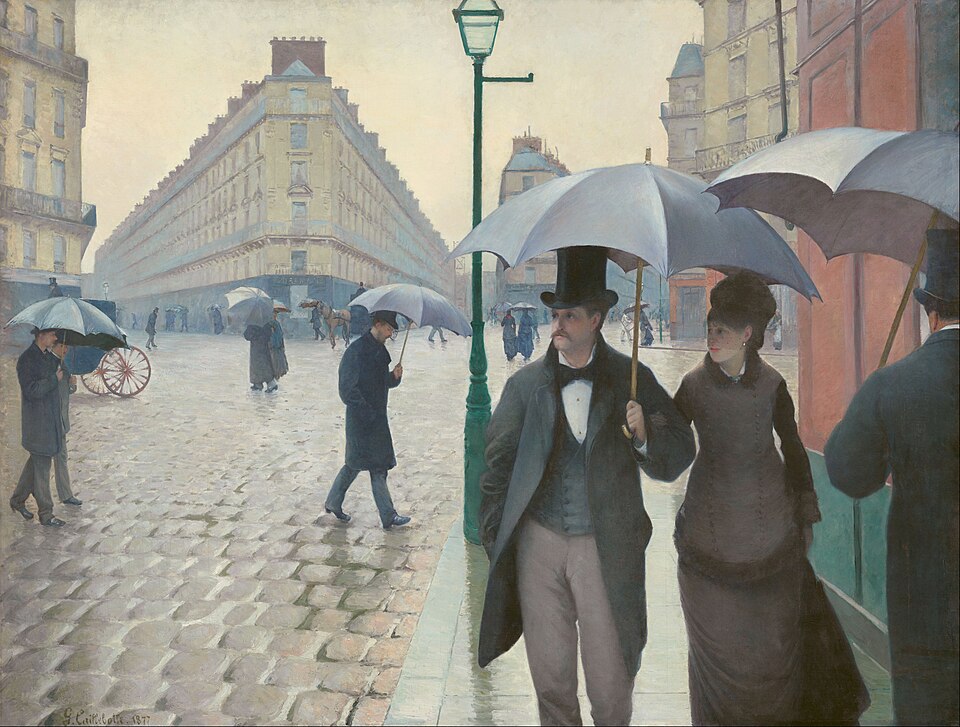
Paris Street; Rainy Day, Gustave Caillebotte, 1877. Image: Wikimedia Commons, public domain Do this: Look at the picture together for a quiet minute before anyone talks.
Read aloud: Caillebotte painted this huge picture of his own neighborhood in Paris. Everything is gray and gleaming with rain: the umbrellas, the stones, the sky. The green lamppost divides the picture in two. The couple in front walk right toward us, as if we are about to bump into them on the sidewalk.
Point and find:
- Count the umbrellas you can see.
- Find the green lamppost. What is it for?
- How do you know it is raining?
- Find the carriage wheel far away.
Ask:
- “What do you wear when it rains?”
- “Do you like rainy days? Why?”
Show: Snow is falling. What do you say?
Say this: “Snow falling is il neige.”
Answer: Il neige.
Show: It is very hot. Quel temps fait-il?
Say this: “Hot is chaud.”
Say this: “Say il fait chaud.”
Answer: Il fait chaud.
Do this: Ask out loud. Let your child try first; help only after a real try.
Ask: Say it is raining in French.
Listen for: Il pleut.
Ask: Say it is nice out in French.
Listen for: Il fait beau.
Ask: Say it is cold in French.
Listen for: Il fait froid.
3 more on the lesson page.
Read aloud: Make a weather wheel and turn it to today’s weather each morning.
Steps:
- Divide the plate into five slices.
- Draw a sun, rain, snow, a hot sun with a thermometer and a snowman: one in each slice.
- A parent writes il fait beau, il pleut, il neige, il fait chaud, il fait froid; trace them.
- Attach the arrow in the middle.
- Every morning, ask Quel temps fait-il? and turn the arrow.
Tips for you:
- Dress your paper doll from Lesson 5.1 for the weather.
- Keep a weather chart for a week.
Done when your child can say:
- My wheel shows five kinds of weather.
- I can say today’s weather in French.
Do this: Your child picks one or more; you write the date.
- Draw five little pictures of weather. A parent writes the French under each one.
Read aloud: Paris gets rain on many days of the year, so umbrellas are everywhere. Long ago, umbrella sellers stood on Paris street corners calling out to people caught in the rain.
- Saying il fait froid as il est froid. For weather, French uses il fait.
- Saying the d in froid. It is quiet: FRWAH.
A parent calls out the weather in French: il neige! Grab the right clothes from a pile and put them on: le manteau, le chapeau! Then il fait chaud! Take them off fast!
Say this: “Tell me what you learned today.”
Listen for: Ask Quel temps fait-il? (What is the weather?).; Answer il fait beau, il pleut, il neige, il fait chaud, il fait froid.; Choose clothes for the weather in French.
While the earth remaineth, seedtime and harvest, and cold and heat, and summer and winter, and day and night shall not cease.
In the French Bible of Louis Segond (1910), this verse reads: <i lang="fr">Tant que la terre subsistera, les semailles et la moisson, le froid et la chaleur, l’été et l’hiver, le jour et la nuit ne cesseront point.</i> After the flood God promised that seedtime and harvest, cold and heat, summer and winter, would not stop. Every kind of weather comes from His faithful hand.
Spread over the week
3 sessions of 15–20 minutes. Stop while it is still going well.
- Session 1. Warm-up, then read and teach the new idea and the new words. Picture study and show how.
- Session 2. Practice together, then start the project. Finish the project, then the sketchbook.
- Session 3. Narration, the game and the Scripture.