Parent guide · Grade 3 French · Unit 5
Lesson 5.1 Mon Animal
Written for the parent. The Read aloud parts are written to your child; read them as they are. Do this parts are for you. Answers for you are marked Listen for.
At a glance
- Time
- 3 sessions of 20–30 minutes
- Goal
- Name ten animals in French. Say J’ai un… / Je n’ai pas de… (I have / I don’t have). Describe animals with colors and grand / petit.
- You need
- Paper, crayons or markers
- A sketchbook or plain paper, and crayons
- A King James Bible
- Worksheet A · the lesson page (it also has a short video (8:39))
Steps
Do this together: Do you have a pet? Which animal would you most like to have? Today you learn to talk about animals in French.
Read aloud: The story. Rosa Bonheur grew up in a family of artists in France, and from a little girl she loved animals more than anything. She kept rabbits, sheep, goats and even, later, lions at her home! To paint horses truly, she went twice a week for a year and a half to the horse market in Paris, sketching the great gray and white workhorses as grooms in blue smocks led them round. Her painting The Horse Fair is enormous, more than sixteen feet wide, and it made her famous in France, England and America. God made the animals, and the psalm says, O LORD, how manifold are thy works! in wisdom hast thou made them all.
Read aloud: Animals. le chien (dog), le chat (cat), le lapin (rabbit), le poisson rouge (goldfish, literally red fish), l’oiseau (bird), le cheval (horse), la tortue (turtle), le hamster, la souris (mouse), le mouton (sheep).
Read aloud: Talking about animals. J’ai un chat noir. (I have a black cat.) J’ai deux poissons rouges. Je n’ai pas de chien. (I don’t have a dog.) Grand and petit usually come before the noun: un grand cheval blanc (a big white horse), un petit lapin gris (a little gray rabbit).
Do this: Say each word clearly; your child says it back twice. Point to a picture or the real thing when you can.
- le chien [luh SHYAN]: dog
- le chat [luh SHAH]: cat
- le lapin [luh lah-PAN]: rabbit
- le poisson rouge [luh pwah-sohn ROOZH]: goldfish
- l’oiseau [lwah-ZOH]: bird
- le cheval [luh shuh-VAHL]: horse
- la tortue [lah tor-TÜ]: turtle
- la souris [lah soo-REE]: mouse
- le mouton [luh moo-TOHN]: sheep
- grand [GRAHN]: big; tall
- petit [puh-TEE]: little; small
- j’ai [ZHAY]: I have
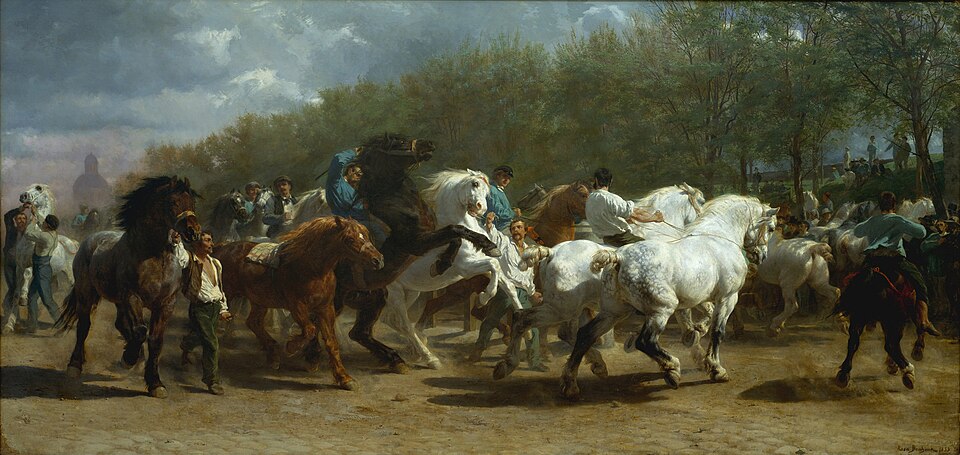
The Horse Fair, Rosa Bonheur, 1852–1855. Image: Wikimedia Commons, public domain Do this: Look at the picture together for a quiet minute before anyone talks.
Read aloud: Rosa Bonheur painted the horse market held near the Salpêtrière hospital in Paris, whose dome you can see in the distance. The horses are Percherons, huge workhorses from Normandy that pulled wagons and ploughs. Everything moves: the horses toss their heads, the grooms pull and shout, and dust rises from the ground.
Point and find:
- Find a horse rearing up on its back legs.
- What color are most of the horses?
- What are the grooms wearing?
- Find the dome in the distance.
Ask:
- “Why do you think Bonheur went to the market so many times?”
- “Which horse would you choose? Describe it in French.”
Show: Say I have a little black cat.
Say this: “Petit comes before the noun.”
Say this: “Noir comes after.”
Answer: J’ai un petit chat noir.
Show: Say I don’t have a horse.
Say this: “Je n’ai pas de + animal.”
Answer: Je n’ai pas de cheval.
Do this: Ask out loud. Let your child try first; help only after a real try.
Ask: Say rabbit in French.
Listen for: Le lapin.
Ask: Say horse in French.
Listen for: Le cheval.
Ask: Say bird in French.
Listen for: L’oiseau.
3 more on the lesson page.
Read aloud: Draw and describe your dream pet (or a real one) in French.
Steps:
- Draw your pet, real or dreamed.
- Write its name: Il s’appelle… / Elle s’appelle…
- Write two sentences with colors and size: C’est un grand chien marron.
- Present it to your family: J’ai un…
Tips for you:
- Make a poster of five animals with descriptions.
- Bring a real pet to the presentation!
Done when your child can say:
- I wrote three sentences about my animal.
- I used colors and grand or petit.
Do this: Your child picks one or more; you write the date.
- Write five sentences in your French notebook about animals you have or would like: J’ai un chat gris. Je n’ai pas de cheval.
Read aloud: In Rosa Bonheur’s day, a woman needed police permission to wear trousers in Paris. She got a permit, because skirts were impractical in the dusty horse market and the slaughterhouses where she studied animals.
- Saying les chevals. The plural is les chevaux.
- Putting grand after the noun. Say un grand chien.
Think of an animal. The others ask yes-or-no questions in French: Il est grand? Il est noir? C’est un chat? Answer oui or non until someone guesses it.
Say this: “Tell me what you learned today.”
Listen for: Name ten animals in French.; Say J’ai un… / Je n’ai pas de… (I have / I don’t have).; Describe animals with colors and grand / petit.
O LORD, how manifold are thy works! in wisdom hast thou made them all: the earth is full of thy riches.
In the Louis Segond Bible (1910): <i lang="fr">Que tes œuvres sont en grand nombre, ô Éternel! Tu les as toutes faites avec sagesse.</i> The psalmist praises God for His many works, all made in wisdom. Every animal shows something of His wisdom.
Spread over the week
3 sessions of 20–30 minutes. Stop while it is still going well.
- Session 1. Warm-up, then read and teach the new idea and the new words. Picture study and show how.
- Session 2. Practice together, then start the project. Finish the project, then the sketchbook.
- Session 3. Narration, the game and the Scripture.