Parent guide · Grade 3 French · Unit 4
Lesson 4.2 À Table!
Written for the parent. The Read aloud parts are written to your child; read them as they are. Do this parts are for you. Answers for you are marked Listen for.
At a glance
- Time
- 3 sessions of 20–30 minutes
- Goal
- Name the things on the table and six vegetables in French. Say Bon appétit and ask for food politely. Describe how a French family shares a meal and gives thanks.
- You need
- Plates, glasses, forks, knives, spoons and napkins
- Small paper cards and a pen
- A sketchbook or plain paper, and crayons
- A King James Bible
- Worksheet A · the lesson page (it also has a short video (8:09))
Steps
Do this together: Who sets the table in your house? What goes on it? Today you learn the French words for the table and the food on it.
Read aloud: The story. About three hundred years ago in Paris, the painter Jean-Siméon Chardin painted a simple family scene. A mother in a white cap and apron is setting soup bowls on a white tablecloth. Her two little children sit waiting. Before anyone eats, the younger child folds tiny hands and says the grace, the bénédicité, while the mother pauses over the table to listen. A toy drum hangs forgotten on the chair. Chardin presented the painting to King Louis XV in 1740. Saint Paul wrote, Whether therefore ye eat, or drink, or whatsoever ye do, do all to the glory of God.
Read aloud: The table. l’assiette (plate), le verre (glass), la fourchette (fork), le couteau (knife), la cuillère (spoon), la serviette (napkin). Vegetables: la carotte, la pomme de terre (potato, literally earth apple), les petits pois (peas), les haricots verts (green beans), la tomate, la salade (lettuce).
Read aloud: At a French table. When the meal is ready, someone calls À table! Everyone sits down together, and nobody starts until all are served and someone says Bon appétit! Hands rest on the table, not in the lap. To ask for something: Passe-moi le pain, s’il te plaît. (Pass me the bread, please.)
Do this: Say each word clearly; your child says it back twice. Point to a picture or the real thing when you can.
- l’assiette [lah-SYET]: plate
- le verre [luh VEHR]: glass
- la fourchette [lah foor-SHET]: fork
- le couteau [luh koo-TOH]: knife
- la cuillère [lah kwee-YEHR]: spoon
- la serviette [lah sehr-VYET]: napkin
- la carotte [lah kah-RUT]: carrot
- la pomme de terre [lah pum duh TEHR]: potato
- les petits pois [lay puh-tee PWAH]: peas
- les haricots verts [lay ah-ree-koh VEHR]: green beans
- Bon appétit! [bohn nah-pay-TEE]: Enjoy your meal!
- À table! [ah TAHBL]: Come to the table!
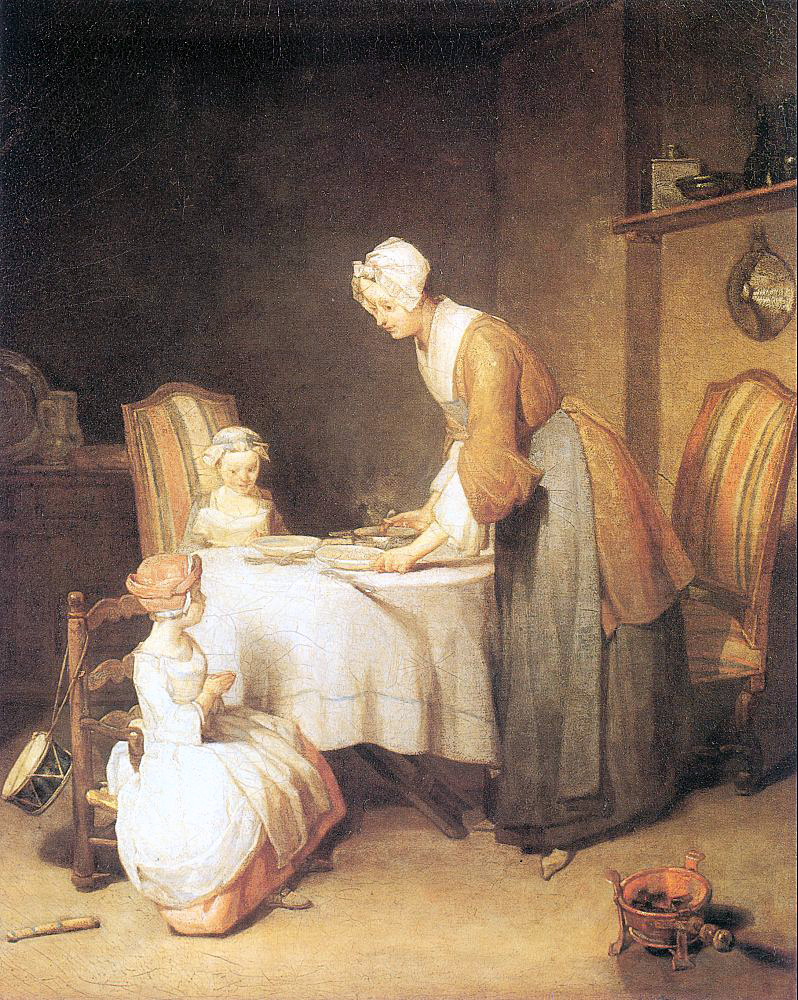
Saying Grace (Le Bénédicité), Jean-Siméon Chardin, about 1740. Image: Wikimedia Commons, public domain Do this: Look at the picture together for a quiet minute before anyone talks.
Read aloud: Chardin loved quiet scenes of ordinary life: a kitchen, a servant girl, a child at play or at prayer. He painted soft light and simple things, so that a bowl or a tablecloth seems almost holy. He painted more than one version of this scene. Notice how the mother pauses, bending over the table, waiting for the grace to be finished.
Point and find:
- Find the toy drum.
- What is the mother doing?
- What is the youngest child doing with his hands?
- What is on the table?
Ask:
- “Why do you think the mother waits before serving?”
- “How does your family give thanks before meals?”
Show: Ask your sister to pass the carrots.
Say this: “Pass me is passe-moi.”
Say this: “Carrots: les carottes.”
Answer: Passe-moi les carottes, s’il te plaît.
Show: What do you say when everyone is served?
Say this: “Wish everyone a good meal.”
Answer: Bon appétit!
Do this: Ask out loud. Let your child try first; help only after a real try.
Ask: Say plate in French.
Listen for: L’assiette.
Ask: Say fork in French.
Listen for: La fourchette.
Ask: Say potato in French.
Listen for: La pomme de terre.
3 more on the lesson page.
Read aloud: Set the table for a real meal and label everything in French.
Steps:
- Set one place carefully: plate in the middle, fork on the left, knife and spoon on the right, glass above the knife, napkin on the plate.
- Make a little card for each item with its French name.
- Set the rest of the table and quiz a family member: Qu’est-ce que c’est? C’est une fourchette!
- Call the family: À table!
Tips for you:
- Put a little bread on the table, French style: in France, bread often sits right on the tablecloth.
- Make a menu card in French listing the vegetables.
Done when your child can say:
- I set the table correctly.
- I can name six table items and four vegetables in French.
Do this: Your child picks one or more; you write the date.
- Draw a place setting in your French notebook and label l’assiette, le verre, la fourchette, le couteau, la cuillère and la serviette. Draw three vegetables and label them.
Read aloud: France is famous for its long family meals. In 2010 UNESCO added the French gastronomic meal, a festive meal shared around the table, to its list of the world’s cultural heritage.
- Saying bon appétit with a silent n. Here the n links: bohn nah-pay-TEE.
- Starting to eat before Bon appétit. Wait for everyone!
One person is the waiter, the other the customer. The customer asks in French for things on the table: Une fourchette, s’il vous plaît. The waiter must bring the right thing. Switch roles.
Say this: “Tell me what you learned today.”
Listen for: Name the things on the table and six vegetables in French.; Say Bon appétit and ask for food politely.; Describe how a French family shares a meal and gives thanks.
Whether therefore ye eat, or drink, or whatsoever ye do, do all to the glory of God.
In the Louis Segond Bible (1910): <i lang="fr">Soit donc que vous mangiez, soit que vous buviez</i> Even eating and drinking can be done to the glory of God, when we give thanks and share the table with love.
Spread over the week
3 sessions of 20–30 minutes. Stop while it is still going well.
- Session 1. Warm-up, then read and teach the new idea and the new words. Picture study and show how.
- Session 2. Practice together, then start the project. Finish the project, then the sketchbook.
- Session 3. Narration, the game and the Scripture.